In today’s economy, primary resources such as lithium, as well as many non-ferrous and rare earth metals, have already become almost as politically significant as oil, with one important qualification. The countries beginning to reap the greatest benefits from these resources are those that control not only their supply but also their downstream processing into components needed by high-tech industries. For Russia, this presents a challenge that calls for a reassessment of its domestic industrial policy, export priorities and even its understanding of what a resource-based economy means in the digital age.
| Asia-Pacific region |
| USD bln |
| Shares of export destinations |
| Destination |
| China |
| Asia excluding China |
| Turkey |
| Europe |
| North America |
| Other |
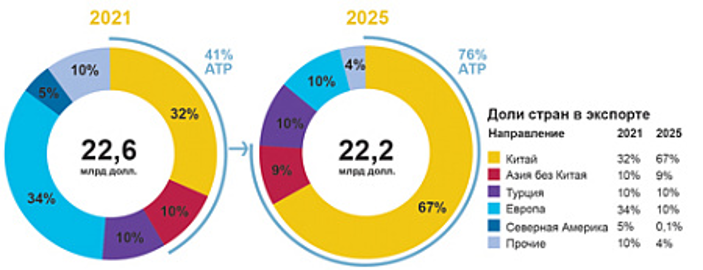
Exports of copper, nickel, aluminium and tin by value; shares of destination markets, %. APR: Asia-Pacific region. Source: presentation by expert Alexander Mishchenkov based on mirror statistics from foreign trade data.
New high-tech industries are transforming the basic needs of the economy. The introduction and development of electric vehicles, autonomous systems, robotics and artificial intelligence have marked a turning point, demonstrating that the modern economy depends on more than oil alone
The combination of the energy transition, artificial intelligence and constrained mining supply is making lithium, copper, nickel, aluminium and several other metals strategic raw materials, approaching oil in political significance, Pavel Gamov, a mining and metals expert at the Institute for Growth Economics, told Nezavisimaya Gazeta
These materials will directly influence which countries emerge as leaders and which fall behind in the competitiveness of high-tech markets. The defining feature of the present moment, however, is that the countries beginning to derive the greatest benefit from primary resources are those controlling not just their supply but also their downstream processing, Antonina Levashenko, head of a laboratory at the Gaidar Institute, told Nezavisimaya Gazeta.
For Russia, this turning point presents both an opportunity and a challenge, requiring coordination between the relevant government departments, producers, processors and consumers. Several industry conferences have addressed these issues
The Ministry of Industry and Trade highlighted the strategic importance of Russia’s non-ferrous metals industry, which supplies raw materials and other materials to a wide range of sectors, from mechanical engineering to construction and electrical manufacturing. The ministry also acknowledged that the industry currently faces certain restrictions on foreign trade and changes in domestic market conditions, according to a welcome address by Ivan Markov, Director of the ministry’s Department of Metallurgy and Materials, to the Creon Group’s ‘Non-Ferrous Metals 2026’ conference, held in Moscow on October 14
Fares Kilzie, head of the Creon Group, explained that a temporary slowdown in construction, the cable industry and the energy sector was reducing traditional consumption volumes. At the same time, demand was growing from data centres, electric vehicles and energy storage systems, particularly the production of lithium-ion batteries, which also use non-ferrous metals. ‘Without specific volumes and specifications being established by these consumers, new capacity risks remaining underutilised or, worse still, being channelled into export markets as primary raw materials,’ he warned.
At the same time, judging by the experts’ presentations, redirecting exports towards China is itself a risky strategy despite external restrictions, as it creates dependence on a single buyer
Industrial strategy expert Alexander Mishchenkov presented the results of his analysis of mirror data from foreign customs authorities at the conference. The findings show that Russian non-ferrous metals exports have shifted entirely from Western markets to Asian and Middle Eastern markets, with China becoming by far the largest buyer, while Turkey and CIS countries have established themselves as key hubs and processors.
According to Mishchenkov’s calculations, Asia accounted for 76% of the total value of Russia’s copper, nickel, aluminium and tin exports in 2025, with China alone accounting for 67%. In 2021, by contrast, Asia represented about 40% of Russian exports of these metals and China 32%. Europe’s share fell from 34% to 10% between 2021 and 2025, while North America’s share dwindled to almost zero
The question of future reliance on China was also discussed in relation to the lithium industry. Speaking at the Creon Eurasian Forum ‘Lithium 2026’, held on October 13, Alexander Grigoryev, Deputy Director-General of the Institute for Natural Monopoly Problems, warned that the main problem was not the availability of raw materials but the lack of guaranteed demand for mining projects
The expert said that, even under the most optimistic consumption forecasts, the launch of production at the Kolmozerskoye deposit alone would result in lithium supply reaching 1.4 times domestic demand by 2035. Last year, the Ministry of Natural Resources and Environment estimated Russia’s total balance-sheet reserves of lithium oxide at 3.5 mln tonnes. Developing these reserves, however, requires clearly defined objectives
Export potential also faces constraints. China is effectively the only accessible destination, but it is rapidly expanding its own mining operations, has a wide choice of suppliers and is able to dictate terms to the market
As Pavel Gamov explained to Nezavisimaya Gazeta, Russia has an opportunity to turn lithium from an import vulnerability into a source of technological sovereignty, but only if it moves beyond the ‘mine, concentrate, China’ model to a full chain of ‘mine, hydrometallurgy, cathode materials, cell, energy storage system’, meaning the entire battery production cycle.
‘Otherwise, we will end up with a familiar scenario: a resource-rich country where the added value goes elsewhere,’ the expert said. ‘We can no longer repeat the ‘petrol station country’ model. The world has changed considerably.’
ORIGINAL: NG/Electric vehicles and artificial intelligence are reshaping the economy’s basic needs