Russia’s economy could grow by 0.8% this year, economists at the Russian Academy of Sciences’ Institute of Economic Forecasting (IEF RAS) expect. Experts say GDP is being supported by a smaller decline in investment and consumer demand. However, consumer demand is already slowing. Some experts describe the current economic situation as ‘stabilisation of stagnation’.
On Friday, Rosstat confirmed its preliminary estimate of GDP dynamics in the second quarter. GDP growth in the second quarter of 2026 was 1.3% year on year, following a 0.2% decline in the first quarter. In the first half of the year, Russia’s economy grew by 0.6%. The second-quarter increase in GDP was driven primarily by higher turnover in catering, hotels, wholesale and retail trade (see Nezavisimaya Gazeta, August 13, 2026).
Industrial production is probably providing less support to GDP. Rosstat previously revised its estimate of industrial production for the first half of the year. According to the revised data, industrial output was unchanged year on year in the first half, rather than growing by 0.4% as previously estimated. Manufacturing output rose by 0.2%, rather than 0.7%, while the raw-materials sector cut output by 0.7%, compared with a previously estimated decline of 0.5%. In the first seven months of the year, industrial production increased by a modest 0.1%.
Following Rosstat’s revision of the production index, IEF RAS also lowered its estimate for Russian industrial output. Economists now expect annual production growth of 0.4%, compared with 0.7% in their previous forecast at the end of July. Overall, they expect the Russian economy to grow by 0.8% this year.
The researchers’ estimate is nevertheless somewhat more optimistic than that of the Ministry of Economic Development. The ministry expects Russian GDP to grow by 0.6% in 2026, slightly above its April forecast of 0.4%, Economic Development Minister Maxim Reshetnikov said in early September (see Nezavisimaya Gazeta, September 3, 2026).
The Central Bank, analysing first-half data and preliminary third-quarter indicators, said Russian economic growth was developing in line with the regulator’s 2026 forecast, which envisages growth of between 0% and 1%.
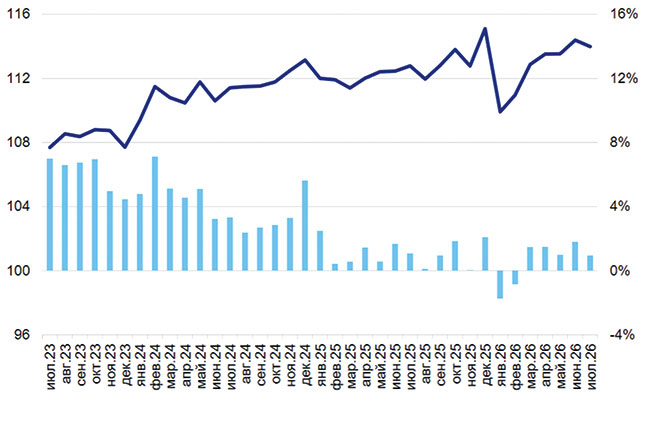
GDP physical volume index estimate
Right-hand scale: estimated physical volume index of Russia’s GDP, as a percentage of the same month a year earlier. Left-hand scale: estimated physical volume index of Russia’s GDP, with January 2019 = 100. Source: IEF RAS
IEF RAS highlights ‘diverging trends’ across economic sectors. The decline in mining, energy and agriculture seen throughout 2026 has been accompanied by a reversal of negative trends and renewed growth in construction and transport. The sharpest fall in output has been recorded in coke and petroleum products, where output dropped 19.3% year on year in July, linked to production capacity being taken offline as a result of attacks. However, the completion of repairs at a number of oil refineries could make a positive contribution to both mining and manufacturing output, the researchers expect
In manufacturing alone, the annual growth rate was 2.4% in July, compared with 2.8% in June. The number of industries increasing output exceeded the number cutting production, the researchers stress. They also note an improvement in metallurgy. Output rose by 11.4% in July, compared with a 3.4% decline in June and a 9.3% fall in the first half of the year. ‘Steel production in Russia rose by 3.1% year on year in July, which is attributed to a revival in construction driven by infrastructure projects and government programmes, while production of basic precious metals and other non-ferrous metals increased by 18.8% year on year, following a 5% decline in June 2026,’ IEF RAS said. The researchers add that the end of the decline in other non-metallic mineral products and rising output in four of the five machinery-related activities in June and July provide indirect evidence of a gradual recovery in investment activity.
Indeed, experts identify the smaller decline in fixed investment as one of the factors stabilising the economy. The Central Bank has said investment activity is gradually recovering after weak performance in the first quarter.
Rosstat previously reported that fixed investment fell by 6.6% year on year in the second quarter of 2026, following a 14.3% decline in the first quarter. Overall, investment fell by almost 10% year on year in the first half.
The Ministry of Economic Development had forecast a 1.5% decline in investment in 2026. In its April forecast, the ministry expected investment growth to resume in 2027. In early September, Reshetnikov said the ministry now expected investment growth in Russia to resume from 2028.
‘We are now preparing the forecast. For now, it looks as though our investment will return to growth sometime from 2028. Even for 2027, our expectations are modest,’ the minister said. ‘A certain investment pause is natural, but it does not prevent the economy’s potential from growing, both now and in the future,’ Reshetnikov said.
The investment pause could therefore last three years, from 2025 to 2027. For comparison, Rosstat estimates that fixed investment fell by 2.3% in 2025 after rising by 8.4% in 2024, 9.8% in 2023, 6.7% in 2022 and 8.6% in 2021, while declining by 0.1% in 2020.
IEF RAS identifies the continued growth in consumer demand as another stabilising factor. In the first half of the year, sales of passenger cars rose by 23.6% year on year, clothing sales by 9.2%, tobacco products by 8.4%, and cosmetics and perfumes by 7.7%.
The researchers had previously not ruled out the possibility that the current consumer boom would gradually fade as growth in real disposable household incomes slowed (see Nezavisimaya Gazeta, September 3, 2026).
There are already signs of such a slowdown. Retail turnover rose by 5.3% year on year in July, compared with growth of 7.3% in June and 7.8% in May. Researchers attribute this to slower growth in non-food sales, from 11.3% year on year in May and 9.8% in June to 6.7% in July. In addition, sales of new passenger cars in Russia fell by 6.5% year on year in August, to 114,300 units
The researchers have again warned that the consumer boom could fade ‘in the coming months’. Growth in non-food sales is expected to slow as demand becomes saturated, real wage growth continues to decelerate and the depreciation of the rouble pushes up prices for imported goods and products made using imported components.
Consumer activity remained high in July, but growth slowed somewhat compared with June, agrees Olga Belenkaya, head of macroeconomic analysis at Finam.
Operational data from SberIndex‘s laboratory also suggest that the revival in consumer spending in Russia may already have ended. Taking inflation and seasonality into account, consumer spending in the three months from June to August 2026 fell by 3.7% compared with the previous three months, from March to May, the laboratory calculated. Spending declined across all categories relative to the March-May period: food and non-food goods, as well as services. The contribution of each category to the change was: non-food goods, -2.4%; food, -1.1%; services, -0.1%; catering, -0.1%.
In August, compared with July 2026, total consumer spending adjusted for inflation and seasonality rose by 0.2%. Non-food spending increased by 0.4%, catering expenditure by 0.5%, and spending on services by 0.5%. At the same time, household spending on food fell by 0.3% (see Nezavisimaya Gazeta, September 8, 2026).
At the same time, current statistical data, ‘cleansed of the negative impact of war-related damage on individual sectors’, point to continued economic activity, according to the researchers. IEF RAS cites growth in tax revenues from non-oil and gas sectors as evidence. In the first eight months of the year, such revenues rose by 18% to RUB 20.9 tn, according to the Finance Ministry.
It is too early to speak of full economic stabilisation given the current indicators, experts interviewed for the article say. Business analyst Vitaly Lavrinovich believes that GDP growth of 0.6% in the first half and a forecast of 0.8% for the full year point more to stagnation than to a sustained economic recovery. With industrial production flat and investment activity weak, he says, the figures indicate stagnation rather than the emergence of sustainable growth.
‘The slower rate of decline in investment can certainly be considered a positive signal, but a smaller decline and growth are fundamentally different things. If investment continues to fall, even at a slower pace, that does not yet mean investment activity is recovering. Consumer demand can support current GDP, but long-term growth requires investment, expansion and modernisation of production, higher productivity and greater business activity,’ Lavrinovich says.
He describes the current situation as stabilisation at a stagnation level. In other words, the economy is not experiencing a pronounced decline, but there are also no convincing signs of a transition to sustained growth. ‘The main problem is that prolonged stagnation is not a neutral state. For some time, an economy can indeed operate with minimal growth without a sharp deterioration in its main indicators. But over time, the consequences of underinvestment accumulate, the renewal of production capacity and technology slows, and productivity growth is constrained. As a result, today’s stagnation begins to reduce the potential for tomorrow’s growth,’ the expert stresses.
ORIGINAL: NG/The Economy Has Stabilised in Stagnation