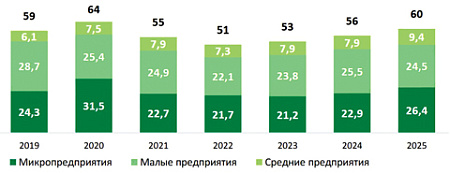
Small and medium-sized businesses are one of the main ‘suppliers’ of jobs in the Russian economy. Almost 40% of Russia’s working-age population is employed in this sector in various forms, making its social role difficult to overstate. But according to opinion polls, an increasing number of small and medium-sized businesses are shifting into survival mode, largely unnoticed by official statistics. And alongside them, millions of Russians employed by such companies are experiencing roughly the same financial shocks
Survival mode rather than growth has essentially become the norm in the entrepreneurial segment of the labour market, researchers at the Institute of Sociology of the Russian Academy of Sciences (RAS) have found
‘Entrepreneurs assess the state of their businesses as follows. More than 40% of respondents said that by the end of 2025 their business had entered survival mode,’ said Inessa Orekhova, a research fellow at the RAS Institute of Sociology, citing surveys conducted since 2021 by the Public Opinion Foundation and the Higher School of Economics among small and medium-sized business owners. She published her findings in the journal Theory and Practice of Social Development.
Assessments deteriorated sharply. In 2024, 28% of surveyed entrepreneurs said their businesses were in survival mode, compared with around 32% in 2022, when economic uncertainty was particularly high.
Business strategies that envisage neither growth nor development have their own rationale: companies lack both the opportunities and the resources to pursue them. But this balancing act on the brink of collapse leaves entrepreneurs fatally dependent on any changes in economic conditions, Orekhova also explained.
‘In 2025, such changes affecting small and medium-sized enterprises (SMEs) occurred in economic policy: tax administration and state digital oversight intensified, the tax base expanded and mandatory payments increased,’ the expert said.
Consumer behaviour also changed, shifting towards greater saving and reduced discretionary spending. As Orekhova noted, ‘some entrepreneurs preferred to shut down rather than operate at break-even or at a loss’.
The shocks affecting small and medium-sized businesses remain partly outside the scope of official statistics. For example, Rosstat’s published data on companies’ financial performance, including the share of loss-making and profitable enterprises, as well as data on underemployment and wage arrears, exclude small businesses.
‘The only way to analyse how this sector is doing is through indirect indicators,’ the Proeconomics expert Telegram channel explained. Yet the social importance of small and medium-sized businesses is, without exaggeration, considerable.
‘Without an expansion of systemic support measures, deterioration in the sector’s position creates a risk of large-scale negative social consequences because of the significant share of the working-age population employed by SMEs,’ analysts at Business Solutions and Technologies (DRT, formerly the Russian division of international audit firm Deloitte) warned in a separate study.
‘Employment in SMEs has increased by 36% since 2019, reaching 29.3 mln people. This has raised the sector’s share of total employment to 39%, based on 76 mln working-age people aged 15 and over as of 2024. This makes the condition of small and medium-sized businesses a factor with direct social consequences,’ DRT analysts said.
In their study, SMEs are defined as legal entities and individual entrepreneurs that meet established criteria for employee numbers and annual revenue, as well as self-employed people included in the SME register.
The SME category contains several segments: microenterprises with up to 15 employees and annual revenue of up to RUB 120 mln; small enterprises with 16 to 100 employees and revenue of up to RUB 800 mln; and medium-sized enterprises with 101 to 250 employees and revenue of up to RUB 2 bln.
Over roughly the past five years, the sectoral structure of SMEs has remained relatively stable, with services and retail dominating. Allowing for fluctuations, their respective shares have been around 40% and 35%. The analysts nevertheless noted one significant change during the period under review: the share of manufacturing in the SME sector fell from 26% after 2020 to 23%.
At the same time, SME turnover at comparable 2019 prices grew at an average annual rate of 1.7%, with small and microenterprises making a substantial contribution. Together, they accounted for around 85% of total turnover, according to the DRT study.
The picture may look positive, but only at first glance, the Proeconomics channel commented. According to the figures presented, employment in SMEs rose by 36% between 2019 and 2024, from 21.5 mln to 29.3 mln people, while SME revenue at comparable prices increased by less than 2%, from RUB 59 tn in 2019 to RUB 60 tn in 2025. This suggests that revenue per employee fell by roughly 1.3 times over the period.
The very concept of an SME is ‘extremely broad’, Oleg Nikolayev, an expert at the Stolypin Institute for the Economy of Growth and a member of the General Council of Delovaya Rossiya, told Nezavisimaya Gazeta. ‘It brings together self-employed people doing occasional side jobs and serious factories employing hundreds of people.’
‘When the authorities report the successes of SMEs in recent years, with the sole success being that increase in employment in the sector, they are talking about the fruits of the campaign to bring the shadow economy into the formal economy, which began just under 10 years ago. This campaign, combined with the tax service’s dramatically increased ability to obtain information, brought millions of previously invisible workers into the open as they registered as self-employed. They were all added to the SME army, and there you have the result,’ Nikolayev told Nezavisimaya Gazeta.
According to Yaroslav Kabakov, director of strategy at Finam, if employment grows substantially faster than real turnover, productivity and revenue per employee are falling. At a minimum, this leads to an efficiency crisis.
The main threat now is not so much the mass disappearance of SMEs as their transformation into a low-margin employment sector. ‘Companies continue to operate and create jobs, but they are earning less and less per employee and becoming increasingly unable to invest in development,’ the expert said. ‘For the economy, this means weaker potential for productivity and investment growth. High interest rates only exacerbate the problem, because small businesses are much more dependent on bank lending and their own working capital,’ Kabakov continued. ‘As a result, formal growth in employment may conceal a deterioration in the quality of economic activity.’
RAS sociologists reached a similar conclusion: ‘Russian small and medium-sized entrepreneurship currently does not meet the economic requirements of the state.’ DRT analysts conclude that the situation requires the development of government support mechanisms or a review of the current conditions that are having the most damaging impact on small and medium-sized businesses
ORIGINAL: NG/Small Business, Major Negative Social Consequences