Officials, economists and academics attempted to formulate new requirements for building a modern defence complex at a scientific conference in Moscow. Some specialists believe Russia’s defence industry is poorly suited to a prolonged period of military and technological conflict. The rejection of civilian initiatives, the inability to adapt quickly, and military and industrial bureaucracies isolated from society all weaken Russia’s position.
The military economy no longer appears to be a narrow departmental issue. The world is entering a period in which the resilience of states and societies is being tested simultaneously across military, technological, industrial, biological, climate and information dimensions. Rising international tensions, competition for resources and technological leadership require a new discussion about military development, the military economy and state strategy.
These arguments were presented at an international conference named after Vitaly Shlykov, a leading expert on military economics and military development, an illegal intelligence officer and founder of the liberal school of military analysis in Russia.
The modern world has returned to an era of wars and conflicts organised very differently from those of previous decades. This new era of conflict is prolonged, linked to technological shifts and requires a different language of description, explained Sergei Karaganov, academic supervisor of the Faculty of World Economy and International Affairs at the Higher School of Economics. According to him, Russia must develop its own intellectual framework for understanding military power, strategic deterrence and the role of the military-industrial complex.
‘The previous paradigm of economism is being exhausted. The economy must serve the security of the individual and the state, and the military economy cannot remain a closed sphere for a narrow circle of agencies,’ specialists argue.
The military-industrial complex of 2021 and that of 2026 are effectively different structures, according to Kirill Lysogorsky, First Deputy Head of Russia’s Ministry of Industry and Trade. He said the entire system of management, procurement planning and interaction with civilian industry has changed. Combat experience is rapidly translated into technical specifications, requirements for new equipment and upgrades to existing systems. Among the key priorities, the official named equipping the military based on real combat experience, technological independence, flexible manufacturing, robotics, artificial intelligence, cyber protection, testing infrastructure and industrial security.
However, those familiar with the real situation in communications, anti-drone defence or the use of maritime and ground drones may find it difficult to share the officials’ triumphant self-assessments. Aleksey Chadayev, director of scientific-research centre Ushkuynik and adviser to the transport minister, spoke about systemic problems in anti-drone defence.
‘Our centre was created from the outset with a focus on anti-drone solutions, not strike or reconnaissance frontline drones. While we have achieved some success over the past two years in the latter, the former hasn’t seen any significant results. The reason for that is simple: frontline drones have a qualified customer: Russian Defence Ministry. Anti-drone solutions have never had such a customer. We are currently studying the experience of mobile fire groups, which today lack a competence centre that could consolidate this experience and develop methods for area and facility protection. There are no test grounds where simulated attacks are regularly conducted and different countermeasures tested. There is no cheap mass-produced aerial target on which shooters can hone their skills, nor any order for its development and production. There is no analytical group collecting information on attacks that have already taken place and analysing how they unfolded. There are many other absences. But most importantly, there is no responsible structure capable of turning all these absences into realities,’ Chadayev said.
Yet according to Lysogorsky, today’s Russian defence complex is not only factories, research organisations and design bureaus.
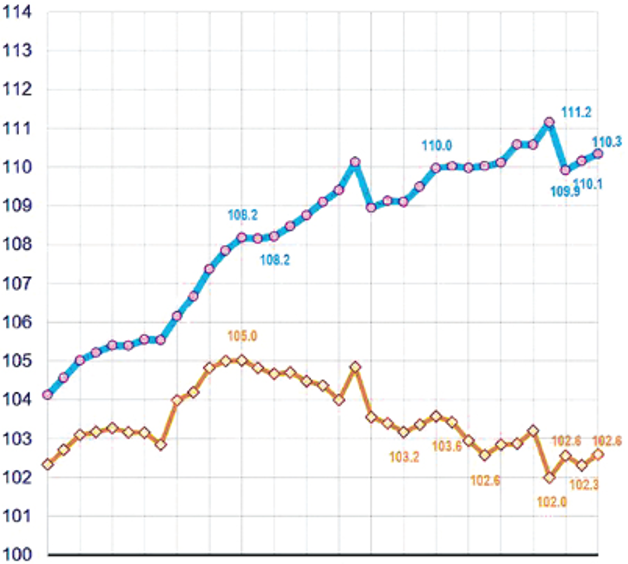
Average monthly level in 2021 = 100, seasonally adjusted
| Industry overall (CMASF) |
| Industry excluding sectors dominated by the defence-industrial complex (CMASF) |
‘It is a multi-vector renewable resource: production, technology, science, personnel and finance. Production, technology, science, human capital and finance are all combined in this formula. The defence industry has become one of the major mechanisms of the country’s technological mobilisation,’ the official stressed.
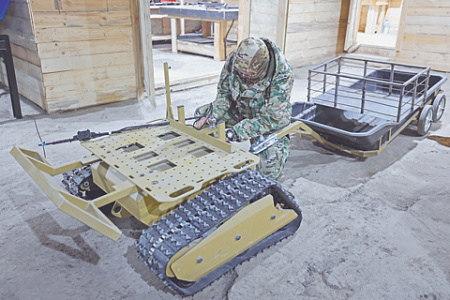
Chadayev described the practical functioning of this ‘multi-vector renewable resource’ through the example of robotic supply carts at the front
‘While the enemy is increasing the use of robotic carts, the Russian armed forces are reducing theirs. Not because there is a shortage of them: thousands are sitting in storage depots. Usage is being reduced because losses are too high, both from enemy drones and the lack of communications. The latter wasn’t a problem with Starlink around, but now, the lack of a communications network on the battlefield that is resistant to jamming and radio shadow zones has become particularly acute. For the same reason, we have yet to launch our robotic carts into mass production, despite performing well in testing grounds and frontline trials. Running them on reinforced fibre optics is expensive, while using radio alone is a lottery that usually ends with the loss of equipment,’ the specialist explained. According to him, public criticism should focus on the issue of mass digital communications for the frontline
Some economists are considering the prospects for the period after the end of the special military operation.
‘Under sanctions, the defence industry has become a locomotive for growth, technological change and support for old industrial regions. But this impulse has its limits. A difficult crossroads lies ahead: the special military operation may end, while high international tensions remain,’ warned Dmitry Belousov of the Centre for Macroeconomic Analysis and Short-Term Forecasting.
The general industrial base must be capable of producing military goods when necessary. Defence enterprises must preserve competencies through civilian products. In modern warfare, the decisive factor is no longer stockpiles of previous-generation equipment, but the resilience of new production flows.
A closed defence hierarchy is giving way to a distributed ecosystem, according to Higher School of Economics professor Ekaterina Degtereva. This distributed ecosystem includes the state, civilian manufacturing, garage developers, small innovative enterprises, digital companies, universities, research centres and technological development funds.
This argument was also supported by Sang Chul Park, professor at the Korea University of Technology and Education, who described the rise of South Korea’s defence sector. Civilian and defence industries in South Korea developed hand in hand, and, since the 2010s, the boundary between them has become less distinct. Public-private partnerships have become one of the primary mechanisms driving defence industry growth. The export success of South Korea’s defence industry is built on the technological base of the entire economy, the scholar explained.
According to Degtereva, special attention should be paid to the non-material motivation of employees and managers. Technological patriotism, ideological mechanisms and criminal liability for disrupting state programmes and corruption form an important framework of the industrial system. Strategic stability increasingly depends on technology, infrastructure and organisation. Modern warfare, she argued, is a struggle between production ecosystems. Raw materials, components, data and infrastructure are becoming elements of strategic rivalry. Where trade logic once prevailed, the logic of security is increasingly taking over.
ORIGINAL: NG/Two Views of the Realities of Russia’s Military-Industrial Complex