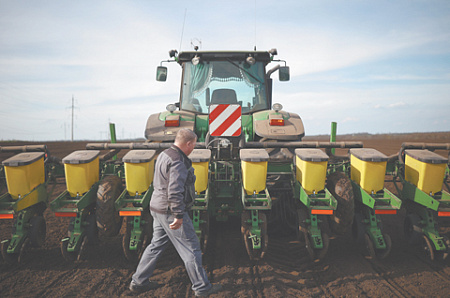
Russian Prime Minister Mikhail Mishustin emphasised on Wednesday that agrarians must be provided with all necessary resources to complete the spring planting. It was previously reported that the sowing campaign in several regions is lagging by several weeks due to cold weather. The meeting also highlighted upcoming discussions on amendments to the Tax Code regarding the regulation of digital currencies.
‘It is crucial that agrarians have access to all the necessary resources to complete the spring planting, including specialised equipment, fuel, mineral fertilisers, and plant protection products,’ Mishustin said at that meeting on Wednesday. ‘The federal budget has allocated funds for preferential short-term loans for agribusiness, with more than half of this funding earmarked to support crop farming.’
Several regions of Russia have reported delays of several weeks in the sowing campaign due to cold weather, with the timing for planting spring crops potentially shifting by up to three weeks. Agrarians have warned that this could result in a reduced harvest. Ksenia Bolomatova, Executive Director of the Russian Union of Grain Exporters and Producers, explained that the prolonged snowmelt has delayed the start of fieldwork in the Central and Volga Federal Districts, which together account for about 46 % of the planned spring grain sowing areas. However, she noted that this delay could have a positive effect on water availability for the upcoming harvest.
The Institute for Agricultural Market Studies (IKAR) has revised its forecast for this year’s total wheat harvest, downgrading it from 91 million tonnes to 90 million tonnes, and for barley, from 19 million tonnes to 18 million tonnes. The wheat export forecast for the 2026/27 season has also been reduced, from 47.5 million tonnes to 46.5 million tonnes, while the barley export estimate has been lowered from 5.5 million tonnes to 4.5 million tonnes. The primary reason for these adjustments is the significant delay in fieldwork in the Central Federal District and the Volga region, caused by adverse weather conditions. IKAR CEO Dmitri Rylko acknowledged the risks associated with conducting certain operations outside of optimal agrotechnical deadlines, which could result in under-sowing, particularly of spring cereals. The season’s final outcome, he added, will ultimately depend on how weather conditions unfol.
Alongside to adverse weather conditions, the rise in prices for fertilisers and agricultural machinery is also hindering the sowing campaign, according to Vladimir Plotnikov, First Deputy Chairman of the State Duma’s Agricultural Committee. He noted that this year, the amount of introduced fertilisers is lower than last year due to higher prices
‘Ammonium nitrate has increased by 30 % since the beginning of the year, urea by 12 %, and ammophos by 16 %,’ he said. Plotnikov also pointed out that demand for machinery is declining due to its high, and often unwarranted, prices.
The Ministry of Agriculture believes that weather conditions in several regions will not significantly affect crop condition. Oksana Lut, Head of the Ministry, stated that spring planting has already begun in 55 regions. ‘However, abnormal weather conditions across Central Russia, Volga region, and some southern areas are preventing agrarians from fully starting the sowing campaign, causing work to lag behind last year’s pace. So far, about 4.6 million hectares have been sown across the country,’ she said. Lut expects the weather to normalise soon, which will help speed up the sowing and ensure that the spring planting is completed within optimal agrotechnical deadlines. This year, approximately 56 million hectares have been designated for spring crops. Another 20 million hectares are for winter crops, 97 % of which remain in good or satisfactory condition despite the weather, an improvement over last year. ‘Overall, we expect the total sowing area this year to increase to 83 million hectares,’ Lut added. She also assured that Russian agrarians are fully equipped with the necessary resources for a successful sowing campaign, including seeds, fertilisers, machinery, fuel and other essential supplies.
The minister also highlighted the growing independence of domestic agricultural producers from imported seed material.
‘We continue to promote the shift towards domestic plant breeding. Together with the regions, we have approved a plan to increase the share of Russian seeds sown by 2030. Since 2022, the reliance on imported planting material has been steadily decreasing. By last year, the self-sufficiency rate in this area approached 70 % (with a target of 75 % by 2030),’ said the head of the Ministry of Agriculture.
Another key factor for a successful sowing campaign is the availability of affordable mineral fertilisers for farmers
‘Given the current global market demand, we are closely monitoring fertiliser prices. We continue to implement comprehensive measures to ensure their availability for Russian agrarians. In particular, maximum selling prices have been set for nitrogen and nitrogen-containing fertilisers, including ammonium nitrate. Until May 7, a temporary restriction has been introduced on the issuance of export licenses for ammonium nitrate, and non-tariff quotas have been established for the export of certain types of fertilisers until November 2026,’ the minister said.
‘This set of measures is currently helping to maintain stability in the domestic market,’ promised Oksana Lut.
Agrarians are also fully supplied with agricultural machinery. ‘This year, nearly 7,000 new units have been purchased. Furthermore, the rate of delivery through the preferential leasing mechanism is 1.3 times higher than last year,’ the minister emphasised.
According to the Rosspetsmash Association, shipments of domestic agricultural machinery to the Russian market in the first quarter totaled RUB 32.4 billion, marking a 16 % decline compared to the previous year. This decline is observed across nearly all types of machinery produced in Russia, except for combines. To put this into perspective, agricultural machinery sales in the domestic market fell by 42.3 % in January 2026 alone. Overall, the market for Russian agricultural machinery has been on a downward trend since 2024. The primary reasons are the high key rate and the low profitability of agriculture.
‘Together with the Ministry of Industry and Trade, we are working on improving the efficiency of agricultural machinery use and reducing its cost. We are also focused on developing new types that meet the current needs of farmers,’ Oksana Lut stated on Wednesday during a meeting.
Furthermore, she continued, RUB 26.5 billion has been allocated this year to subsidise preferential short-term loans. Of this, approximately RUB 17.5 billion is designated for seasonal work, fully covering the needs of farmers. ‘In addition, given the rising climate risks, we continue to develop agricultural insurance with government support. This year, RUB 4 billion has been allocated to finance this protection mechanism for crop farmers, surpassing last year’s funding level,’ the head of the Ministry emphasised.
Also on Wednesday, the government decided to subsidise a loan for the implementation of a major investment project in the petrochemical industry. ‘This concerns the national project for technological leadership, “New Materials and Chemistry,” and the development of the so-called cluster investment platform: a special mechanism that enables businesses to ramp up the output of priority products, which is crucial for achieving our country’s technological sovereignty. As part of this initiative, we will allocate RUB 50 billion to subsidise the preferential interest rate for the construction of a large-scale chemical facility. Meanwhile, the total private capital contribution to the project will exceed RUB 330 billion, seven times the amount of the subsidy,’ emphasised Mikhail Mishustin. As a result, Russia will establish a full-cycle production facility for synthetic fibres, threads and polymers that are in high demand in light industry The additional supply of these materials will reach 450,000 tons per year, ensuring a significant share of the domestic market, according to the government.
The agenda of the government meeting also included the consideration of amendments to the Tax Code regarding the regulation of digital currencies.
‘The draft law aims to establish comprehensive and unified regulation of relations arising from the organisation of the circulation and exchange of digital currencies and digital rights, as well as the placement of digital rights in Russia,’ the materials for the meeting explained.
It was previously reported that the government law-making commission approved amendments to the Tax Code proposed by the Ministry of Finance. The draft amendments propose the introduction of personal income tax (PIT) on income from digital currency transactions, including exchanges. PIT will be levied on all net income from the sale of cryptocurrency in Russia.
As explained by Vladimir Gruzdev, Chairman of the Association of Lawyers of Russia’s Board, the amendments aim to align existing legislation with the new law ‘On Digital Currency and Digital Rights,’ which is being prepared for adoption. This is necessary to establish a unified system for regulating the circulation of digital assets in Russia
Last week, the State Duma passed the draft law ‘On Digital Currency and Digital Rights’ in its first reading. The draft law, which regulates cryptocurrency in Russia, recognises it as property but keeps a ban on using it for domestic payments. However, it does allow cryptocurrency to be used for payments under foreign trade contracts, including those involving securities, digital rights, works, services, information and intellectual property.
If the draft law is adopted, its key provisions will come into force on July 1, 2026. (see NG dated April 22, 2026).
Officials believe that the draft law will help legalise the market. However, experts argue that in its current form, the draft law on regulating the cryptocurrency market is not aimed at legitimising existing grey practices or attracting new players. Instead, it seems focused on creating a closed domestic market with limited opportunities for ordinary users. ‘The main and key restriction is the inability to withdraw cryptocurrency to personal (non-custodial) wallets. What is the point of acquiring assets whose core value proposition is independent, private custody if that very function is being stripped away by the forthcoming regulation?’ questions Andrey Zubarev, Senior Researcher at the Digital Finance Studies Department at the Gaidar Institute. He argues that it would be just as effective to forgo separate regulation and simply allow the launch of exchange products based on cryptocurrency for any type of investor on domestic traditional exchanges
‘The introduction of personal income tax (PIT) on cryptocurrency transactions is a step towards integrating them into the official financial system: crypto assets are effectively recognised as property, and income from their sale and exchange is taxed at rates of 13–15 % and higher for large sums. The new measures appear to be a compromise: the state does not ban cryptocurrencies but instead tightens its grip by bringing them into the tax net through mandatory reporting. However, it is difficult to talk about a significant increase in interest, as taxation merely reflects existing demand, while restrictions on the use of cryptocurrencies within the country hold it back. As a result, the effect of ‘legalisation’ will be limited,’ said Yaroslav Kabakov, Director of Strategy at FINAM.