Because of excessively high prices and unaffordable mortgages, Russians are unable to absorb the full volume of newly built housing entering the primary market. The launch of new residential developments in Russia is growing at roughly twice the pace of new apartment sales. Signs of weak demand persist in around one-third of the country’s regions, according to DOM.RF. In some cases, the problem is aggravated by developers using ‘dubious instruments’ that merely create the appearance of demand. According to data from the Real Estate Market Indicators portal (IRN), up to half of transactions in Moscow’s new-build market are not genuine sales but apartment reservations under instalment payment schemes.
Between January and April, Russian property developers launched almost 14 mln square metres of new residential projects, 18% more than during the same period in 2025
At the same time, 7.4 mln square metres of housing were sold in new developments during January–April, an annual increase of 8%. Supply in the new-build market is expanding roughly twice as fast as demand, according to DOM.RF’s analytical centre.
Experts at the centre said this means the market is entering a phase in which demand becomes the main test.
‘Mistakes in location, pricing or product structure are becoming more costly for developers. There are already examples of developers expanding supply while incorrectly assessing demand prospects.’
‘The current level of demand is not automatically absorbing all new housing volumes. This is especially evident in the regional structure,’ DOM.RF added. According to its data, around one-third of regions and one-quarter of housing under construction continue to show signs of insufficient demand. Nevertheless, the analytical centre still considers the national new-build market to be broadly balanced overall.
Within individual regions, however, imbalances are clearly intensifying. For example, figures from Moscow’s property registration agency Rosreestr indicate ‘alarming stagnation’ in the capital’s new-build market, according to experts at IRN. Based on the statistical data they cited, around 4,100 shared construction participation agreements were registered in April on Moscow’s primary market. That was about 8% more than in March, but almost 40% lower than in April last year. The negative trend has now continued for three consecutive months.
‘The situation is even worse than it appears at first glance. Up to half of all transactions in new-build developments are not actual sales but apartment reservations through instalment payment programmes,’ IRN experts said. ‘According to Moscow Rosreestr statistics, the share of mortgage-backed deals fell to 35.5% in March 2026. Adding another 10% to 15% of purchases made with cash barely brings the total to 50%, with the remaining transactions being instalment agreements. This trend continued in April. The new-build market today is balancing on the edge, sustained by artificial payment deferrals.’
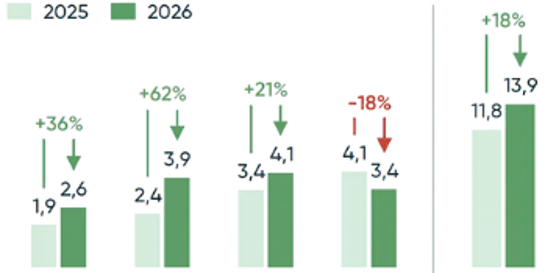
| янв / Jan | фев / Feb | мар / Mar | апр / Apr | 4 мес. / 4 months |
New-build housing market dynamics, Source: DOM.RF Analytical Centre
The portal’s analysts explained that the mass subsidised mortgage programmes of previous years created a price gap between primary and secondary housing markets, effectively trapping the new-build sector in a dead-end situation. Without government-backed mortgage support, which is gradually being reduced, buyers are effectively disappearing from the primary market.
At the next stage, however, such a trend could theoretically lead to a positive outcome for buyers in the form of lower apartment prices. Experts interviewed by Nezavisimaya Gazeta remain doubtful that such a scenario is likely in the near future.
According to DOM.RF data, among Russia’s million-plus cities, prices for mass-market new-build housing declined year-on-year in April only in Krasnodar, by around 1%, and Volgograd, by 2%. In the business and luxury segments, prices fell in five cities. The sharpest declines were recorded in Nizhny Novgorod, down 5%, and Rostov-on-Don, down 4%, while prices in Yekaterinburg, Ufa and Perm declined by between 2% and 3%.
‘The real estate market remains at a crossroads. On the one hand, the absence of affordable mortgages has been putting pressure on prices for more than a year. On the other hand, prices are being supported from below by high inflation and a shortage of liquid supply,’ IRN analysts said of the Moscow market. ‘Against these contradictory forces, housing prices are either stagnating or attempting to grow roughly in line with inflation.’ In their view, the longer the period of high interest rates continues, the greater the probability of a downward trend in housing prices as demand continues to lag behind supply.
Experts interviewed by Nezavisimaya Gazeta, however, do not expect any major fall in new-build prices. On the contrary, according to Dmitry Proskurin, commercial director at Metrium, prices are still gradually rising ‘because many developers are obliged to increase the price per square metre as construction progresses under commitments to banks providing project financing’.
‘Across the country, nominal price growth continues in both the primary and secondary housing markets. Average monthly growth is around 1%,’ said Stanislav Bannikov, commercial director at Plato Development.
At the same time, because current price growth rates are lower than in previous years, especially in 2023 and 2024, the current situation is better described as stabilisation, he said. The period of rapid price rallies has ended. The market is now waiting for decisions on mortgage rates and clarity regarding new state support programmes. Price growth has slowed, but, the expert warned, buyers should not expect actual price declines
ORIGINAL: NG/Housing Is Not Becoming More Affordable in Russia’s Largest Cities