The departure of skilled Russians to Southeast Asian countries has become a persistent factor behind the outflow of labour from Russia, sociologists have found. Thailand, Vietnam and the Philippines still have far fewer Russian-speaking migrants than the United States or Europe, but the flow of people relocating from Russia to Asia is steadily increasing. A ‘Russian-speaking economy’ is developing across the region, creating jobs for local residents as well. Many migrants continue to work remotely for Russian companies, while others are gradually reducing their economic ties with Russia.
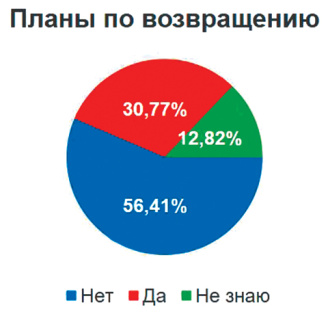
Long-term plans of respondents to return to Russia or remain in Southeast Asian countries. Source: Regional Problems of Transforming the Economy, No. 7, 2026
Almost 60% of Russians living in Southeast Asian countries intend to remain there permanently. Fewer than 26% plan to return to Russia. Many Russian-speaking migrants have already started families and have children. Stable transnational family networks are emerging across the region. A ‘Russian-speaking economy’ is developing in Southeast Asia. Tourist visits are often turning into extended stays, accompanied by property purchases and business registration, according to Dmitry Zorin and Viktoria Medvedeva of the Institute of Social Demography of the Russian Academy of Sciences, the authors of the study.
International statistics indicate that around 9.1 mln people from Russia now live outside the country. Based on national census data, the largest Russian-born populations are currently in Germany, with 1.1 mln people, the United States, 500,000, Turkey, 200,000, and Spain, 130,000
Southeast Asia is not among the leading regions by the number of Russians living there. However, the region has seen a sharp increase in tourist and emigrant flows from Russia. The rise in tourism is closely correlated with the number of Russian-speaking migrants moving to the region for extended periods, according to a study of migration flows from Russian regions to Southeast Asian countries. The statistical basis for the findings consisted of a sociological survey of Russian-speaking respondents living in Southeast Asia, covering migration cohorts formed between 2020 and 2025, as well as official sources from several Southeast Asian countries
More than 80% of Russian-speaking emigrants work in professions that form the backbone of the knowledge economy and creative sector. A quarter of respondents, 25.6%, work in IT and digital technologies. Another quarter work in creative industries such as design, media and architecture. Around 15% work in social services, including education and healthcare, while a similar proportion are employed in tourism. The remainder are professionally distributed across law, marketing and other sectors
The number of Russian citizens permanently living in Thailand is estimated at around 50,000, concentrated mainly in Pattaya and Phuket. Vietnam has between 25,000 and 30,000 Russian-speaking residents and Russian citizens, mainly in Hanoi, Vung Tau, Nha Trang and Ho Chi Minh City. Cambodia has up to 5,000 Russian citizens and Russian speakers, mainly in Phnom Penh and Sihanoukville. In Laos and Myanmar, the number of Russian citizens is measured in hundreds and tens respectively. They include freelancers, teachers and spouses of former students from Southeast Asia who studied in Russia. In the region’s island states, Russian-speaking communities are concentrated mainly in Bali, Indonesia, and the Philippines. As a result of migration, a ‘Russian-speaking economy’ has already emerged across the region: a system of economic actors and relationships operating in Russian and targeting Russian-speaking customers. Russian-language schools officially operate in many countries in the region, and not only at embassies
Official figures for the number of permanent Russian residents in Southeast Asia often differ substantially from the reality on the ground. In 2024, for example, the actual permanent Russian presence in Phuket, Thailand, was estimated at around 60,000 people. However, according to the Russian consul general in Phuket, the official number of Russians living there on long-term visas, including business, student, family and retirement visas, was only 9,800. The sixfold discrepancy between the actual and official figures is explained by the widespread practice of making short trips out of the country to renew visa status
People from former Soviet countries often decide to stay long term or even relocate permanently after travelling to a country as tourists. The Russian-speaking diaspora in Vietnam, for example, consists of two distinct groups. The first comprises people who initially arrived for tourism but later decided to stay, starting their own businesses, finding remote-work opportunities or earning income from property rented out in Russia. The second group consists of people who relocated from Russia and Ukraine after leaving their countries over the past four years amid mobilisation measures and the special military operation. This group also includes ‘secondary migrants’ who initially chose to live in Central Asian countries such as Uzbekistan, Kyrgyzstan and Kazakhstan, or in the South Caucasus, including Armenia and Georgia, but subsequently moved to Vietnam for various reasons.
People from former Soviet countries often decide to stay long term or even relocate permanently after travelling to a country as tourists. The Russian-speaking diaspora in Vietnam, for example, consists of two distinct groups. The first comprises people who initially arrived for tourism but later decided to stay, starting their own businesses, finding remote-work opportunities or earning income from property rented out in Russia. The second group consists of people who relocated from Russia and Ukraine after leaving their countries over the past four years amid mobilisation measures and the special military operation. This group also includes ‘secondary migrants’ who initially chose to live in Central Asian countries such as Uzbekistan, Kyrgyzstan and Kazakhstan, or in the South Caucasus, including Armenia and Georgia, but subsequently moved to Vietnam for various reasons.
Migration trends point to human capital moving to jurisdictions offering more favourable conditions for remote employment and residence, lower tax burdens and a higher quality of life. In the medium term, this movement of human capital could reduce labour productivity in the Russian regions from which migrants originate. It is also widening the development gap between central and peripheral regions of Russia, specialists at the Russian Academy of Sciences’ Institute of Social Demography say. According to their findings, stable Russian-speaking diasporas have already emerged in Southeast Asia and could become channels for reverse knowledge transfer in the long term. For now, however, these growing diasporas represent a net demographic loss for Russia
To mitigate the negative consequences of migration from Russia, researchers have begun developing incentives in Russian regions to encourage skilled professionals to return, including tax benefits, reintegration programmes and the development of remote-work infrastructure within Russia.
ORIGINAL:NG/Russian-Speaking Economy Grows in Southeast Asia