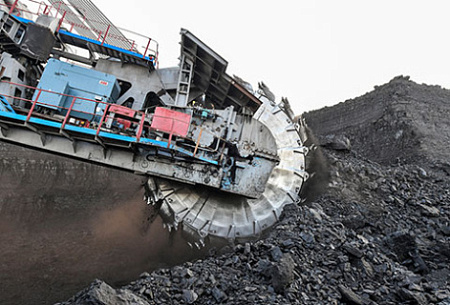
This Wednesday, the Russian government published an updated programme for the development of the coal industry through 2050. The document assumes that coal will remain one of the leading energy resources in both Russia and the rest of the world even in 25 years’ time. The programme calls for existing mining capacity to be maintained and conditions created for developing new coal reserves. New sectors of the economy, including data centres (DCs) and charging stations for electric vehicles, are expected to support domestic demand for coal.
The coal industry development programme considers several scenarios depending on global demand for coal, commodity prices and the energy intensity of the global economy
Four development scenarios are proposed: stress, conservative, inertial and target.
Under the target scenario, Russian coal production is expected to reach 530.1 mln tonnes in 2030, 595.2 mln tonnes in 2036 and 662 mln tonnes in 2050. Coal exports would reach 266.7 mln tonnes in 2030, 320.2 mln tonnes in 2036 and 350.1 mln tonnes in 2050. The target scenario assumes relatively favourable conditions for coal production and exports, with prices and demand for the commodity rising and EU sanctions lifted. Even so, the coal industry is expected to undergo a digital transformation ‘through the use of breakthrough technologies and efficient equipment’.
Under the conservative scenario, which assumes current coal production and export volumes remain broadly unchanged, output would reach 454 mln tonnes in 2030, 460.5 mln tonnes in 2036 and 460.8 mln tonnes in 2050.
The inertial scenario assumes rising coal production and consumption in domestic and foreign markets, the gradual retirement of inefficient and unsafe capacity, while the European embargo and sanctions remain in place. Coal production under this scenario would reach 491.6 mln tonnes in 2030, 545.3 mln tonnes in 2036 and 586.4 mln tonnes in 2050.
The stress scenario developed by the government assumes declining coal production and consumption in both domestic and foreign markets, driven by falling demand and prices, a continued embargo and an expanding package of EU sanctions. Under prolonged financial and sanctions pressure, falling export revenues and limited access to capital, the Russian coal market would consolidate, with weakly capitalised and loss-making companies pushed out. Over time, the coal industry could develop a partially monopolised market structure dominated by several large vertically integrated groups. Under this scenario, production could fall to 438.3 mln tonnes in 2030, 381.3 mln tonnes in 2036 and 318.9 mln tonnes in 2050. Coal exports would fall to 100 mln tonnes by 2050.
The programme stresses that achieving these long-term objectives will require the Russian coal industry to undergo a series of phased transformations
The first stage, through 2030, calls for government support for coal companies, diversification of production, an expanded product range and stronger production, market and investment capacity across the industry.
The second stage, from 2031 to 2036, is intended to create the conditions for the coal industry to move to a new technological paradigm. The third stage, from 2037 to 2050, would involve ‘realising the potential competitive advantages of Russian coal companies as part of the long-term state energy policy, using the most advanced technological, economic and organisational solutions’.
The cornerstone of the updated programme, however, will be a new investment cycle in the industry, Deputy Prime Minister Alexander Novak said on Monday.
The new investment cycle will focus on six areas. ‘The first is ensuring technological sovereignty by creating industry demand for mining equipment, unmanned and autonomous mining technologies and digital platforms. The second is developing promising deposits and creating new mining centres in the east of the country, in Yakutia, Tuva, Khakassia, Transbaikal, Taimyr and Chukotka,’ the government official said
The third area is domestic consumption: maintaining coal-fired power generation while improving its efficiency, alongside the development of coal chemistry and deeper processing. The fourth is increasing exports by expanding the Eastern Polygon, developing ports, strengthening ties with friendly countries such as China and India, and increasing supplies to south-east Asia, the Middle East and Africa, Novak said. The fifth and sixth areas are safety and human resources
The government’s plans are intended to increase the industry’s gross value added sixfold by 2050, with a total multiplier effect of almost RUB 10 tn
New sectors of the economy, including data centres, artificial intelligence facilities and charging stations for electric vehicles, are also expected to drive domestic demand for coal. The programme says data centres could be powered by their own coal-fired generation. ‘As the economy undergoes digital transformation, technological processes become automated and robotised, and artificial intelligence and other innovative technologies are introduced, Russia will see the emergence of new domestic consumers of coal products across different areas of industry, transport, construction, environmental services and information technology infrastructure, including data centres,’ the programme states.
Russia’s coal industry has been in crisis in recent years. Last year, the combined loss of coal companies exceeded RUB 400 bln, compared with a loss of RUB 112 bln the previous year. The share of profitable coal companies fell to 33.9% last year from 46.7% in 2024, while the share of loss-making companies rose to 66.1% from 53.3%. The final loss was worse than the Energy Ministry’s forecast of RUB 300–350 bln.
The government subsequently ordered monitoring of coal companies’ financial condition and instructed officials to introduce state support measures if necessary. In December last year, the government extended a deferral on mineral extraction tax and insurance payments for coal companies. In March this year, it approved a further deferral of mineral extraction tax and insurance payments until the end of April. Companies will be able to repay the resulting liabilities in equal monthly instalments from May through the end of November 202
Coal exports have continued to grow this year. They increased by 7.2% in the first eight months, Deputy Prime Minister Novak said. ‘Global prices are now recovering. We clearly need to take advantage of these market conditions to restore the industry’s financial health,’ he said.
Daniil Gonenko, an associate professor at the Presidential Academy, said it was too early to write off coal-fired generation.
For Russia and most developed and developing countries, it remains highly valuable. The first advantage is obvious: it is cheap and readily available energy. We have enough reserves to last for generations, while extraction and logistics have long been established. The second factor, which isn’t discussed as often, is waste. Ash and slag from coal-fired power plants and overburden from mining can be used in construction to make cement, road foundations, blocks and crushed stone. There is a huge stockpile of this waste, estimated at more than 1.5 bln tonnes, while only a small proportion is put to use. At present it simply takes up land, leaving scars on the environment, although with the right approach it could become a source of construction materials,’ he said.
Building data centres next to coal-fired power stations makes sense, according to Gonenko.
‘The modern world, and above all expanding data centres and AI systems, needs vast amounts of stable, affordable electricity, and coal-producing regions such as Siberia and Kuzbass have exactly that. A data centre next to a coal-fired plant makes sense: electricity is cheap and the cold climate makes cooling less expensive. The energy crisis that has begun in Europe could eventually lead to sanctions being lifted and, on the other hand, to higher demand for energy from Russia. This could provide an additional boost to regional development. But data centres alone cannot save the industry. They create additional demand, not the main source of it,’ he said.
ORIGINAL: NG/Coal-Fired Power to Drive Russia’s Economic Digitalisation