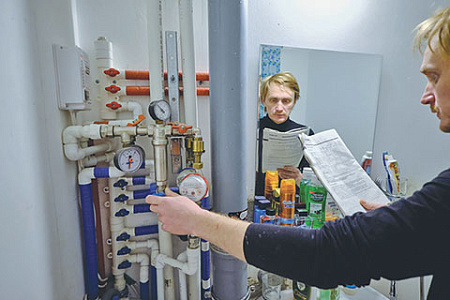
The State Duma elections are over, and the time for unpopular measures has come. The Ministry of Economic Development has revised its tariff-increase plan. The new forecast envisages an even steeper rise in the cost of housing and utility services than in the May version. The scale of the tariff burden being shifted onto households, which will have to pay for years of underinvestment in the sector, is striking. Over the five-year period from 2025 through 2029, the total amount households pay for utility services will increase by 60%. Housing and utility tariffs will rise twice as fast as overall inflation is expected to increase and eight times faster than GDP.
In 2027, the average nationwide household payment for utility services will increase by 11%. In 2028, it will rise by another 8.6%. In 2029, it will increase by 7.6%.
These targets were set out by the Ministry of Economic Development in its new socio-economic forecast. The document was published at the end of last week as part of preparations for the federal budget for the next three-year period
The total household payment calculated by the ministry includes payments for gas, electricity, heating, water supply, wastewater disposal (sewerage) and solid municipal waste management. ‘The above parameters will be differentiated across Russian regions depending on regional conditions,’ the ministry said.
Over the entire three-year forecast period, the increase in utility tariffs set out in the new document will be higher than in the previous version of the government forecast published in May this year. For example, the May version assumed that the total household payment for utility services would rise by 8.7% in 2027.
According to the Ministry of Economic Development’s rationale, one reason for revising the tariff plan towards an even larger increase is higher-than-expected current inflation. At the same time, despite all the inflationary setbacks of recent years, the ministry continues to place firm faith in the Central Bank’s promise to achieve its 4% inflation target in 2027.
There is another reason for the revision of the tariff plan. ‘In 2027–2029, when tariffs are approved in the heating, water supply and wastewater sectors, resource-supplying organisations will be provided with targeted additional revenue to implement investment programmes for the modernisation of utility infrastructure, amounting to an additional 1.5% of revenue annually,’ the Ministry of Economic Development said in its materials.
Similar factors are cited in the rationale for the new tariff targets for gas and electricity. In the gas supply sector, for example, ‘long-term measures are being implemented to improve the reliability of natural gas supplies to the domestic market, modernise the gas transmission system and connect new regions to the Unified Gas Supply System, while the social gasification programme is also continuing,’ the ministry said.
‘In accordance with the decisions taken, wholesale gas prices for all categories of consumers will be indexed in 2027–2029 by an additional 3 percentage points above forecast inflation to ensure the implementation of large-scale measures,’ the ministry explained.
In describing trends in the electricity sector, the ministry referred to the implementation of major investment projects, including ‘the construction and reconstruction of main electricity grid facilities to develop the Moscow power system, and the construction of electricity storage systems in southern Russia’.
The utility burden is becoming increasingly heavy, with the scale of price increases in housing and utility services striking. In its materials, the Ministry of Economic Development provides figures for the five-year period from 2025, when actual data are available, through 2029, the forecast period. This makes it possible to assess the trend.
The published data show that the cumulative increase in household payments for utility services over 2025–2029 will be about 60%. Such a 1.6-fold increase in utility costs over five years raises questions.
First, there is the question of how this will affect inflation and whether the Central Bank will be able to meet its inflation target under such tariff pressure. According to the new Ministry of Economic Development forecast, cumulative inflation over 2025–2029 will be about 27%. This means that household utility payments will rise twice as fast as inflation over the five-year period under review.
Second, questions arise about the efficiency of the housing and utilities sector as a whole. Another comparison is revealing: according to the Ministry of Economic Development forecast, cumulative GDP growth over 2025–2029 will be just 7.5%. Thus, household utility payments will rise eight times faster than the Russian economy as a whole over the same five-year period.
‘Accelerated tariff growth by infrastructure monopolies will lead to a whole range of problems: higher business costs, faster inflation and the subsequent failure to meet the inflation target, and slower growth in households’ real incomes,’ warned Natalya Churkina, an analyst at the Institute for Comprehensive Strategic Studies. ‘Moreover, it has already become commonplace that each new version of the forecast revises tariff growth upwards. As a result, both businesses and households are losing confidence in the planned figures,’ she said. ‘It is therefore unsurprising that inflation expectations remain high under such conditions.’
According to Yulia Kovalenko, an expert at Plekhanov Russian University of Economics, the rise in utility tariffs can indeed logically be explained by the need both to renew infrastructure assets and to address the consequences of, among other things, unforeseen weather conditions.
| Индексация, в % / Indexation, % | 2025 (факт) / (actual) | Майская версия* / May version* | Сентябрьская версия / September version | ||||||
| 2026** | 2027 | 2028 | 2029 | 2026** | 2027 | 2028 | 2029 | ||
| Совокупный платеж граждан за коммунальные услуги / Total household payment for utility services | 11.9 | 99 | 8.7 | 7.1 | 6,1 | 9.9 | 11 | 8.6 | 7.6 |
| Оптовые цены на газ для населения / Wholesale gas prices for households | 10.3 | 9.6 | 9.1 | 7 | 7 | 9.6 | 10.4 | 7.4 | 7 |
| Тарифы на электроэнергию для населения / Electricity tariffs for households | 12.6 | 11.3 | 8.6 | 9.1 | 5 | 11.3 | 14.4 | 12.1 | 10.1 |
| Тарифы на пассажирские перевозки ж/д / Rail passenger transport tariffs | 11.4 | 0 | 5.9 | 5.9 | 5,9 | 9.2 | 0 | 9.2 | 9.2 |
| Тарифы на ж/д грузоперевозки / Rail freight tariffs | 10 | 0 | 8.3 | 6 | 4.9 | 8.5 | 0 | 7.3 | 5.6 |
| Годовая инфляция (рост цен декабрь к декабрю) / Annual inflation (December-on-December price growth) | 5.6 | 5.2 | 4 | 4 | 4 | 6.8 | 4 | 4 | 4 |
Growth in infrastructure-sector companies’ tariffs: comparison of two government forecasts
Rail = railway transport, * The May indexation plan is now outdated; ** In 2026, indexation will take place on October 1. Source: Ministry of Economic Development
But Churkina said faster tariff increases have not so far translated into a comparable reduction in infrastructure deterioration.
Rosstat’s latest available data show that heat losses in Russia’s heating networks reached 12.1% in 2025, up from 11.1% in 2015 and 9.1% in 2005. Almost 30% of heating networks required replacement in 2025, compared with about 29% in 2015 and 25% in 2005. The overall length of heating and steam networks, measured on a two-pipe basis, was 5% lower in 2025 than in 2005.
Around 45% of the street sewerage network required replacement last year, compared with almost 44% in 2015 and 30.5% in 2005.
Water supply has shown some improvement. Almost 41% of the street water-supply network required replacement in 2025, down from about 44% in 2015. In 2005, the figure was lower still, at about 38%.
Even higher tariffs may not be enough. Dmitry Baranov, a leading expert at Finam Management, told Nezavisimaya Gazeta that the task was not merely to keep networks in working order but to eliminate a long-standing investment shortfall after decades of underfunding. ‘The sector needs not only funding for current operations, but also additional resources to replace infrastructure that has already deteriorated,’ he said.
That money is being raised largely from Russian households, either directly through tariffs or indirectly through the higher prices of goods and services generated along supply chains, despite households’ limited ability to pay.
Baranov said the state was not abandoning co-financing altogether. The Comprehensive Programme for the Modernisation of Housing and Utilities through 2030 has been estimated at 4.5 trillion roubles, he said, but a substantial share of the cost is still effectively being passed on to future consumer payments. ‘The tariff is being relied upon because it is a stable source of income, with tariff revenue arriving regularly,’ Baranov said.
‘From the standpoint of economic logic, a utility service should be paid for by the person who receives it. But the logic of “the consumer pays” works only to a limited extent here: consumers should pay for their current consumption, but not necessarily for the entire infrastructure debt accumulated over decades,’ he added. The consequences of past underfunding, Baranov said, are ‘the legacy of the entire system, not the result of a particular family’s consumption today’.
Churkina said infrastructure companies were passing their costs on to businesses and consumers, while the efficiency of housing and utility providers was not being adequately monitored. Boris Kopeykin, chief economist at the Stolypin Institute for the Economy of Growth, also pointed to problems with insufficient transparency in tariff-setting and a lack of incentives for providers to improve efficiency.
ORIGINAL: NG/Utility Tariffs to Rise Eight Times Faster than GDP