
Point-of-sale (POS) loans for household appliances, electronics, building materials, furniture and clothing are becoming a luxury for Russian consumers, who are finding it increasingly difficult to prove their eligibility for credit. The rejection rate for consumer loan applications made directly at points of sale is currently around 85–86%. Only one in seven applications is approved. Lenders are screening out risky and impulsive buyers, forcing them to look for alternative ways to pay
Amid tight monetary policy, Russian banks continue to have a low appetite for risk. According to the National Bureau of Credit Histories (NBKI), the rejection rate for POS-loan applications has now stabilised at 85–86%. ‘Since mid-2024, it has not fallen below 80%,’ Alexei Volkov, NBKI’s marketing director, told Nezavisimaya Gazeta.
POS loans are express loans offered to consumers directly in shops, without the need to visit a bank. The term comes from ‘point of sale’.
This form of lending is typically used to buy household appliances and electronics, building materials, furniture, jewellery, clothing and footwear, both in traditional offline retail and increasingly in online shops
According to data from lenders that submit information to the NBKI, the average POS loan was RUB 70,000 in July. POS loan terms are also getting longer, allowing borrowers to reduce their monthly payments. Such loans are now issued for an average of 18 months
The particularly high rejection rates for POS lending are due to the fact that this type of credit is primarily aimed at borrowers who are prone to making spontaneous decisions. The risks are therefore inherently higher, as is the rejection rate,’ Volkov told Nezavisimaya Gazeta.
POS loans also have another distinctive feature.
‘They are often used by people with relatively low incomes who are also unable to officially document those incomes,’ Alexei Varpakhovsky, marketing director at the Webbankir platform, told Nezavisimaya Gazeta
The tightening, however, is not limited to shop loans. It is part of a broader trend. ‘In August, banks rejected almost 78% of all retail loan applications and 76% of cash-loan applications. So the problem goes beyond purchases in shops. The rejection rate is likely to increase,’ said Kirill Chernovol, a research fellow at the Gaidar Institute’s laboratory.
He noted that since April 1, 2026, banks have no longer been allowed to treat any regular incoming payments as a borrower’s income. They can now take into account only payments specifically labelled as ‘salary’, ‘pension’ and so on.
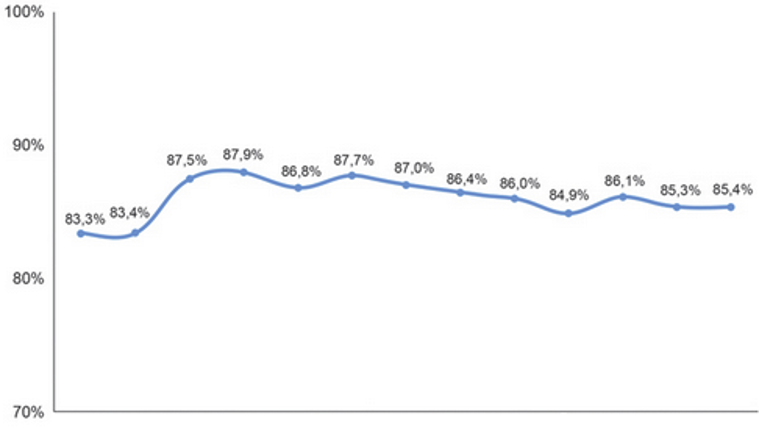
| АВГ.25/AUG 2025 | СЕН.25/SEP 2025 | ОКТ.25/OCT 2025 | НОЯ.25/NOV 2025 | ДЕК.25/DEC 2025 | ЯНВ.26/JAN 2026 | ФЕВ.26/FEB 2026 | МАР.26/MAR 2026 | АПР.26/APR 2026 | МАЙ.26/MAY 2026 | ИЮН.26/JUN 2026 | ИЮЛ.26/JUL 2026 | АВГ.26/AUG 2026 |
POS loan rejection rate, % Source: NBKI
‘And since July 1 this year, unverified income declared by a borrower, for example, when someone simply says in a shop that they earn RUB 200,000 a month, can only be counted at 90% and only up to the level of average per-capita income in the region,’ Chernovol added.
In addition, from the third quarter the Central Bank restricted the share of other consumer loans issued to borrowers with high debt-service ratios.
‘If a person spends half of their income or more servicing existing financial obligations, there is a high risk that they will not receive a new loan. Only official income is taken into account when calculating the debt burden,’ Varpakhovsky added
Banks are nevertheless competing for consumers with high creditworthiness. ‘For POS-loan applications from such borrowers, the rejection rate is currently 66%,’ the NBKI said.
In addition to monetary policy measures, experts pointed to another factor affecting borrowers’ prospects: the deterioration in real disposable household incomes.
‘More and more Russians are failing credit scoring because of unstable or low incomes, which automatically increases the rejection rate,’ said Maria Yermilova, an associate professor at the Plekhanov Russian University of Economics
The question is what consumers do after their application for a shop loan is rejected. According to Alexei Rodin, a financial adviser at Rodin.Capital, only 10–15% of customers may abandon the purchase altogether after being refused credit. This can be particularly useful when the purchase is an emotional decision: the customer gains time, creating a kind of cooling-off period in which to reconsider and calm down.
‘In other cases, the buyer will look for an alternative. This could be an instalment plan, a credit card or a loan from a microfinance organisation,’ Rodin said. In extreme cases, he added, there is a risk that the customer could turn to an illegal lender
Yermilova also noted that, from the consumer’s perspective, online loans and microfinance, including the shadow sector, could become alternatives
There are other options: finding a cheaper equivalent of the desired product, turning to the second-hand market or renting the equipment needed
According to data cited by Rodin, POS lending accounts for only 2–3% of all retail lending, and its share has fallen almost threefold over the past 10 years. He therefore considers the various risks associated with POS loans to be relatively minor for the banking system as a whole
At the same time, Yermilova’s forecasts suggest that widespread rejection of POS loans could slow retail sales growth, particularly in household appliances and electronics.
ORIGINAL: NG/Shops Join Banks in Screening Out Customers