
Discussions of the 2027 budget and the tax burden could prove difficult. Businesses are raising a broader concern: higher taxation is now starting to work against budget revenues by reducing investment, profits and tax receipts. The proportion of loss-making companies in Russia is already rising, while aggregate nominal profits are falling. As a result, regions are losing tax revenues and regional budget deficits are growing.
The authorities and businesses have reached a point at which the tax burden is beginning to undermine budget revenues and a shortage of investment affects economic growth, Nornickel president Vladimir Potanin told RBC television.
‘Growth is weak, so the tax base is shrinking while spending is rising. That puts pressure on the budget,’ he said.
According to Potanin, unpredictable tax changes and a growing tax burden, combined with high interest rates and a shortage of market liquidity, are holding back investment and cooling the economy. As the authorities seek to contain the budget deficit, investment expenditure is among the first areas to be cut. ‘At the same time, substantial amounts of profit are being taken from companies, large and small, in various ways. This also reduces the funds available for investment,’ he said. Potanin described the shortage of investment as the ‘key problem’ today.
The Nornickel chief considers a heavy fiscal burden on business understandable in the current circumstances.
‘But only if it comes out of money already earned. You cannot take money in advance; you have to take it from earnings, not from funds a business does not yet have. This is now the main subject of our discussions with the Finance Ministry,’ he said. ‘The burden must be paid entirely out of profits,’ Potanin believes He also recalled a ‘social contract’ reached two years ago during discussions of tax changes. ‘We proceeded on the understanding that there would be a commitment to tax stability. The burden could be heavy, but it would remain stable for a certain period and be based on profits rather than taking money out of working capital,’ Potanin said.
‘If business owners do not understand how the government intends to collect taxes from them, it is extremely difficult for them to plan investment,’ he stressed.
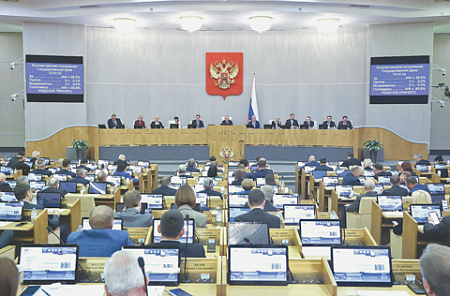
In early October, the government submitted a package of budget bills to the State Duma, including the draft federal budget for 2027, extensive amendments to the Tax Code and a bill introducing a new tax on the windfall profits of metallurgical companies. The budget envisages revenue of RUB 43.3 tn and expenditure of RUB 48.7 tn, with a planned deficit of RUB 5.44 tn
Oil and gas revenue is expected to decline to RUB 7 tn, or 16.2% of federal budget revenue. Non-oil-and-gas revenue, meanwhile, is projected to rise to RUB 36.6 tn. This increase is expected to come from tax law changes, higher VAT, corporate profit tax and personal income tax receipts, changes to excise duties and state fees, and improved administration and collection. Non-oil-and-gas sources are thus expected to account for 83.8% of federal budget revenue in 2027.
Last week, Finance Minister Anton Siluanov said a compromise had been reached with businesses over the windfall tax on certain companies.
We did very good work, met with businesses and found a compromise on the windfall tax. This was the tax that worried them most,’ Siluanov said. ‘We adjusted the arrangements to smooth out spikes in payments for those who would otherwise face a large potential tax bill in a single calendar year.’
Alexander Shokhin, head of the Russian Union of Industrialists and Entrepreneurs (RSPP), later said the compromise between the Finance Ministry and businesses over the windfall tax could not yet be considered final. ‘We understand the need to balance the budget and the scale of the tasks to be addressed within the three-year budget framework. Businesses are ready to help find solutions that will bring in additional budget revenue. But I would not say that a final compromise has been reached and all the parameters agreed,’ he told the media
The RSPP also argued that the tax was effectively being introduced retroactively: the tax base for 2027 would be calculated based on the extent to which mineral prices in 2026 exceeded their 2025 baseline levels. In its view, applying a mandatory payment to a past period runs counter to fundamental principles of taxation because companies could not have factored it in beforehand.
Reports indicate that the windfall tax would be calculated by multiplying the volume of minerals extracted by the amount by which their average price in 2026, 2027 or 2028 exceeds the average price in 2025. For 2027 and 2028, the 2025 baseline price would be adjusted by factors of 1.1 and 1.21 respectively. No tax would be payable if the price increase were less than 10%. Metal and fertiliser producers could pay up to 30% of windfall income for 2026–2028 if average annual world prices for the minerals concerned, expressed in roubles, were 10% higher than the 2025 baseline. The total new tax would be capped at 15% of revenue from each type of mineral, less the mineral extraction tax assessed.
Calls from businesses for a tax compromise come amid a prolonged investment slowdown and rising corporate losses. Fixed capital investment in Russia fell by 2.3% in real terms last year. Capital expenditure dropped by almost 10% year on year in the first half of 2026, and the Ministry of Economic Development expects it to fall by 5.4% over the full year
The financial position of Russian businesses is also worsening. In the first seven months of this year, 21,500 organisations reported losses and 42,900 made profits. The share of loss-making organisations rose by 2.8 percentage points compared with the same period a year earlier, to 33.4%, according to Rosstat.
Calculations suggest that the number of loss-making sectors in Russian business nearly quadrupled, from three to 11, in the first seven months of the year. Metallurgy, wood processing and car manufacturing joined traditionally troubled sectors such as coal mining, passenger transport and postal services
Corporate profits are falling. According to Rosstat, Russian companies recorded RUB 13 tn in profits net of losses in the first seven months of 2026, down 16% year on year
Almost one in four Russian companies is now said to be on the brink of default. By early August, 195,700 of the country’s 709,600 corporate borrowers had overdue debts, equivalent to 27.6% of the total. Before 2022, only 13.1% of corporate borrowers had overdue debts
The sharp rise began in the second half of 2024, when the economy started slowing. Over the following year and a half, the share of borrowers with overdue debt increased by almost a third. The main cause of the crisis is the mismatch between borrowing costs and business profitability. According to the Centre for Macroeconomic Analysis and Short-Term Forecasting, businesses are spending a record 36–37% of operating profits on debt servicing (see Nezavisimaya Gazeta, September 28, 2026).
Payment arrears are also increasing in the Russian economy, as reflected in growing overdue corporate receivables. According to Rosstat, overdue receivables exceeded RUB 9 tn at the end of July, up 21.7% year on year.
A shortage of funds is leading to rising wage arrears. At the end of August, total wage arrears exceeded RUB 2.4 bln, having increased by RUB 385 mln in a month. Only 31 Russian regions had no overdue wage payments. A shortage of companies’ own funds was the main cause, accounting for 97.8% of total overdue wage arrears in August.
Overdue wage payments are growing by more than 18% a month. The proportion of workers owed overdue wages remains below 1%, but the pace of deterioration in companies’ financial position is causing concern
Corporate difficulties, in turn, are adding to the problems facing regional budgets by reducing tax receipts. According to the Accounts Chamber, Russia’s consolidated regional budgets recorded a surplus of RUB 140 bln in the first quarter of 2026. By the end of the first half, however, this had turned into a deficit of more than RUB 134 bln, although that was smaller than the RUB 398 bln deficit recorded in the first half of 2025 (see Nezavisimaya Gazeta, September 23, 2026).
‘There are significant changes in the structure of regional budget revenues. The share of corporate profit tax continues to decline, from 23.1% in the first half of 2025 to 22.9% in the first half of 2026. At the same time, the share of personal income tax is rising, from 31.1% in the first half of last year to 33.1% in the first half of this year,’ said Accounts Chamber auditor Natalya Trunova
According to Finance Ministry forecasts, the aggregate deficit across regional budgets could reach nearly RUB 2 tn by the end of the year (see Nezavisimaya Gazeta, September 20, 2026).
ORIGINAL: NG/Russian businesses oppose paying taxes in advance