Next year’s budget, which the Finance Ministry has described as difficult, could also breach the limits set by the government. According to the Sberbank Centre for Macroeconomic Research (CMI), the budget deficit will widen to 2.7% of GDP in 2027, rather than the 2% of GDP that the Finance Ministry hopes will persuade the Central Bank of Russia to ease its monetary policy. The gap between the official plan and the expert forecast is RUB 1.6 tn. Oil-market conditions account for only RUB 200 bln of that gap, while the remaining RUB 1.4 tn is linked to non-oil and gas revenues, banking analysts warned. The CMI’s findings are striking: the non-oil and gas deficit in the 2027 budget will reach a massive 5.8% of GDP. To meet its own target, the government will need to bring this down to 5.2% of GDP.
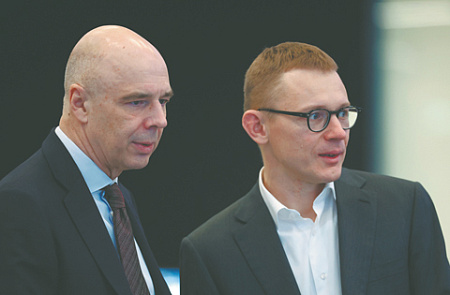
This week, on September 24, the government will consider the draft federal budget for 2027–2029. The document is then due to be submitted to the State Duma by the end of the month. Speaking at the Moscow Financial Forum, Finance Minister Anton Siluanov described the budget for the next three-year period as difficult, although he added that the budget had ‘always been difficult’ in recent years.
Siluanov said the federal budget for 2027 had been drawn up with a deficit of 2% of GDP. As it turns out, this is an achievement. ‘Just a couple of months ago, we prepared a number of measures for fiscal consolidation and produced a budget with a deficit that does not pose any particular risks,’ the minister said at the forum. The Finance Ministry then sent a return pass to the Central Bank
At a recent press conference on the key rate, Bank of Russia Governor Elvira Nabiullina said the budget parameters were an important prerequisite for monetary policy.
‘We expect their details to be clarified by the end of September,’ the Central Bank governor said. While waiting for this, although not only for this reason, the Bank of Russia paused its key-rate cuts in September.
The Finance Ministry is confident it can now persuade the Central Bank. ‘The important thing is that we have aligned ourselves with the Central Bank. What matters today? That inflation, inflation expectations and interest rates should come down. The Central Bank is constantly looking at the budget deficit projected for the three-year period. It will use that to shape its monetary policy. And we are all watching monetary policy to see when it starts to ease, when Elvira [Nabiullina] starts easing it. We have done everything to give Elvira that opportunity,’ Siluanov said.
However, expert forecasts suggest that achieving a 2% deficit is not guaranteed. On the same day as Siluanov’s statement, Sberbank’s Centre for Macroeconomic Research said it expected the federal budget deficit to reach RUB 6.4 tn in 2027, or 2.7% of GDP, compared with the stated target of 2% of GDP. The gap is RUB 1.6 tn, or 0.7 percentage points of GDP.
Most importantly, the CMI estimates that oil-market conditions account for only RUB 200 bln of this gap. The remaining RUB 1.4 tn would require the government to reduce the non-oil and gas deficit to 5.2% of GDP, compared with the 5.8% projected by the CMI.
This refers to the deficit driven by domestic revenues from the economy and unrelated to energy exports, whose global prices change too frequently and unpredictably.
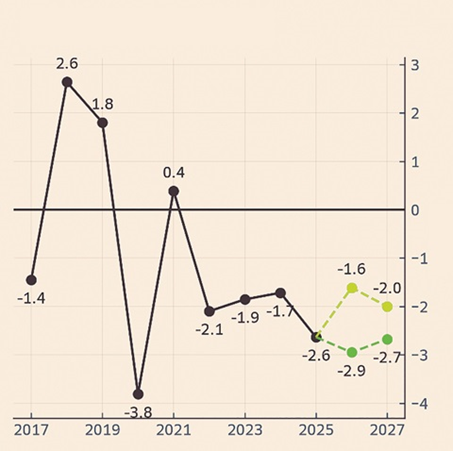
For several years, federal spending in Russia has exceeded revenues. Negative figure = deficit. Finance Ministry/draft = budget draft prepared by the Finance Ministry. Source: Sberbank Centre for Macroeconomic Research
Alexander Isakov, head of Sberbank’s CMI, told Nezavisimaya Gazeta where such a huge non-oil and gas deficit figure came from.
‘What is the oil and gas deficit? It is the size of the deficit assuming zero oil and gas revenues. Oil and gas revenues are about 3.3% of GDP in 2027, both in our estimate and in the government’s calculations. This means that the non-oil and gas deficit will equal the standard deficit plus oil and gas revenues,’ he explained. ‘The key reasons for the growing deficit are indeed linked not so much to energy prices as to the state of the economy,’ agreed Vera Kononova, deputy head of the department at the Institute for Integrated Strategic Studies. ‘The halt in economic growth and deterioration in business financial performance play an extremely important role.’
Kononova noted that, according to Rosstat, companies’ aggregate financial result fell by more than 10% year on year in the first half of the year (see Nezavisimaya Gazeta, September 20, 2026). This alone, she said, means that the tax base has narrowed in a number of areas, further worsening the deficit.
The Finance Ministry has also now acknowledged that the federal budget deficit will exceed the original plan in 2026. ‘We expect the deficit to be higher than planned, but within 3% of GDP,’ Siluanov said in an interview with Vesti.
In January-August, the ministry previously reported, the budget deficit stood at 2.5% of GDP, or RUB 5.8 tn, compared with the full-year target of 1.6% of GDP, or RUB 3.8 tn. According to the minister, the deficit will be financed mainly from existing cash balances.
The question now is how the Finance Ministry can achieve the reduction in the non-oil and gas deficit recommended by experts next year, so that the government’s 2% target for the overall federal budget becomes achievable.
According to Olga Belenkaya, head of the department at Finam, the main option is to restrict spending and reduce it as a share of GDP. Another possibility is to target revenues rather than expenditure: non-oil and gas revenues could increase through faster economic growth or higher taxes.
‘Measures to increase the tax burden were already adopted in 2025–2026 to reduce the deficit. These concerned corporate profit tax, personal income tax and value-added tax,’ Belenkaya noted. But further tax increases would no longer be advisable, as they could slow an already weak rate of economic growth even further. ‘To normalise the deficit, the first priority is to restore economic growth,’ Kononova continued. ‘This requires creating favourable conditions for doing business, including monetary, foreign-exchange, tax, tariff and other conditions.’
At the same time, the expert’s comments suggest that the monetary burden not only suppresses economic growth itself but also creates direct losses for the federal budget because of the need to subsidise high market interest rates for an extended period.
‘The planned spending on this for 2026 is RUB 1.8 tn, and the actual amount could be higher. In 2025, for example, actual spending on these measures was 1.5 times higher than planned by the end of the year,’ Kononova said.
In addition, tight monetary policy is increasing the Treasury’s costs of servicing government debt.
Sberbank’s CMI shared its view of the situation with Nezavisimaya Gazeta. ‘Two hundred years ago, Mikhail Speransky said: “Every government expenditure is a tax.” It is difficult to find a more concise description of the dilemmas of fiscal policy: any continuing commitments require corresponding resources,’ Isakov explained.
At the same time, he said, the budget deficit itself is a figure that should not be taken out of context.
‘For the economy, the effects of a hypothetical 3% deficit depend on the nature of spending growth, the sustainability of the debt trajectory and the level of confidence in saving through rouble-denominated instruments. All three factors currently look favourable,’ Isakov said.
The sovereign debt trajectory is sustainable, higher government spending is responding to external challenges and remains within historical norms, while investors’ inflation expectations, although elevated, should decline as price growth slows, he said.
The Finance Ministry, meanwhile, is already looking for areas from which additional revenue can soon be extracted.
For example, Deputy Finance Minister Alexei Sazanov said at the forum that the ministry expects an additional RUB 50 bln in 2027 from licensing wholesale and retail trade in tobacco and nicotine-containing products.