The mortgage market is showing a noticeable recovery. In June, lending volumes increased both month on month and year on year. Two-thirds of newly issued loans are backed by state support schemes. Analysts are more concerned by another trend: a rising number of loan rejections by banks, including under subsidised programmes. By some estimates, one in four applications fails to secure approval.
According to data from the Central Bank, the volume of mortgage lending increased by almost 50 % in June compared with May, reaching RUB 483 bln. By comparison, mortgages worth RUB 309 bln were issued in June 2025. State-backed mortgages accounted for the largest share of new lending. Family mortgages made up around 65 % of all new loans, amounting to RUB 288 bln. A month earlier, they had accounted for 55 % of new lending. According to the Central Bank, the surge in demand may have been driven by expectations that the programme’s terms would be revised from July 1
Market-based mortgage lending increased to RUB 162 bln in June from RUB 148 bln in May. However, interest rates remained high: the average rate on market-based mortgages issued in June stood at 18 % per annum, according to the regulator’s review. Meanwhile, mortgage lending in the secondary housing market totalled RUB 62.6 bln, up 5.6 % from May and more than double the level recorded a year earlier, according to data from Domklik (which aggregates data from Sberbank).
Overall, mortgage lending totalled RUB 2.2 trn in the first half of the year, up 48 % year on year, according to Dom.RF. Domklik said state-backed mortgages remain the backbone of the market, with lending under state-backed programmes rising 38 % compared with the first half of 2025. Market-based mortgage lending expanded 3.7-fold over the same period, lifting its share of total lending to more than 31 %. Analysts attribute the trend to the cycle of declining interest rates.
According to Yaroslav Gutnov, founder of SIS Development, the increase in mortgage lending in June was driven by a sharp rise in applications from families anticipating tighter terms for state-backed mortgages from July 1. ‘The June spike is not a sign of a recovery in demand but a one-off effect. Borrowers rushed to secure loans ahead of the announced tightening of family mortgage terms, although the changes were ultimately postponed. This is a classic expectation effect rather than a sustained trend,’ said Yulia Ruzhitskaya, Commercial Director at UNIKEY.
Housing market experts point to another trend: banks are tightening their mortgage approval standards.
‘Obtaining a mortgage is becoming more difficult, and it is not just because of high interest rates. The share of rejected applications has increased. The main reasons remain borrowers’ high debt burdens, unverified income and poor credit histories,’ experts at IRN said.
By some estimates, 20–25 % of all applications are rejected. In the first half of 2026, the rejection rate remained at around 20 % of all mortgage applications submitted, according to Est-a-Tet.
‘Since early last year, banks have become much stricter in verifying borrowers’ employment and declared income, assessing whether the latter is consistent with average levels for comparable positions and companies in the region. The tightening has been driven in large part by changes introduced by the Central Bank in March last year. Borrowers are now required to provide proof of employment,’ said Maria Avrova, Head of Mortgage Lending at Est-a-Tet.
New requirements are also being introduced, such as the mandatory inclusion of spouses as co-borrowers, further complicating the approval process.
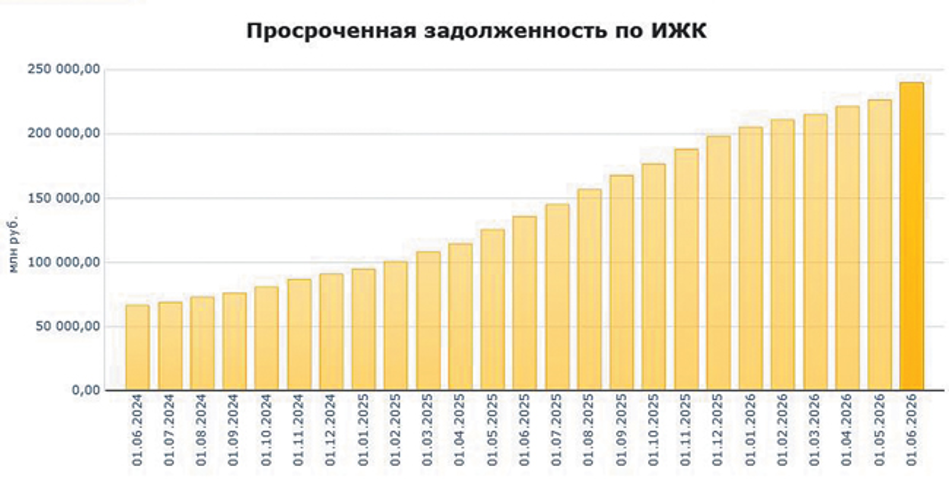
| Overdue mortgage debt |
| RUB mln |
| Dynamics of overdue mortgage debt in Russia. Source: Central Bank |
According to Regina Gordeeva, founder of the BezFiltrov real estate agency, one in four mortgage applications is rejected. As experts note, rejections are largely driven by high borrower indebtedness, poor credit histories and overall debt burdens. With a debt service ratio above 50–60 % (meaning that 50–60 % of a borrower’s or household’s income is used to service loans), securing a mortgage becomes difficult. Bankruptcy also effectively shuts borrowers out of the mortgage market.
‘Approval rates are indeed declining. By spring 2026, overall mortgage approval rates had fallen to around 50 %, down from more than 60 % previously. Since the start of the year, stricter debt burden requirements have been introduced. The ideal borrower is now someone with a flawless credit history and no outstanding loans, which automatically excludes a significant share of potential buyers,’ Yulia Ruzhitskaya added.
Analysts and market participants also point to another trend: a growing number of bank refusals to grant state-backed family mortgages to buyers with children.
‘Servicing such loans generates limited returns for banks. At the same time, further tightening of the state-backed family mortgage programme is expected, likely from October 1. As a result, most banks have little incentive to issue such loans under the current terms. Mortgage demand is now growing solely due to a significant increase in the number of applications,’ concluded Dmitry Proskurin, Commercial Director at Metrium.
Gutnov said banks were rejecting applications more frequently than usual in June, as many borrowers who formally met the programme criteria had unstable incomes or poor credit histories. He expects the spike in demand to persist for another three months after the Finance Ministry extended the current family mortgage terms at least until October 1.
‘However, rejection rates will remain elevated. Banks are not looking to expand their pool of high-risk borrowers, particularly in a challenging economic environment. Market mortgage rates remain prohibitively high,’ he said.
While overall mortgage lending continues to grow, overdue mortgage debt is also rising. According to the Central Bank, overdue mortgage debt approached RUB 240 bln as of June 1. It increased by nearly 6 % month on month and by 76 % year on year, and has risen almost 3.6-fold over the past two years. Although the share of overdue debt remains relatively low at 1.1 % of the total, the continued rise in ‘bad’ mortgage debt is a cause for concern.
The regulator has also acknowledged the trend. ‘In the mortgage segment, the share of non-performing loans rose from 1 % to 1.7 % over the past year, reaching 1.8 % as of April 1, 2026. Although the figure has nearly doubled, it remains low by historical standards,’ the Central Bank said (see Nezavisimaya Gazeta, May 11, 2026).
Amid rising arrears, more unconventional policy ideas have also emerged. The Public Chamber has proposed creating a dedicated state fund to cover rental payments for distressed mortgage borrowers. According to Vladislav Grib, deputy secretary of the body, the fund would be financed by developers participating in mortgage programmes (see Nezavisimaya Gazeta, January 27, 2026).
Unlike the primary housing market, approval rates in the secondary housing market are increasing. According to IRN, citing Tatyana Reshetnikova, Deputy Head of the Mortgage Department at Etazhi, approval rates rose from 59.6 % in June last year to 66.2 % in June 2026. The upward trend has continued into July.
Experts do not expect any meaningful easing in banks’ approach to mortgage approvals. In their view, a significant increase in mortgage approval rates would require a broader easing of economic, geopolitical and other risks in the country, as well as a substantial cut in the key rate, followed by lower mortgage rates, making mortgages more affordable for a larger number of citizens. Given the Central Bank’s still hawkish stance, this appears unlikely this year.
Yaroslav Gutnov does not rule out an increase in demand for standard mortgages in the coming months. Dmitry Proskurin notes that, despite persistently high market mortgage rates, schemes involving the sale of secondary housing to purchase new-build properties remain relevant.
‘Many clients are opting for trade-in schemes. The additional amount to be paid is often relatively small and affordable, particularly under the family mortgage programme,’ he said.
Some experts, however, point to growing constraints on such schemes. With market mortgage rates for secondary housing still high, it has become increasingly difficult for households to buy a new-build home by selling an existing property.
‘The ‘sell a one-bedroom flat and take out a mortgage for a two-bedroom flat’ model has largely stopped working, and it is not only because of high borrowing costs. Even though the key rate has been declining and market mortgage rates for secondary housing have come down from their peaks, the average rate still stands at around 19–20 % per annum. The gap with subsidised programmes is huge: around 6 % under the state-backed programme versus around 20 % on the standard market. At these rates, the monthly payment on the additional borrowing required to bridge the gap between a one-bedroom and a two-bedroom flat effectively wipes out any economic rationale for the upgrade,’ Ruzhitskaya said.
ORIGINAL: NG/Mortgage lending rebounds as overdue debt rises