The number of new businesses registered in the first half of 2026 has fallen to its lowest level in 17 years, according to the analytical service of FinExpertiza audit and consulting network. The key difference from previous downturns is that the decline in new company registrations has now continued for three consecutive years. Moreover, almost twice as many businesses closed in Russia during the six-month period as were opened. At the same time, the automated simplified tax system (ASTS) is becoming increasingly popular among businesses because of the tax relief it offers.
The ASTS is a special tax regime that allows entrepreneurs and organisations to reduce their tax burden and simplify accounting. It was introduced in several regions in July 2022 and rolled out across Russia in 2025. The regime will remain in effect until the end of 2027. Under the system, the Federal Tax Service calculates the tax payable using data from cash registers, bank statements and taxpayers’ online accounts. Its main advantages include exemption from value added tax for businesses with annual revenue of up to RUB 60 mln, as well as exemption from fixed social insurance contributions for sole proprietors (IPs) and from insurance payments covering directors and employees of legal entities. The tax rates under the ASTS are 8% when levied on revenue and 20% when levied on revenue minus expenses. In the latter case, a minimum tax rate of 3% applies.
Interfax reported that more than 400,000 businesses transferred to the special regime between January and June 2026, including 203,200 companies and 203,700 sole proprietors. At the beginning of the year, only 827 legal entities and 158,700 sole proprietors were using it. The combined figure therefore increased 2.6-fold over six months. By mid-July, the number of ASTS participants had reached 433,500, including 192,500 companies and 241,000 sole proprietors.
By sector, the largest group consists of businesses involved in retail and wholesale trade, accounting for about 38.7%. Construction represents approximately 9%, services, including HoReCa, hotels, repairs and personal services, account for around 6%, with transport businesses making up roughly 5%.
Analysts attribute the growing popularity of the ASTS to several factors, with the most important among them being the tax changes introduced in 2026. Under the standard simplified tax system (USN), the revenue threshold for VAT exemption was reduced from RUB 60 mln to RUB 20 mln, increasing the tax burden for some businesses. In such circumstances, the ASTS, which retained the RUB 60 mln VAT-free threshold, became more attractive to companies with annual revenue from RUB 20 mln to RUB 60 mln.
Another trend has also emerged. As interest in the ASTS rises, the number of legal entities is falling while the share of sole proprietors continues to grow. According to Federal Tax Service data, the number of legal entities in the small and medium-sized business sector fell by 5.2% year-on-year in the first half of 2026, while the number of sole proprietors went up by 7.8%. As a result, sole proprietors accounted for 69.4% of all SMEs, compared with 66.6% in mid-2025.
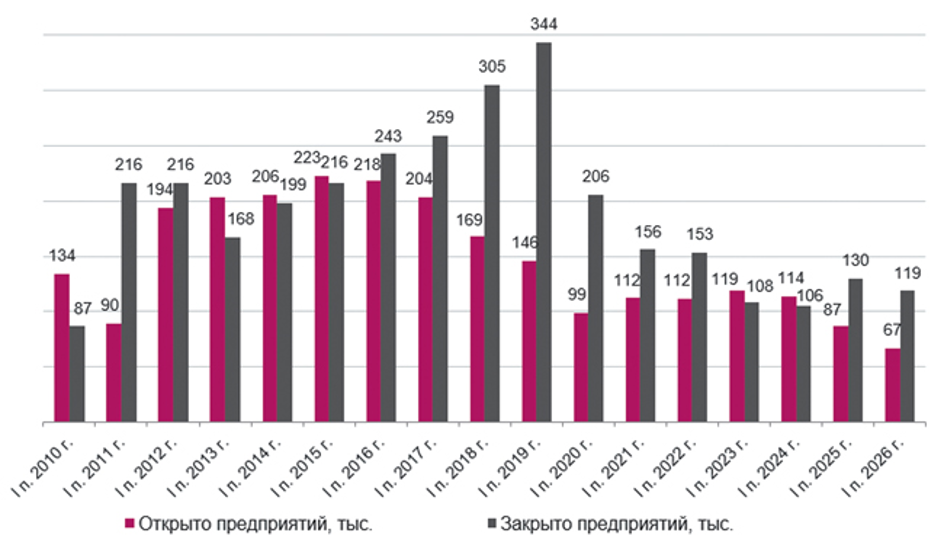
Overall, however, fewer new businesses are being registered. Based on Federal Tax Service data, FinExpertiza calculated that 66,700 commercial facilities were registered in Russia during the first half of 2026, 23.6% fewer than a year earlier. New registrations have now fallen for three consecutive years. The number of businesses opened declined by 4.5% in the first half of 2024 and by further 23.4% in the first half of 2025. Therefore, the number of registrations in the first six months of 2026 has been the lowest since 2010.
Experts believe that the fall in the number of new companies to its lowest level since 2010 points to a continued downturn in business activity.
The last significant decline in business openings was recorded in 2011, but researchers considered that fall to be a one-off decline.
‘The current trend is fundamentally different, as the number of new companies has been declining for the past three years,’ FinExpertiza mentioned.
Over the same period, 118,700 companies ceased their operations. So, the number of business closures was almost 1.8 times the number of new registrations. The total number of active businesses stood at 2.5 million on July 1, down 2.1% from the beginning of the year, as reported by FinExpertiza analysts.
More than 85% of closed businesses were removed from the Unified State Register of Legal Entities through administrative decisions by the tax authorities. A third of all closed companies showed signs of unreliable registration data, including the use of addresses shared by large numbers of companies, nominee directors, nominal founders and other indications of fictitious activity.
Almost 40% of businesses, in other words more than 47,400 facilities, ceased operating under a simplified procedure for removing SMEs from the state register.
‘This mechanism allows owners to close a business voluntarily without undergoing the standard liquidation procedure, provided that the company has no outstanding debts,’ the researchers explained. ‘Legally, however, the termination of operations is recorded not as a liquidation initiated by the owners, but as the removal of the organisation from the register by decision of the registration authority.’
Only 17,000 companies, or 14.4%, were liquidated at their owners’ initiative. This included 2,500 organisations making up 2.1% of all closures that went through bankruptcy proceedings. One in ten businesses was removed from the register as inactive.
According to FinExpertiza, the structure of business closures also changed significantly in the first half of 2026. ‘More entrepreneurs are choosing to cease operations through the simplified procedure available to SMEs,’ the company said. ‘The number of businesses closed in such a way more than tripled, from 15,000 to 47,400. This mechanism accounted for 40% of all commercial company closures during the six-month period.
Meanwhile, the tax authorities’ contribution to the total number of closures declined as the number of simplified closures increased, according to FinExpertiza president Elena Trubnikova.
The number of companies removed from the register because of unreliable information fell by 32%, from 59,400 to 40,400, while the number of inactive companies dropped by 43%, from 21,500 to 12,200,’ she said. ‘For comparison, a year earlier almost half of all liquidated companies had been removed from the register because they had provided unreliable information or showed signs of being inactive legal entities.’
| 1H 2010 |
| 1H 2011 |
| 1H 2012 |
| 1H 2013 |
| 1H 2014 |
| 1H 2015 |
| 1H 2016 |
| 1H 2017 |
| 1H 2018 |
| 1 п. 2019 г. |
| 1H 2020 |
| 1H 2021 |
| 1H 2022 |
| 1H 2023 |
| 1H 2024 |
| 1H. 2025 |
| 1H 2026 |
| Businesses opened, thousands |
| Businesses closed, thousands |
| Opening and closure of commercial facilities in Russia. Source: FinExpertiza. |
‘In the SME sector, not every legal entity registered with the tax authorities represents a genuine business,’ said Oleg Nikolayev, a member of the general council of Delovaya Rossiya. ‘The Federal Tax Service has been clearing the register for several years, removing companies that show signs of fictitious activity. However, even after subtracting the 34% of closed companies with unreliable information and, hypothetically, the 10.3% of abandoned companies that neither submit reports nor conduct transactions through their accounts, the figure remains high. There were 66,100 genuine businesses liquidated as opposed to 66,700 new registrations, which, anyway, is a sign of stagnation and even a decline.’
‘The decline in new business projects was the reasonable outcome of a few factors contributing to the situation simultaneously. With the key rate high and the economic outlook uncertain, borrowing is no longer a development tool for most small and medium-sized companies. As a result, entrepreneurs are postponing new projects and investment in business expansion,’ Valery Babushkin, co-founder of Cyberbird Fintech Group, explains.
Many indicators point to worsening current conditions for Russian businesses. Analysts at the National Credit Ratings (NCR) agency previously reported that, as of May 1, 2026, one in six of the 600,000 SMEs with outstanding loans was in arrears. The total volume of overdue SME debt reached RUB 623.8 bln, while its share of the overall loan portfolio had risen to 4.1% since the beginning of 2026. According to the agency, the sharpest deterioration in debt quality has occurred among microbusinesses. The proportion of borrowers in this category that entered default during the previous 12 months rose from 8.1% to 9.9%. Among small businesses, the figure soared from 3.7% to 5.9%. The default rate among medium-sized businesses was only slightly lower than among small businesses.
Experts also pointed out that businesses in some sectors were taking out loans because of rising overdue receivables. This was particularly common among wholesale and retail companies and manufacturers. At the end of March 2026, total overdue SME receivables were 1.3 times higher than a year earlier and accounted for 6.8% of all receivables. To make it even worse, rising arrears create cash-flow gaps, forcing SMEs to take out new loans to service existing debts, as emphasized by analysts (see Nezavisimaya Gazeta, July 14, 2026).
Of the businesses surveyed by the Bank of Russia in July, 44% said they expected profits to decline in 2026. Around 30% expected no change, while approximately 25% forecast an increase. More than half of those anticipating growth expected it to be modest, at no more than 5%, according to the Central Bank’s report on regional economies. The main contributors to constraining profit growth were increasing costs for raw materials and components, higher logistics expenses and weaker demand.
According to Maxim Chaika, head of Neva-Pravo law firm, there are several simultaneous contributors to the decline in new companies.
‘The most significant are the rising tax burden, the high cost of borrowing and the general caution shown by entrepreneurs when launching new projects,’ he said. ‘Changes to tax legislation that took effect on January 1, 2026, have become a serious challenge for small and medium-sized businesses. Many entrepreneurs who previously operated under special tax regimes were unprepared for the transition to paying VAT and the associated increase in administrative and financial costs. Interest rates also remain high, making it considerably more expensive to launch and develop a business.’
Viktor Vernov, co-founder of fintech platform ROWI, believes that expensive borrowing was the key challenge for large companies, while SMEs faced a different situation.
Loans have never been particularly accessible to this segment, while the margin on individual transactions is traditionally higher, so SMEs are less sensitive to borrowing costs,’ he said. ‘The decline in consumer demand and households’ shift towards saving proved far more painful for small and medium-sized businesses. The high key rate also aggravated the situation, as people have preferred to place their money in deposits rather than spend it.’
In 2026 Russian businesses have suffered from pressure from the external economic environment, the budget deficit, which was weakening consumer demand, a sweeping tax reform that had reduced income and high banking rates. These factors primarily affect small businesses with no substantial financial cushion to withstand economic downturns, Over 75% of companies report that they are not making a profit. More than 209,000 small businesses closed in the first quarter of 2026,’ Marina Pavlova, founder of the Yunona legal consulting agency, said