Russian officials regularly cite an unemployment rate of 2%, equivalent to 1.7 million people who, according to surveys, are looking for but unable to find permanent work. Based on these official statistics, Central Bank officials, among others, justify policies that suppress economic activity in the country. In reality, however, actual unemployment in Russia is several times higher for a number of reasons, including unpaid leave, reduced working hours and part-time employment. More than 4 million Russians were placed on unpaid leave last year
The current situation in Russia’s labour market is difficult, Minister of Economic Development Maxim Reshetnikov said on Thursday. Details of these difficulties are outlined in a new report by the Centre for Macroeconomic Analysis and Short-Term Forecasting (CMASF). ‘In the third quarter of last year, the number of people granted unpaid leave at their own written request reached its highest level since 2017, exceeding 4 million,’ said CMASF lead expert Ekaterina Sabelnikova
By sector, the most acute problems with underemployment are observed in machinery manufacturing, particularly motor vehicle production, metallurgy, the public sector, retail trade and several service industries, including hospitality.
The number of employees working reduced hours at the initiative of employers rose sharply in the second half of 2025. Growth in this form of hidden unemployment was driven primarily by the automotive industry, where more than 21% of employees worked reduced hours at the employer’s initiative
Part-time employment arrangements agreed between employers and employees are most common in education, which accounted for about 22% of all workers in this category at the end of 2025. Healthcare and social services represented a further 14% of Russians working part-time under such agreements.
Data from recruitment agencies indicate that the period of genuinely low unemployment in Russia ended in 2024. In 2025, labour market tightness, measured as the ratio of CVs to vacancies, began to rise rapidly and reached its highest level in eight years in March 2026. Recently, there have been an average of 10 to 11 job applications for every vacancy in Russia. Such a picture points to the return of an employer-driven labour market, which is inconsistent with official claims of record-low unemployment.
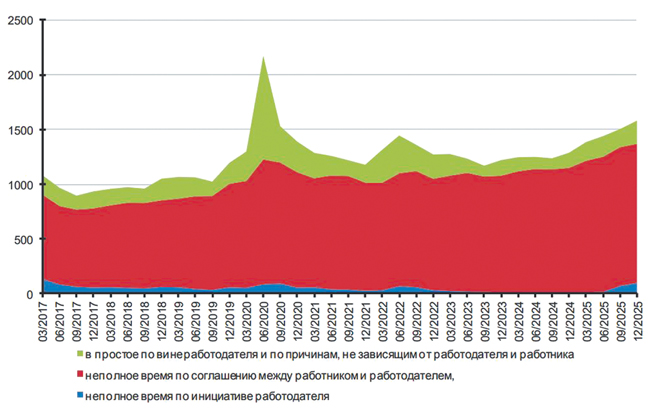
Number of employees working reduced hours by category, thousand persons. Source: CMASF
The scale of hidden unemployment in Russia is gradually increasing and differs significantly from the official picture. To measure hidden unemployment, economists often use the concept of ‘composite unemployment’. In addition to formally unemployed individuals, defined as those seeking work and ready to start immediately, this measure includes people working reduced hours or on unpaid leave. According to such calculations, Russia’s composite unemployment rate may currently exceed 3% of the labour force.
‘When we look at unemployment figures, the rate remains at a historic low of 2.2%… On the one hand, this creates an extremely difficult situation for employers because there are labour shortages in many areas. On the other hand, I do not believe this figure fully reflects the complexity of the situation,’ Reshetnikov explained on Thursday. He also noted that the Central Bank relies on the official low unemployment rate when justifying its policy of exceptionally high interest rates
The minister also pointed to structural changes taking place in the labour market, linked to the growth of digital platforms and platform-based employment.
The impact of these developments is examined in a study by Elena Uzyakova, Sergei Milyakin and Nina Skubachevskaya of the Institute of Economic Forecasting of the Russian Academy of Sciences. According to their calculations, ‘the stimulus from the development of sectors using platform services generates an additional 1.5% increase in gross output and a 3% increase in employment relative to the total level’. Given that around 5% of all employed people work through platforms, the overall effect of platform-based activity is estimated at 8% of total employment.
The largest contributions to employment growth came from wholesale and retail trade, manufacturing, and information and communications. Sectors with relatively low labour productivity accounted for a significant share of employment growth, which analysts say is far from the optimal form of labour reallocation needed to overcome Russia’s labour resource constraints.
ORIGINAL: NG/More Than 4 Million Russians Were Placed on Unpaid Leave