Near-zero GDP growth, industrial stagnation, an investment collapse of more than 14%, annual inflation approaching 6%, and sectoral and regional imbalances, including fuel supply disruptions on the domestic market. These are the conditions under which the St Petersburg International Economic Forum (SPIEF) is taking place. The forum has become a platform for repeating familiar talking points that have already been voiced countless times, despite the pomp and expense of the event. So far, its main news story has been the physical absence of a key speaker rather than any breakthrough decisions, reform announcements or major contracts capable of delivering tangible economic benefits beyond publicity and helping struggling sectors emerge from crisis
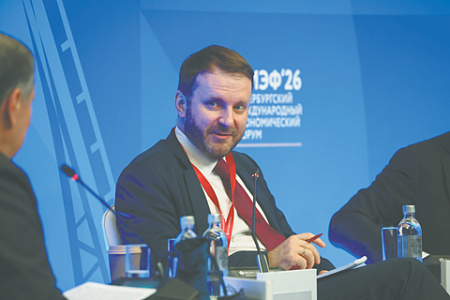
The Western economy is under strain. Meanwhile, China, India and African economies continue to grow. These shifts are fundamental in nature. Russia must move away from a sanctions-defensive model, stop waiting for restrictions to be lifted and make greater use of emerging opportunities. Reforms and structural changes are needed. A growth model is not something carved in stone. A new investment cycle is required. Those were the key themes advanced by Maxim Oreshkin, Deputy Chief of Staff of the Presidential Executive Office, during the second day of SPIEF at the forum’s most anticipated session, entitled ‘‘How to Return to a Trajectory of Sustainable Economic Growth amid Global Uncertainty.
Russia’s external debt amounts to just 10% of GDP. The country will soon repay it entirely, meaning it no longer depends on external financial infrastructure. Real incomes have increased by more than 24% over the past three years, while the Russian economy is already demonstrating ‘fairly stable growth’ of around 10% over the same period. Tax policy has not become excessive. The country is repeatedly hit by shocks but has developed an antidote. Fiscal and monetary policy are closely intertwined. Fiscal policy aims to keep inflation within target and ensure interest rates remain compatible with lending activity. These were among the points made by Finance Minister Anton Siluanov during the same session.
The main constraints on Russia’s economic growth are the labour market and low unemployment, to which the Central Bank is responding. The contours of a new economic model are already becoming visible: a stronger rouble and higher interest rates. The government is implementing a programme of structural reforms, including measures to improve business conditions and formalise economic activity. Investment remains an urgent issue. However, productivity growth depends not only on investment. Lean manufacturing practices have not yet been fully adopted, digitalisation remains incomplete and artificial intelligence offers considerable untapped potential. More important than any growth model are institutions, including property rights and investor protections. Communication with the Central Bank is constant, although there is a desire for greater room to ease monetary policy. Those, in brief, were the main arguments presented by Minister of Economic Development Maxim Reshetnikov.
Yet anyone who follows economic news closely has heard these points repeatedly over recent months, if not years. Whether such familiar messages justified an event of this scale is a rhetorical question
In the absence of major policy announcements, attention has instead shifted to analysing seating arrangements on stage or comparing different versions of the forum programme
Siluanov, representing the fiscal bloc, was seated between the former and current economic development ministers, Oreshkin and Reshetnikov. Whether that positioning reflected any real balance of influence remains open to debate, even with Central Bank Governor Elvira Nabiullina absent from the discussion after initially appearing in the programme before later withdrawing due to illness, according to the official explanation
The fact that one of the forum’s main stories has become the absence of a speaker rather than any significant statement, reform initiative or landmark industry agreement speaks volumes about the significance of the discussions that did take place
State Duma Budget Committee Chairman Andrei Makarov, Deputy Chief of Staff of the Presidential Executive Office Maxim Oreshkin, Finance Minister Anton Siluanov and Minister of Economic Development Maxim Reshetnikov discussed economic growth in the absence of Central Bank Governor Elvira Nabiullina. Photo by Roscongress Foundation
Expectations for the forum were high, perhaps unrealistically so, helped in no small part by the organisers themselves. Prior to the event, they released a widely discussed report criticising current monetary policy and calling for a reassessment of inflation measurement by excluding the impact of the special military operation. (see Nezavisimaya Gazeta, May 26, 2026.)
It was a striking intervention. The report sharpened the debate over the influence on the Russian economy not only of sanctions and external shocks but also of the military campaign itself, which Russian industrial companies increasingly cite as a factor affecting their investment plans. Yet it remains questionable whether such issues fall within the remit of economic ministers or even the Central Bank governor
Despite occasional attempts by participants to inject humour into the proceedings, the tone of the forum’s flagship session conveyed fatigue more than urgency. Yet the economic conditions facing Russia this year leave little room for complacency or delay. What is needed is a rapid and rigorous assessment of economic policy measures, their effectiveness and consequences, better coordination among government agencies and a candid review of policy outcomes
On June 3, the Ministry of Economic Development published updated economic data. Annual inflation stood at 5.8% in January-April. During the same period, GDP grew by just 0.2% year-on-year. Industrial production was effectively stagnant, rising only 0.7%, while construction activity contracted by roughly 8%.
Economists have already begun warning of the risk of stagflation: economic stagnation or decline combined with accelerating price growth
Sectoral imbalances and underperformance are also creating problems for regional budgets, a theme that emerged during another SPIEF session attended by Siluanov, titled ‘Regions in the Face of Global Challenges’.
‘The situation varies from region to region, especially in those heavily dependent on sectors such as coal mining, metallurgy and timber processing,’ the minister said, effectively identifying some of the most troubled industries in the current economic environment.
Most strikingly, Ministry of Economic Development data show that fixed capital investment fell by more than 14% year-on-year in the first quarter
‘We rely on the numbers,’ Reshetnikov stressed during the forum. Yet he immediately added that the ministry treats those figures ‘cautiously’, acknowledging an apparent discrepancy between GDP dynamics and the scale of the investment collapse.
In other words, uncertainty no longer exists only between different branches of government with competing priorities. It now appears within a single ministry regarding the very statistics on which it bases its calculations, forecasts and recommendations for fiscal policy, which in turn influence monetary policy.
A repetition of familiar talking points, ambiguity about the causes of current economic developments, inconsistencies in the data, a lack of open and substantive discussion of policy measures and their consequences, and a deep fatigue surrounding debates about a new economic growth model, discussions that have persisted for decades: this is not what the country’s premier economic forum should be. Final conclusions will have to wait until the SPIEF plenary session on June 5.
ORIGINAL: NG/Economic Forum of Platitudes Amid an Investment Collapse