Russia’s coal industry remains mired in a prolonged crisis, with companies reporting annual losses running into hundreds of billions of roubles. The government had previously hoped to overcome the crisis in 2026. The Energy Ministry now warns that losses are unlikely to be eliminated completely even in 2027, which would mark the sector’s fourth consecutive year in the red. Coal producers and regional authorities are trying to adapt and are putting forward unconventional ideas. An earlier proposal involved producing ‘crypto-coal’. Now there is a proposal to locate data centres in disused open-pit coal mines
Russian Energy Week is taking place amid intense pressure, with Ukrainian drone attacks on Russian oil refineries continuing and authorities dealing with the aftermath of strikes on data centres. These events inevitably shape the agenda
Yet behind these immediate concerns lies the need to address a more entrenched problem: Russia’s coal sector has been in crisis for several years
If coal producers can increase shipments, the sector’s losses could narrow to RUB 100 bln in 2027, compared with the RUB 300–310 bln forecast for 2026. Deputy Energy Minister Dmitry Islamov made the announcement on October 15 on the sidelines of Russian Energy Week, adding that ‘we probably won’t be able to eliminate losses completely’
Thus, 2027 could become the fourth year of Russia’s coal crisis. The industry has suffered substantial financial losses since 2024, when its aggregate financial result (profits less losses) turned negative. According to Russia’s federal statistics service, Rosstat, the sector recorded a net loss of almost RUB 113 bln that year.
In 2025, coal producers’ net losses reached RUB 408 bln. For January–July 2026, Rosstat estimates net losses in coal mining at RUB 178 bln
The proportion of loss-making coal companies is expected to remain at 70% in 2026, according to materials Islamov presented at Russian Energy Week. In 2024, the figure was lower, at around 53%.
Islamov identified three factors behind the industry’s losses: global coal prices, shipment volumes and exchange-rate movements.
‘Price trends are currently positive. The exchange rate has risen slightly but has yet to return to its pre-crisis level. As for shipments, the logic is simple: prices have risen, and the more coal the industry can ship, the faster it can reduce losses and improve its financial performance,’ the deputy minister said
Industry analysts have previously described the negative pressures in starker terms, pointing above all to stagnant domestic demand amid exceptionally tight monetary policy and the government’s policy of reducing coal’s share of Russia’s electricity generation.
Exports were expected to offset these difficulties. Instead, weak international market conditions, sanctions and domestic logistics barriers have worked against Russian coal producers. Companies have faced not only falling world coal prices but also limited domestic infrastructure capacity, with the cost of using that infrastructure becoming an increasingly heavy financial burden.
‘For a long time, when coal market prices were weak, logistics companies, particularly port operators and shipping companies, held down their charges in the hope of a recovery. But the cumulative effect of deferred price increases is now being felt: port handling charges and freight rates have risen, while coal prices have not recovered enough to produce a comparable improvement in profitability,’ Maria Nikitina, founder of the N.Trans LAB project and an expert at the Institute for Growth Economics, told Nezavisimaya Gazeta.
‘Added to this are capacity shortages on Russia’s Eastern railway network, restrictions on exports through the Baltic and the loss of access to some southern routes. As a result, logistics costs on certain routes absorb as much as 50–60% of coal’s final value. The industry is now facing the consequences of logistics providers’ accumulated expectations of higher prices, while coal itself continues to yield low returns,’ Nikitina said.
The government has previously introduced systemic anti-crisis measures, including tax relief and efforts to remove bottlenecks in logistics infrastructure, with particular attention to railway capacity, wagon leasing costs and port handling charges. There has also been targeted financial assistance for individual companies selected by the Ministry of Finance. Together, these measures were presented as something close to a guarantee that the coal crisis would end in 2026 (see Nezavisimaya Gazeta, July 1, 2025).
‘Do you think the crisis will be over next year?’ a TASS journalist asked Deputy Energy Minister Dmitry Islamov in the summer of 2025. ‘We are confident it will. We already expect production indicators to grow next year,’ he replied. But the timetable now appears to have shifted.
Against this background, some other statements by government officials may seem rather strange. For example, at a meeting of the State Council’s Energy Commission on October 15, Alexei Chekunkov, Minister for the Development of the Russian Far East and Arctic, said that the Far East had 25.8 billion tonnes of explored coal reserves. Almost 75% of this amount, he said, belonged to the ‘unallocated reserve fund’: resources ‘not yet brought into economic use but capable of providing a reliable foundation for a growing economy’.
Yet the Russian economy is clearly not growing fast enough to overcome a coal crisis that has lasted for three consecutive years, even without drawing on that ‘unallocated reserve fund’. The problem is not a shortage of raw materials but, first, a lack of demand for coal and, second, obstacles to delivering it to customers.
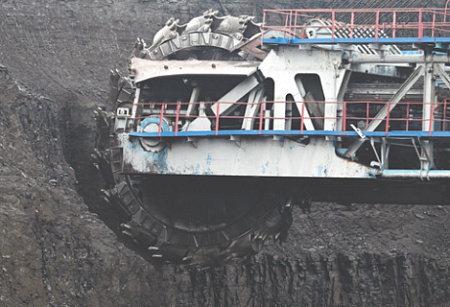
The industry’s crisis is giving rise to unconventional ideas in coal-producing regions. Last year, officials in Kemerovo Region examined the economic feasibility of building cryptocurrency mining farms at coal companies’ sites. The Kuzbass authorities concluded that a power station combined with a mining farm near an open-pit coal mine could pay for itself in roughly four years. Cooperation between the cryptocurrency industry and the coal sector was seen as one way to slow the decline in coal production (see Nezavisimaya Gazeta, August 18, 2025).
Kemerovo Region Governor Ilya Seredyuk also proposed at Russian Energy Week that data centres be located in disused open-pit coal mines
‘When coal producers finish working a mine, they have to spend considerable sums on land reclamation and site maintenance. Instead, they could simply build a multi-storey monolithic structure there, extending downwards rather than upwards,’ he said.
‘Roughly speaking, it’s a huge pit, 300 metres deep. If you put all the infrastructure of a data centre, computing centre or cryptocurrency mining facility inside it, the capital costs of creating such data centres would be minimal,’ the governor explained. ‘You put a roof over it, landscape the area and create a park on top: the data centre is covered.’
According to the governor, placing computing infrastructure in disused mines would also allow IT companies themselves to cut costs, particularly those associated with cooling equipment.
Furthermore, following recent strikes on data centre infrastructure, the proposal has gained relevance as a means of improving the physical protection and security of such facilities
Nikitina told Nezavisimaya Gazeta that the idea was attractive because coal could be used to generate electricity locally, eliminating the need to transport it thousands of kilometres.
She cautioned, however, that such projects would involve risks: converting underground sites would still require investment, and there was no guarantee that the resulting data centres would be competitive.
Seredyuk identified coal-fired power generation using supercritical steam technology as another promising opportunity for Kuzbass.
‘This would enable Siberia and Kuzbass to become a major hub for data centres, which we envisage as an industrial ecosystem. It would bring together power generation, computing infrastructure, artificial intelligence, manufacturing, engineering and workforce training,’ the governor said. ‘With the volume of coal we propose to process, this system could create 40,000 alternative jobs.’ These would be well-paid jobs
It is worth asking, however, whether the very idea of creating new, well-paid jobs might now strike some observers as almost as extravagant as producing ‘crypto-coal’ or moving data centres into disused mines. After all, Russia’s financial authorities increasingly portray low unemployment and rising wages as problems for the economy rather than achievements