Russian authorities have pledged to revive the country’s investment cycle. For now, however, capital investment continues to decline. External risks and concerns over property rights are the main factors weighing on Russia’s investment climate, bankers told the International Banking Forum in St Petersburg. As a result, businesses are directing investment away from their core operations and into other projects, fearing that their assets could be seized. Large business owners say they are willing to invest, including in protecting infrastructure facilities from attacks, but want the government to set clear standards for infrastructure protection
Russian authorities are seeking to launch a new investment cycle to encourage businesses to invest across a range of sectors
‘Our task now is to give businesses more opportunities to invest in manufacturing, agriculture, services and housing construction,’ said President Vladimir Putin in late August. He also stated that many large-scale projects had completed their main investment phases last year, contributing to a slowdown in overall capital investment.
Large business owners have stopped investing in their core operations and are diverting capital elsewhere, as VTB Bank CEO Andrei Kostin stated on Thursday. He attributed the shift to fears among business owners that their assets could be ‘taken away’.
‘I think these fears are exaggerated, but they do exist. We need to look at the laws being adopted and some of the decisions being made. Business needs to be protected, as it is a rather sensitive creature,’ Kostin said.
Such concerns are weighing on Russia’s investment climate. Kostin cited attacks on Russian infrastructure facilities as another factor deterring investment.
He added that investment is also affected by borrowing costs and access to government support. According to the CEO, the Russian economy has relied heavily on low-cost lending and subsidies to attract investment.
Fixed capital investment fell 6.6% YoY in 2026 Q2, following a 14.3% decline in Q1. Overall, in 2026 H1, investment dropped by almost 10% YoY (see Nezavisimaya Gazeta, September 13, 2026).
Despite the current downturn, official capital investment figures could improve towards the end of the year as facilities damaged by Ukrainian drone attacks are rebuilt. The Bank of Russia explicitly cited this as a possibility in its ‘Comments on the Medium-Term Forecast’ (see Nezavisimaya Gazeta, August 30, 2026).
Businesses say they are prepared to invest in protection measures against terrorist attacks but want the government to allow such spending to be deducted for tax purposes, as Alexander Shokhin, President of the Russian Union of Industrialists and Entrepreneurs (RSPP), said on Thursday. He added that the Ministry of Finance was considering the organisation’s proposals.
‘We have quite a few proposals. They include allowing spending on protection against drone and missile attacks to be treated as non-operating expenses for tax purposes, at least in part, for example, 50%,’ Shokhin said.
‘Second, we need to find a way to account not only for companies’ direct costs, but also for spending on active and passive protection systems that are purchased and transferred to the Ministry of Defence and other security agencies. These are costs too. They should not simply be treated as charitable contributions and should also be recognised for tax purposes. Third, there should be insurance mechanisms. Clearly, market-based insurance solutions are not viable here because the risks are high and, as we know, Russia has only one reinsurance company,’ Shokhin said, outlining possible amendments to the Tax Code in response to new requirements for protecting facilities
According to Shokhin, Russia needs uniform standards for protecting industrial facilities from drone and missile attacks, with requirements regularly updated as warfare technologies evolve
‘Things are changing extremely quickly. At the beginning of this year, no one imagined attacks on such a massive scale. Protective netting and some kinetic anti-drone systems were seen as sufficient protective measures. That could have served as a standard, but it is already outdated, to put it mildly, both literally and figuratively. What we need is a mechanism such as Manturov’s subcommittee that can continually update these requirements,’ Shokhin said, referring to the subcommittee for ensuring the uninterrupted operation of certain sectors of the economy chaired by First Deputy Prime Minister Denis Manturov.
Shokhin said the requirements for such a standard were being discussed by the subcommittee, but no standard had yet been adopted.
The RSPP President noted that a uniform approach to protection against aerial attacks was also necessary in the context of implementing the presidential decree on critical infrastructure security. The decree allows company assets to be placed under temporary external management if a business fails to provide adequate protection against drone attacks for critical infrastructure facilities (see Nezavisimaya Gazeta, August 25, 2026).
‘When it comes to placing assets under external management, it is again unclear what constitutes adequate protection or the timely restoration of a facility. These decisions are essentially made on a case-by-case basis, as there can be no fixed criteria. The main thing is to ensure that this lack of transparency is not abused,’ Shokhin said
Nevertheless, Shokhin stressed that businesses have a clear interest in ensuring effective protection.
‘But they cannot protect everything on their own. This also requires closer and more effective coordination with the security agencies and with local authorities in the regions along the flight paths,’ the RSPP President said.
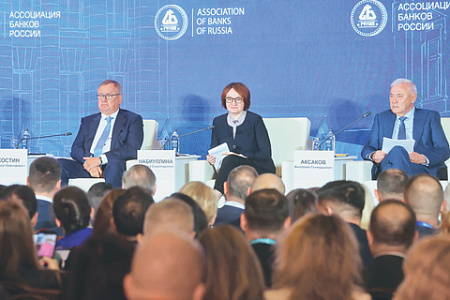
Speaking at the International Banking Forum on Thursday, Governor of the Bank of Russia Elvira Nabiullina said the regulator was prepared to offer preferential regulatory treatment for bank loans used to protect critical infrastructure.
‘Many of your borrowers now want to invest in protecting their infrastructure, including critical infrastructure facilities, and are seeking loans for this purpose. We are prepared to accommodate this from a regulatory perspective. We are ready to apply lower risk weights and waive macroprudential buffer requirements for such loans,’ Nabiullina said.
The Chairman of the State Duma Financial Market Committee and the Council of the Association of Russian Banks Anatoly Aksakov said at the same forum that next week, the State Duma was going to consider specific proposals to restructure loans for businesses affected by attacks. According to Aksakov, overdue corporate debt has risen by 4%, with arrears growing particularly rapidly among small and medium-sized businesses
‘The deterioration in borrowers’ loan portfolios is linked to external attacks on infrastructure facilities. We are developing measures to ease the pressure on affected businesses,’ Aksakov said. He added that these include loan restructuring for marketplace sellers and agricultural businesses affected by attacks, and that specific proposals will be considered next week.
According to Vladimir Chernov, an analyst at Freedom Global, a rapid improvement in the investment climate remains unlikely.
‘Growth in corporate lending does not in itself mean that businesses are launching more new projects. The Bank of Russia did report an acceleration in corporate lending in the spring and the second quarter, but attributed this partly to earlier interest rate cuts. By June, however, growth had already slowed down somewhat,’ Chernov said.
He believes that businesses are facing a range of unfavorable factors at once.
‘These include high borrowing costs, risks to infrastructure from drone attacks, additional spending on protection and uncertainty over the rules of the game. Tax pressures have now been added to the mix. Businesses have less cash available for new projects. Another problem is that yet another change in tax policy reinforces the sense that the rules are unpredictable, which is a major risk for long-term investment,’ Chernov said.
Predictability is crucial to the investment climate. ‘Investors need to understand how they will recoup their investment over three, five, 10 or 20 years. How can we talk about long-term investment when it is difficult to plan even six months ahead?’ said Oleg Nikolayev, an expert at the Stolypin Institute for Growth Economics