Wage arrears in Russia have risen sharply, almost doubling year-on-year. Until recently, overdue wages accumulated primarily because companies lacked their own financial resources. Now, however, unpaid wages attributable to the budget system are growing rapidly as well: overdue salary obligations linked to public-sector funding have increased almost 4,000-fold compared with a year earlier. The breakdown has occurred at the municipal budget level. According to Rosstat, only 19,000 workers have officially been affected by wage arrears, a relatively small number. Yet sociological surveys are already identifying a broader deterioration in household finances.
At the end of April, total wage arrears in Russia approached RUB 3 bln. The figure was up 35% from the end of March and 94% higher than a year earlier.
More than half of all unpaid wages, or 55% of the total, accumulated during the first four months of this year. A further third of the debt originated in 2025, while around 11% dates back to 2024.
A substantial portion of overdue wages, roughly RUB 2.1 bln or 73% of the total, resulted from companies lacking sufficient own funds. This category of debt increased by 41% year-on-year.
However, wage arrears linked to failures of the budget system are now growing at a much faster pace. Such arrears currently amount to around RUB 800 mln, up 3,600-fold from the same period last year. Almost all of this overdue debt, approximately RUB 700 mln, originated at the municipal budget level, representing an increase of more than 3,200 times
By sector, Rosstat found the largest number of affected workers in electricity, gas, steam supply and air-conditioning services, which accounted for 42% of all employees experiencing wage arrears. Construction followed with 23%, while manufacturing ranked third with 20%.
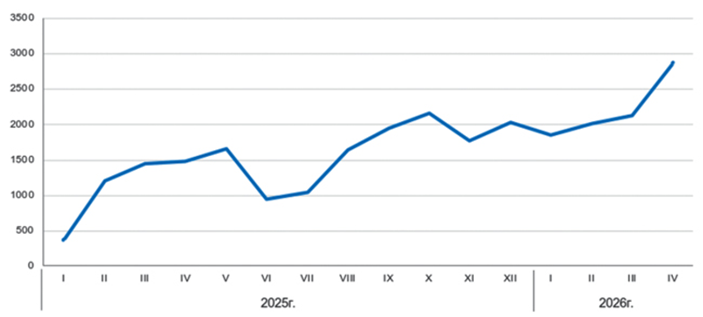
| Dynamics of overdue wage arrears at the end of the month, in RUB mln. Source: Rosstat | |
| 2025 | 2026 |
According to statistical data, there are currently 19,000 workers in the country who are experiencing salary delays – this is twice as many as at the end of March, and approximately three times as many as a year ago. ‘The share of employees with overdue wage claims amounted to less than 1% at the end of April,’ Rosstat said.
At first glance, this appears to be a minor problem. However, Rosstat’s data do not cover all organisations. Small businesses are entirely excluded from these statistical surveys.
Yet it is precisely small businesses, lacking both political influence and often a long-term financial cushion, that tend to be the first casualties during periods of economic stress. This is particularly relevant during the current economic ‘cooling’, when payment delays originating with state contractors and large corporations ultimately cascade down to small businesses. In effect, smaller firms are being deprived of resources needed both for investment and for the timely payment of wages.
For larger market participants, small businesses increasingly serve as a buffer absorbing their financial difficulties and broader economic inefficiencies. When borrowing at elevated interest rates becomes prohibitively expensive, companies seek to shift costs elsewhere.
‘One could say that small businesses are effectively financing key sectors of the economy and large corporations,’ said Ellina Nikolaeva, chair of the public procurement committee at Bashkortostan’s branch of Opora Russia. ‘Small and medium-sized enterprises are not always willing to go to court because they risk losing future contracts,’ Alexander Shokhin, head of the Russian Union of Industrialists and Entrepreneurs and incoming business ombudsman, has also noted. This context is important when interpreting Rosstat’s incomplete data.
More significantly, sociological surveys point to a broader deterioration in living standards that clearly extends beyond the 1% of workers officially affected by wage arrears. Unpaid wages represent only one of the most severe manifestations of financial distress; other problems are becoming increasingly common.
According to data published on May 28 by the Public Opinion Foundation (FOM), the share of Russians reporting a deterioration in their financial situation over the previous two to three months has continued to rise.
As of May 17, 28% of respondents reported worsening finances. The survey covered 1,500 adults across 51 Russian regions through face-to-face interviews conducted at respondents’ homes. At the beginning of 2026, the figure stood at 24%; a year earlier it was 22%.
Moreover, according to FOM, the proportion of Russians reporting a deterioration in their financial circumstances has now reached its highest level in roughly four years. The last time the indicator reached 28% was in 2022.
A range of negative factors is now affecting household finances. Even at the peak of wage growth, higher pay was far from universal. Some industries, by contrast, experienced production stoppages and workforce reductions despite the widely discussed labour shortage.
At the same time, borrowing costs, pushed to prohibitive levels following the Central Bank’s increases in the key rate, have made major purchases increasingly difficult. Russia’s vehicle fleet continues to age, while household appliances and consumer electronics purchased in earlier years increasingly require replacement or repair.
Meanwhile, prices for many goods and services continue to rise sharply despite the Central Bank’s anti-inflation measures, consuming an ever larger share of household budgets. This trend is reflected in households’ assessments of both observed and expected inflation (see Nezavisimaya Gazeta, May 20, 2026).
Such perceptions diverge significantly from official inflation figures and forecasts produced by the government and the Central Bank. However, they correspond closely with the faster-than-inflation growth of regulated tariffs charged by natural monopolies, particularly utility prices.
ORIGINAL:NG/Budget System’s Wage Arrears Surge Thousands-Fold