Darya Garmonenko
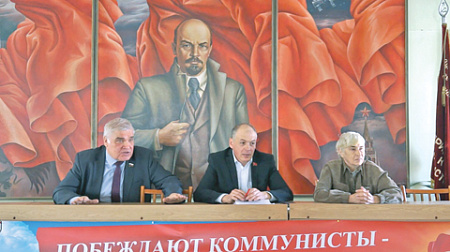
Activists from the Communist Party of the Russian Federation (CPRF) are facing what appears to be politically motivated pressure ahead of elections in at least three Russian regions. While the entire party branch in Altai Territory is under attack, individual party members in Omsk and Orenburg regions are now being labelled extremists. Authorities are invoking Article 20.3 of the Administrative Code concerning the online display of banned symbols. The charge carries a one-year ban on participation in elections and effectively places individuals in the category of non-systemic opposition figures. At the same time as the State Duma elections, these regions are also holding elections to regional legislative assemblies. It appears that efforts to minimise CPRF representation in government structures will be particularly apparent at the regional level.
In Altai Territory, communists are trying to determine the fate of current and former comrades detained in connection with a criminal case involving alleged fraud linked to the salaries of assistants to regional assembly deputies.
The investigation has been ongoing for six months. Although several detentions have taken place, no party member has yet been formally taken into custody.
This suggests at minimum an attempt to exert informational pressure on the Altai branch of the CPRF and possibly an effort to disrupt its work during a major election year. The criminal case periodically intensifies and then slows down again. However, according to the first secretary of the Altai regional committee, Maria Prusakova, both regional committee secretary Vitaly Buldakov and former chief accountant Natalya Chistokletova have now been detained. Prusakova has appealed to Chairman of the Investigative Committee Alexander Bastrykin, Prosecutor General Alexander Gutsan and Director of the Federal Security Service Alexander Bortnikov to place the investigation under their personal supervision. In her view, the investigator handling the case has taken an openly biased position. According to her, investigators have even stated that they intend to ‘imprison all communists’.
In November 2025, CPRF regional assembly deputy Lyudmila Klyushnikova and her assistant Svetlana Kerber were arrested in connection with the alleged fraud case. In February 2026, regional assembly deputies Andrei Chernobai and Yuri Kropotin were detained, followed in April by Anna Yartseva, an assistant to regional deputy Igor Galkin.
Meanwhile, the Kuibyshevsky District Court in Omsk fined two senior regional CPRF officials: Ivan Fedin, second secretary of the Omsk regional committee and assistant to a regional assembly deputy, and regional assembly deputy Vladimir Vinnichenko, the party’s secretary for ideology. They are now barred from participating in any elections for one year after being found guilty under Article 20.3 of the Administrative Code, concerning the ‘propaganda or public display of Nazi symbols or symbols of extremist organisations’. The case relates to old internet posts that used the logo of a now-banned foreign social network in an explicitly negative context.
Similar Article 20.3 cases in Orenburg Region have resulted in election bans for regional assembly deputy Nurlan Munzhasarov, an assistant to CPRF State Duma deputy Nina Ostanina, and for regional assembly deputy Vladimir Gudomarov, who represented the party in the recent gubernatorial election. Authorities cited seven-year-old publications criticising one of the leaders of the non-systemic opposition. Yet officials are now treating communists in much the same way as they treat non-systemic activists. Article 20.3 has increasingly been used to remove even moderately well-known members of the liberal opposition party Yabloko from elections.
Asked by Nezavisimaya Gazeta how the party intends to respond, CPRF legal service head Georgy Kamnev said the party was dealing with all three regional situations.
‘We instructed our regional branches to clean up their social media accounts, but apparently not everyone managed to do so. In reality, cleaning up everything everywhere is impossible. Previously the law was not applied retroactively, now times of absurdity have arrived,’ Kamnev said.
According to him, under current enforcement practices virtually any person or organisation could face prosecution, meaning ‘tens of millions of people’ could theoretically be affected. Kamnev also said the party’s legal department is handling other administrative cases against communists. These include fines imposed on 15 people in Irkutsk Region for laying flowers at a Lenin monument and the banning of a May 9 rally in Nakhodka in Primorye Territory.
Primorye Territory, like Altai Territory, Omsk Region and Orenburg Region, will also hold regional assembly elections alongside the State Duma vote this year. There is little doubt that pressure on communists is connected primarily to these local campaigns rather than the federal parliamentary election itself. At the federal level, the CPRF’s position remains relatively stable. Some pollsters have recently returned the left-wing party to second place in national electoral rankings. According to a CPRF source, party leader Gennady Zyuganov had planned to raise the issue of pressure on party activists during an upcoming meeting between State Duma factions and Russian President Vladimir Putin. However, the meeting has reportedly been postponed indefinitely. The CPRF legal service prepared a briefing for Zyuganov earlier this year stating that at least 31 party members had faced political pressure over the past three years.
‘If the meeting does take place, Zyuganov will certainly mention our comrades and speak up for them,’ the source said.
The communists themselves insist the pressure is directly linked to the State Duma campaign. Kamnev said all the CPRF members deprived of electoral rights were ‘well-known, respected and established politicians in their regions who could have run successful Duma campaigns’. Political analyst Ilya Grashchenkov, head of the Centre for Regional Policy Development, told Nezavisimaya Gazeta that he would not yet describe the situation as a coordinated nationwide campaign against the CPRF following the same model used against Yabloko. ‘The communists have a different status,’ he said. ‘They are a parliamentary party, part of the legal political system with their own faction, regional network and direct political communication channel with the federal centre. A mass purge of the CPRF would create greater systemic risks than similar measures against a non-parliamentary or weak party. But this technology can certainly expand selectively.’
According to Grashchenkov, the aim is not to ban the CPRF as a party but to remove specific recognisable regional candidates from election campaigns, especially in regions where State Duma and regional assembly elections coincide and where local communists possess strong name recognition, political machines or protest appeal. In 2026, the federal campaign overlaps with elections in 39 regions, meaning a single administrative fine can produce double the political effect.
‘Legally this is a very convenient instrument,’ he said. ‘Formally it may involve only a small fine for an old publication, like, repost or image containing banned symbols. But the political consequences are disproportionate to the punishment: a person loses the right to participate in elections for a year.’
According to him, the Omsk and Orenburg cases clearly demonstrate this logic. The Altai case differs in nature, involving more serious criminal allegations rather than reposts or likes, but the political outcome is similar: demoralisation and disruption of the regional CPRF organisation ahead of elections.
‘I would say this blunt, large-scale approach is unlikely to become universal because the CPRF cannot simply be equated with Yabloko without consequences for the parliamentary system as a whole. But selective regional use of the tactic is very likely. Especially in those constituent parts of the Russian Federation where the communists have strong single-mandate candidates, well-known regional legislative deputies, or where there is a risk of mobilising the protest vote,’ Grashchenkov said.
‘This is not so much a fight against the party as an institution as it is the surgical removal of the most dangerous figures from the campaign,’ Grashchenkov observed. ‘The Communist Party remains on the ballot, the brand is preserved, the parliamentary faction continues to exist, but the specific individuals capable of genuinely running a campaign, winning votes and supporting the federal party list are being taken out of the game.” He argued that much depends on signals from the federal centre: if instructions are given not to go too far, some of these cases could be slowed down or handled more softly. Without such signals, regional administrations and security structures may interpret the practice as an acceptable form of pre-election political sanitisation. ‘The danger for the CPRF is that the attack is directed not at the party label itself but at its personnel,’ he said. ‘The party formally remains in elections, its brand survives and its parliamentary faction remains intact, but the specific individuals capable of running campaigns, mobilising votes and supporting the federal party list are removed from the field. In conditions where State Duma and regional assembly elections coincide, this becomes especially sensitive.
ORIGONAL: NG/CPRF Being Squeezed Out of Elections in Three Regions