Rosstat has weighed in on the debate over whether the Russian economy has been ‘overcooled’ by publishing economic data for the first five months of the year. Its figures show that the index of output in the core sectors of the economy was negative over the period. Freight turnover fell by 1.7% year on year, housing completions dropped by 21.7%, and agriculture recorded zero growth. Nevertheless, the Ministry of Economic Development reported cumulative GDP growth of 0.2%, following a 0.2% contraction in the first quarter. Whether these results amount to overcooling or merely insufficient cooling remains an open question, with officials offering no agreed interpretation.
Ahead of the publication of the official January-May economic data, a significant debate unfolded over the extent of the slowdown. Despite GDP contraction and a sharp decline in investment, senior officials rejected claims that the economy had been overcooled, arguing instead that no single indicator can adequately describe overall economic conditions and that a broad range of macroeconomic data should be considered. That approach effectively rules out the simple ‘good/bad’ grading as comparing such diverse and disparate indicators is fundamentally impossible. And no matter what kind of economic problems we encounter today, the broad range of data allows for a multitude of claims and justifications
‘It’s not just a question of unemployment; it’s a question of labour shortages. There are many indicators,’ Central Bank Governor Elvira Nabiullina said in response to Sberbank CEO German Gref’s assertion that the Russian economy had entered an overcooling phase. At the same time, Deputy Prime Minister Alexander Novak acknowledged that Russia was experiencing an unprecedentedly prolonged investment downturn, with no recovery expected even in 2027 (see Nezavisimaya Gazeta, June 28, 2026).
‘During previous crises we never experienced such a long period without investment activity. This is the key issue, and we need to join forces to support the recovery of investment,’ Novak said during a plenary session at the Bank of Russia’s Financial Congress. However, the responses typically offered by the Central Bank and the Ministry of Finance to such calls for coordinated action are already well known.
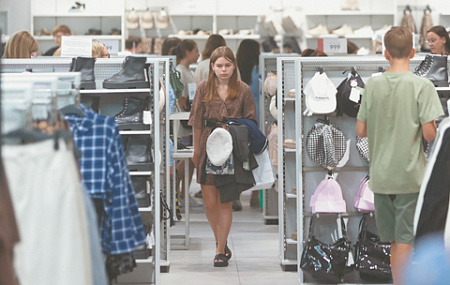
Rosstat’s report on the country’s socioeconomic performance during the first five months of 2026 does contain several positive indicators. Retail trade turnover was 5% higher than a year earlier.
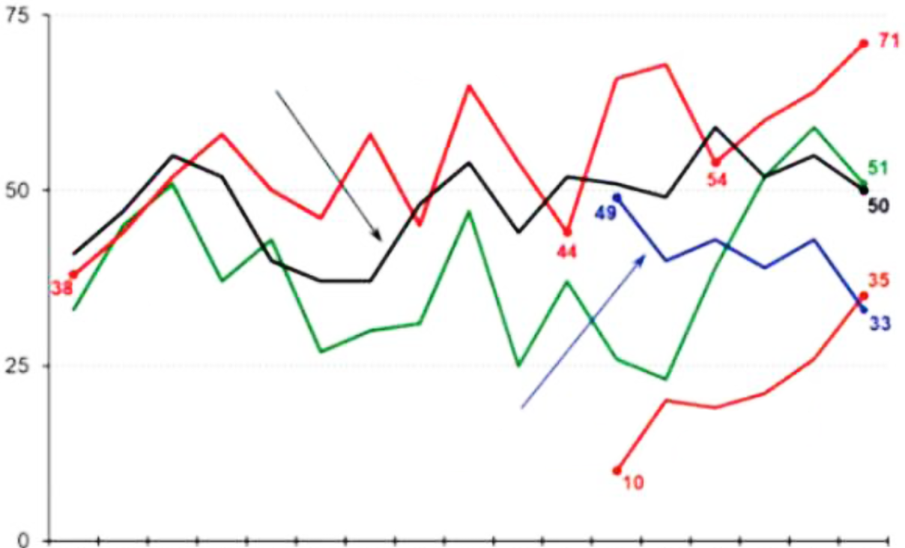
Average nominal monthly wages paid by organisations rose by 14.3% year on year in January-May. Adjusted for official inflation, average real wages increased by 7.8%. Average nominal pensions rose by 8.6%, while real pensions increased by 2.7%.
At the same time, many indicators in the report point to stagnation or decline. The output index for the core sectors of the economy was 0.1% below the corresponding level a year earlier.
Rosstat’s core sectors include agriculture, construction, industrial production, and wholesale and retail trade. Industrial production encompasses mining, manufacturing, energy supply and water utilities.
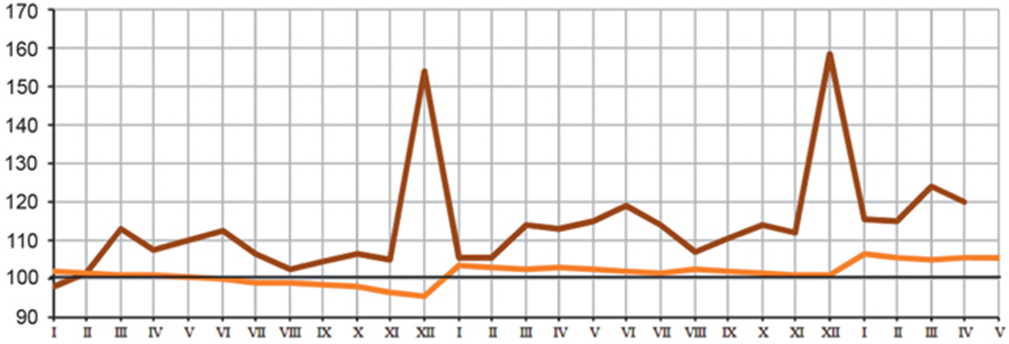
| ▬▬ Real average monthly wages of employees |
| ▬▬ Real pensions |
Real wage and pension indices as a percentage of the average monthly level in 2023. Source: Rosstat.
Freight turnover fell by 1.1% during the first five months of the year, while passenger transport volumes on public transport were also below last year’s level, declining by 0.3%.
The report reaffirmed the previously published figure showing investment falling by 14.3% in the first quarter. It also included business confidence indicators across various sectors, providing insight into companies’ investment intentions.
According to Rosstat’s business activity survey covering 4,833 manufacturing companies (excluding small businesses), the business confidence index remained in negative territory in June 2026 at minus 2%.
Among mining companies, the confidence index also remained negative at minus 3%. The June survey covered 639 mining companies.
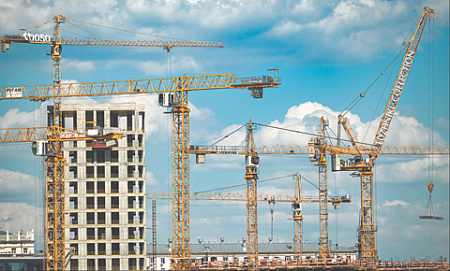
Business confidence in the construction sector was among the weakest, standing at minus 14% in the second quarter of 2026. According to Rosstat, the main constraints facing construction companies were the high cost of materials, components and products (46%), high taxes (39%), shortages of skilled workers (27%), high commercial lending rates (25%), insufficient financing (23%), lack of orders (18%), customers’ inability to pay (14%), competition from other construction firms (13%) and weather conditions (12%).
The business confidence index for retail trade also remained negative in the second quarter at minus 8%. The principal obstacles cited by retailers continued to be high taxes and weak consumer purchasing power.
The services sector was one of the few areas where the business climate improved, with the indicator rising into positive territory at plus 1%, compared with minus 5% in the first quarter.
On Thursday, Central Bank Governor Elvira Nabiullina expanded on her argument against claims that the Russian economy has clearly been overcooled. ‘There are imbalances and structural problems in certain sectors where demand is insufficient despite available supply. This is particularly true in industries affected by export restrictions. A considerable number of production facilities were established partly with a view to manufacture goods for export, and that fact is now being felt quite keenly in some industries. These are manifestations of structural transformation: some sectors are growing more rapidly, experiencing strong demand and shortages of resources, while others face insufficient demand for the capacity they have built. Unfortunately, this is a natural consequence of such a profound structural adjustment. But if we were to take the economy as a whole, there is no such overcooling,’ Nabiullina said during a briefing at the Bank of Russia’s Financial Congress.
ORIGINAL: NG/Rosstat Unable to Distinguish Between Economic Overcooling and Under-Cooling