Amidst slowing industrial growth and declining investment, the Russian authorities aim to launch a new investment cycle in industry no later than 2027. In their view, the main source of future growth should be industrial transformation driven by breakthrough digital technologies. To accelerate this process, companies are being promised reimbursement of up to half the cost of switching to Russian software, along with expanded access to the mechanism of Agreements on the Protection and Promotion of Capital Investments (SZPK).
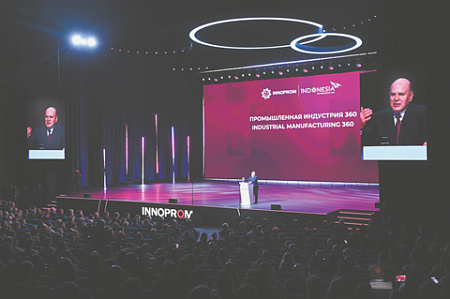
Investment in industry over recent years has enabled Russia to launch and modernise production capacity despite sanctions pressure, Prime Minister Mikhail Mishustin said on Monday during the plenary session of the Innoprom industrial exhibition.
‘Despite unprecedented sanctions, we have not only preserved but significantly strengthened key industries, launched extensive modernisation of enterprises across the country and built new production facilities. This became possible thanks to coordinated efforts by the state and business. Total fixed-capital investment over the past five years amounted to around RUB 24 tn, with almost one-third invested last year alone,’ Mishustin said.
According to him, these investments will provide the foundation for further transformation.
Rosstat estimates that fixed-capital investment fell by 2.3% in 2025 after increasing by 8.4% in 2024, 9.8% in 2023, 6.7% in 2022 and 8.6% in 2021. In the first quarter of 2026, fixed-capital investment declined by 14.3% year-on-year. The Ministry of Economic Development expects investment to fall by 1.5% this year.
Last week, Bank of Russia Deputy Governor Alexei Zabotkin said fixed-capital investment in 2026 could remain flat or decline slightly. ‘Investment reached its peak in real terms in 2024. It fell by a couple of percentage points in 2025. This year it is likely to be broadly flat or perhaps decline slightly,’ Zabotkin said. He noted that fixed-capital investment totalled RUB 42.6 tn in 2025 and reached RUB 6.5 tn in the first quarter of this year.
According to Zabotkin, production capacity continues to expand. ‘Capacity growth depends not on whether investment is rising or falling but on the overall volume of investment taking place. Investment remained at a very high level in 2024, and we can clearly see the results. The slight decline in capacity utilisation reflects the fact that new capacity has been created in sectors where demand has structurally shifted,’ he said.
According to Zabotkin, production capacity continues to expand. ‘Capacity growth depends not on whether investment is rising or falling but on the overall volume of investment taking place. Investment remained at a very high level in 2024, and we can clearly see the results. The slight decline in capacity utilisation reflects the fact that new capacity has been created in sectors where demand has structurally shifted,’ he said.
‘The macroeconomic environment is undoubtedly having an impact. The pace of output growth has slowed somewhat,’ Mishustin acknowledged.
He noted that manufacturing output had increased by almost 23% over the previous three years. Engineering remains a key contributor to growth, expanding by around 8% during the first five months of 2026.
Rosstat reported at the end of June that industrial production increased by 0.4% year-on-year during the first five months of 2026. However, output fell by 0.7% in May after growing by 1.9% in April, 2.3% in March and declining by 0.9% and 0.8% in February and January respectively. Manufacturing output rose by just 0.3% over the five-month period. In May, the strongest annual growth was recorded in the production of other transport equipment, including aircraft and shipbuilding, pharmaceuticals, motor vehicles, trailers and semi-trailers, as well as fabricated metal products excluding machinery and equipment.
Economists have repeatedly argued that Russian industry, like the broader economy, suffers from a deep structural imbalance. Sectors directly or indirectly linked to the defence industry continue to expand, while industries serving civilian demand are either shrinking or stagnating (see Nezavisimaya Gazeta, June 24, 2026).
The government believes further growth will require industrial transformation driven by breakthrough digital technologies. According to Mishustin, these technologies are ‘blurring traditional industry boundaries and enabling integrated business processes that manage every stage of bringing products to market, from design to final sales’.
‘We must stay ahead of the curve by building more flexible production lines, introducing automated systems and making greater use of artificial intelligence,’ he said.
To accelerate the transition to Russian industrial software, the government will reimburse companies for up to 50% of the cost of purchasing and implementing domestic software.
‘Our goal is to ensure the competitiveness of Russia’s high-tech industries through our own digital products,’ Mishustin said.
Previous studies have shown uneven adoption of domestic software. According to joint research by CSoft and the Moscow Power Engineering Institute, around 85% of Russian industrial companies use domestic software to some extent. However, for 35% of enterprises Russian products account for only about half of their IT systems, while for another third the share ranges from 16% to 50%. Fifteen percent of companies do not use Russian software at all. In December 2025, the Ministry of Industry and Trade reported that only 39% of companies in the electronics sector used Russian computer-aided design (CAD) systems. Asked what would encourage greater adoption, 22% of respondents cited subsidies and special incentives, while another 20% said developing software internally was more cost-effective than purchasing external solutions (see Nezavisimaya Gazeta, May 18, 2026).
Another support measure is industrial mortgages, which provide subsidised loans for acquiring, constructing and modernising industrial facilities. Mishustin announced that the programme would receive an additional RUB 3 bln this year. ‘More than RUB 8 bln had already been allocated in the federal budget this year to service these loans. We will provide an additional RUB 3 bln,’ he said. Around 1,100 subsidised loans worth more than RUB 116 bln have been issued under the programme, bringing approximately 5 mln square metres of industrial space into productive use and helping prevent shortages of industrial capacity
Another investment support mechanism is the Agreements on the Protection and Promotion of Capital Investments (SZPK).
‘Dozens of large-scale projects are being implemented under these agreements. Many of them are industrial projects… Companies receive reimbursement for a substantial share of the costs of building production and supporting infrastructure, either in the form of government subsidies or tax deductions,’ the government said.
From this year, the authorities also promise to expand access to the mechanism. Specifically, municipalities will be granted access to the programme and will also be able to reimburse investors’ costs under SZPK agreements. Previously, only regional governments had this authority.
‘We are open to cooperation with everyone on an equal footing and on the basis of mutual respect. We are ready to expand business ties and develop cooperation across a broad range of areas,’ the prime minister said, adding that such cooperation serves the interests of all parties and helps strengthen national economies.
In particular, he said, Russia and Belarus continue to give priority to industrial policy and are actively cooperating on the digital agenda. The two countries are also creating an integrated transport system for the Union State. Other areas of cooperation include energy and industrial cooperation.
Moscow also sees significant potential for cooperation with Kyrgyzstan. ‘Industry comes first. That is where we will look at the opportunities. We also see opportunities in energy, transport, digital technologies and infrastructure development,’ Mishustin said during a meeting with Kyrgyz Prime Minister Adylbek Kasymaliev.
According to Anastasia Levchenko, a researcher at the Gaidar Institute’s Laboratory of Sectoral Markets and Infrastructure, the government’s statements confirm a policy of deepening industrial cooperation within the Eurasian Economic Union (EAEU). For both Belarus and Kyrgyzstan, she said, the key direction is shifting from simple trade towards the creation of joint high-tech manufacturing.
With regard to Belarus, key areas of cooperation could include mechanical engineering and the automotive industry.
‘Russian companies are already replacing Belarus’s critical imports. For example, suppliers from the Saratov Region have replaced German control valves for the Minsk Tractor Works, while a plant in Udmurtia has replaced Italian sealants. Machine-tool manufacturing could also become an important area of cooperation. Collaboration is developing on the production of railway switch components for high-speed rail lines, involving Russia’s Murom Switch Works and Belarus’s Gidropress. A project to manufacture equipment for road construction machinery at a plant in Kurgan is also under way,’ Levchenko said.
Energy could become another promising area of cooperation with Kyrgyzstan.
‘Large-scale projects are already being implemented in this area. Unigreen Energy is building a 300 MW solar power plant in the Issyk-Kul Region, while Rosatom Renewable Energy plans to construct a 100 MW wind farm in the same region. Industrial cooperation also has broad prospects in high-tech industries and the extractive sector. In addition, Kyrgyzstan intends to become a logistics and industrial hub for Eurasia,’ Levchenko said.