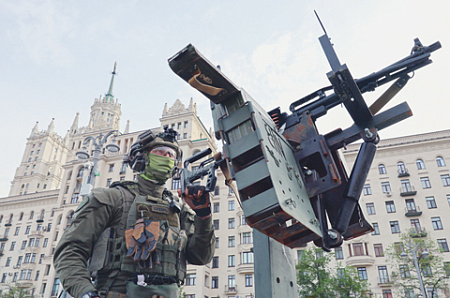
The State Duma has approved a special article to the Law on Defence which, ‘in connection with the need to counter threats of aerial attacks on the territory of the Russian Federation during the special military operation’, establishes special procedures for applying a number of legislative provisions. In order to rapidly deploy a nationwide anti-drone air defence system under the authority of the Ministry of Defence, numerous peacetime legal norms are being suspended. Under the slogan ‘All-Out Fight Against Drones’, authorities will be permitted to bypass supervisory, regulatory, administrative, financial, customs and other restrictions. The temporary suspension of bureaucratic rules is also a key principle of Russia’s Law on Martial Law. While martial law has formally been introduced only in the newly incorporated regions, it is now effectively being extended across the entire country
On June 9, the State Duma considered amendments to the Law on Defence in its second reading before approving the revised legislation in full. The measure passed unanimously, with 367 votes in favour. However, nearly 100 deputies did not participate in the vote. It is possible that this reflected concerns over a special article added to the bill at the last moment which exempts the military from compliance with a large number of existing laws and regulations.
Discussion of these provisions proved impossible both in the relevant parliamentary committee and during the plenary session. The amendments appeared the previous evening under the signatures of several senior parliamentarians with military backgrounds. When Defence Committee chairman Andrei Kartapolov attempted to explain the changes in greater detail, State Duma Speaker Vyacheslav Volodin interrupted him, insisting that everything was already clear and that there was no need to provide ammunition to critics. When it became apparent that representatives of parliamentary factions wished to speak, Volodin suggested dispensing with debate altogether: ‘Everyone understands what tasks this law is intended to solve.’
The legislation itself contains no state secrets and is publicly available. The reluctance to discuss it may have reflected uncomfortable questions, such as why the amendments were introduced only now if military facilities have required protection from drone attacks for a long time. Questions of this kind, and many potential answers, risk falling under legislation prohibiting the discrediting of the armed forces, making open discussion politically sensitive.It is also possible that the ban on debate had even more to do with a separate article stating that, ‘in connection with the need to counter threats of aerial attacks on the territory of the Russian Federation during the special military operation, special rules are established for the application of certain provisions of federal laws and other regulatory legal acts of the Russian Federation’. This provision, too, raises an obvious question: why was it formulated only now?
The special article effectively functions as a temporary wartime law. It consists of eight extensive sections containing numerous subclauses and represents a broad example of emergency lawmaking. In order to assist the armed forces in countering aerial threats, a range of legal procedures may simply be waived. This applies both to the construction or demolition of capital structures and to temporary facilities.
Military authorities will be allowed to proceed without formal documentation relating to land rights, planning permissions and many other regulatory requirements. Construction projects may be undertaken without engineering surveys, supervisory approvals, archaeological assessments or consideration for green spaces and historical monuments. The Ministry of Defence will also be exempt from procedures governing connections to utility and infrastructure networks. Information on property brought under military control will merely be transmitted to the national land registry, while remaining inaccessible to the public.
Another provision concerns the implementation of ‘urgent measures aimed at assisting the Armed Forces of the Russian Federation in countering threats of aerial attacks’. Procurement contracts may be awarded without competitive tenders. Restrictions governing specially protected territories may be disregarded, while licensing requirements for various activities, services, goods production and distribution may be suspended. The law also allows the importation of any goods into Russia without compliance with technical regulations, with customs procedures permitted to be completed after the goods have already been put into use.
Other provisions are similarly far-reaching. The law states that no supervisory inspections will be conducted in relation to active or passive defence systems and other facilities established under the emergency programme. Exemptions include tax inspections, oversight of state defence contracts and monitoring of state corporations’ spending. The text suggests that some oversight by security agencies may nevertheless remain possible. The legislation also permits financing of emergency anti-drone measures through subsidies and grants from all levels of government without increasing the state’s ownership stake in recipient organisations.
The law further provides incentives for businesses involved in implementing these measures. Costs and lost profits incurred while assisting the programme may be recognised as legitimate expenses for taxation, accounting and regulatory reporting purposes, including within investment programmes subject to antimonopoly regulation.Responsibility for the overall system appears likely to rest with the military. Although the legislation envisages a unified national centre to be established by presidential decree, incorporating both a federal operational headquarters and regional structures, implementation will be directed by whichever authority is designated to counter aerial attacks. In practice, this points to the Ministry of Defence.
The legislation will enter into force immediately after the completion of the required procedures, likely during the second half of June. Additional regulations are expected to follow. The law’s stated purpose of repelling attacks on Russian territory inevitably recalls the constitutional Law on Martial Law, which stipulates that martial law should be introduced in cases of aggression against Russia. Such aggression is defined as including bombardment of Russian territory or the use of any weapon by a foreign state against the Russian Federation.
However, a closer reading of the law on martial law makes it easy to see that the State Duma’s June 9 decision effectively reproduces certain provisions of a higher-ranking legal act. For example, Article 1 explicitly states:
‘During a period of martial law, to the extent necessary to ensure the defence of the country and the security of the state, the rights and freedoms of citizens of the Russian Federation, foreign citizens, the activities of organisations regardless of their legal form or ownership structure, and the rights of their officials may be restricted.’
The law on martial law also contains a corresponding Article 8
‘During a period of martial law, federal laws and other normative legal acts of the Russian Federation may, for the purposes of producing goods, carrying out work and providing services for state needs, ensuring the needs of the Armed Forces of the Russian Federation … and meeting the needs of the population, provide for measures involving temporary restrictions on economic and financial activity, the circulation of property, and the free movement of goods, services and financial resources … and establish specific financial, tax, customs and banking regulations both in territories where martial law has been introduced and in territories where it has not.’
This suggests that although martial law itself has not formally been introduced nationwide, certain elements of it are effectively being extended across Russia. The reason may not be related solely to the forthcoming State Duma elections, particularly as electoral campaigns can now be conducted under martial law. The explanation may instead lie in the law itself and in measures adopted at the beginning of 2022, when the State Duma rapidly approved tougher penalties for military offences. The constitutional law explicitly states that such legislation may be adopted either during a period of martial law or in advance of its introduction.
ORIGINAL: NG/Elements of Martial Law to Be Extended Across the Entire Country