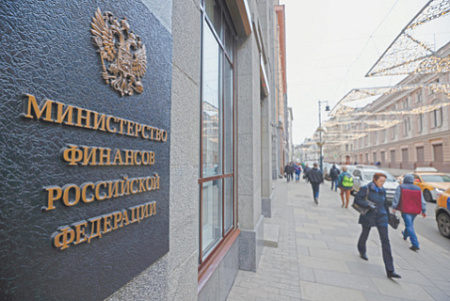
The State Duma is expected to approve in the first reading on Wednesday a government-backed package of amendments to the Budget Code. One proposal would allow the Ministry of Finance to borrow more on the domestic market than currently envisaged in the budget. The government would also gain the right to increase spending without introducing amendments to the federal budget law. Economists warn that rising government borrowing is not an encouraging signal for the economy, as the state would compete more aggressively with businesses for investors’ and banks’ funds. As a result, interest rates could decline more slowly
Under the proposed amendments, the government would be authorised to carry out domestic borrowing beyond the ceilings for internal public debt and domestic borrowing programmes established by the current budget law.
Specifically, the draft legislation would allow the government to increase domestic financing sources for the budget deficit beyond the approved ceiling for domestic public debt, within the limits of funds available in the Treasury Single Account
The bill would also allow the government, during budget execution, to increase spending without amending the budget law not only through additional non-oil-and-gas revenues, as currently permitted, but also through expanded domestic deficit financing and the use of budget balances accumulated as of January 1, 2026.
Last week, Minister of Finance Anton Siluanov said that the parameters of the 2026 federal budget would be revised.‘We will adjust this year’s parameters and the current deficit. The planned deficit is 1.6% of GDP (state budget deficit, Nezavisimaya Gazeta). We can see a trend towards changes in these parameters. The deficit will increase somewhat,’ he said. The minister stressed, however, that the revision would not lead to a substantial increase in domestic borrowing.
‘Gross domestic borrowing is currently planned at RUB 5.5 tn. Even if there is an increase, it will not be as significant as last year,’ Siluanov said.Asked how the deficit would be financed, he noted that the government had a range of funding sources, including budget reserves, asset sales and other measures.
Ministry of Finance describes the amendment as largely technical.‘
‘Following discussions of the bill in the parliamentary committee, we are introducing what is essentially a technical amendment for ourselves. It gives us the right, should additional revenues from revised macroeconomic assumptions prove insufficient, to increase borrowing,’ Deputy Minister of Finance Irina Okladnikova told the State Duma Committee on Budget and Taxes.
The government was granted similar flexibility at the end of 2024, when it received authority to increase spending by up to RUB 1.5 tn without parliamentary approval. At the time, the Ministry of Finance said the additional spending would be financed not through borrowing or the Russian National Wealth Fund but through accumulated rouble balances in the federal budget.
The current budget law envisages a deficit of RUB 3.8 tn, or 1.6% of GDP, this year. However, after the first five months of the year the deficit had already reached RUB 6.01 tn, equivalent to 2.6% of GDP. The domestic borrowing programme for 2026 provides for gross issuance of RUB 5.5 tn, repayments of RUB 1.3 tn and net borrowing of RUB 4.173 tn.
Russia’s public debt remains significantly lower than that of many advanced economies.
‘Eurozone government debt rose to 81.7% of GDP in 2025. The worst figures are well known: Greece at 146%, Italy at 137%, France at 115%, Belgium at 108%. Russia, by comparison, stands at around 16.4%, although estimates vary somewhat. In any case, the figures are incomparable,’ President Vladimir Putin said during the plenary session of the St Petersburg International Economic Forum. Russia’s budget deficit is also lower than in most developed economies. ‘The European Union’s budget deficit in 2025 is 3.1% of GDP. The largest deficits are in Poland at 7.3%, Belgium at 5.2%, France at 5.1% and the United States at 5.9%. Russia’s stands at 2.6%. It may rise by year-end, but I believe it will still remain below that of other industrialised countries,’ Putin said.
Even so, the Central Bank warned a month ago about the scale of the deficit. According to the summary of discussions surrounding the key interest rate published in May, the high deficit and record federal spending in the first quarter could generate a stronger fiscal stimulus in 2026 than previously expected, reducing the disinflationary effect of fiscal policy.
The Central Bank cut its key rate to 14.5% in late April. In its accompanying statement, the regulator sharpened its focus on fiscal risks.‘The federal budget deficit in the first quarter of 2026 was elevated amid record spending execution. Participants noted that this spending dynamic may signal a larger fiscal impulse than assumed in the baseline scenario. Similar situations have occurred before, when heavy front-loading of expenditures early in the year led to a higher overall spending trajectory. This raises the likelihood that fiscal policy in 2026 may fail to deliver the expected disinflationary effect,’ the summary stated.
‘As I have said before, discussions are under way regarding possible changes to budget parameters. The logic remains unchanged: the higher government spending is, particularly structural spending, and the larger the structural primary deficit becomes, the tighter monetary policy will need to be,’ Central Bank Governor Elvira Nabiullina said.
A deficit equal to 2.6% of GDP is not in itself alarming, according to Vladimir Chernov, an analyst at Freedom Global.
‘The issue is that the annual target was 1.6% of GDP, or RUB 3.8 tn, while the deficit reached roughly RUB 6 tn in January-May alone. The budget is performing significantly worse than planned. The real risk emerges if this gap persists in the second half of the year. In that case, the final deficit could exceed 2.6% of GDP and approach or surpass 3%. For financial markets, that would mean more federal bond issuance, higher yields and a more cautious stance from the Central Bank regarding further rate cuts,’ he said.
Chernov expects the budget position to improve somewhat in the second half of the year thanks to seasonal factors, available reserves, potential asset sales and oil-and-gas revenues if oil prices remain elevated.
‘However, risks remain. The key threats are weaker oil-and-gas revenues, a strong rouble, high spending levels and expensive domestic borrowing,’ he said.The problem is therefore not that the deficit has already become dangerous, but that the fiscal buffer has shrunk significantly while the cost of financing remains high.
If additional borrowing is conducted through the domestic market, federal bond supply will increase and yields are likely to remain elevated.
‘This is not the best signal for the economy because the government will compete more actively with businesses for investors’ and banks’ funds. As a result, it will become more difficult for companies to borrow cheaply and interest rates may decline more slowly,’ Chernov added.
There are also inflationary risks.
‘If additional borrowing simply covers a temporary gap between revenues and expenditures, the impact will be limited. But if it turns into a permanent expansion of spending, it will boost demand in the economy and make it harder for the Central Bank to reduce interest rates,’ he said.
Vadim Kovrigin, an associate professor at Plekhanov Russian University of Economics, described the proposal as primarily a tool for operational flexibility.
The Ministry of Finance currently has the right to increase spending during the year without amending the budget law only within the limits of additional non-oil-and-gas revenues. The new provision adds two more sources: increased domestic borrowing and the use of accumulated Treasury balances. In practice, this allows higher spending without initiating a lengthy parliamentary approval process. The government received similar authority at the end of 2024,’ he said.
Should borrowing increase rapidly, the federal bond market would inevitably feel the impact. ‘With the key rate still at 14.5% and only a cautious easing cycle under way, greater bond issuance will keep yields elevated, increase debt-servicing costs and partially crowd out private borrowers,’ Kovrigin said.He doubts the government will cut spending before September’s elections, though it may reconsider afterwards.
Olga Belenkaya, head of macroeconomic analysis at Finam, noted that although a deficit of 2.6% of GDP would not be considered large by international standards, Russia faces additional constraints.
‘The situation is complicated by the high interest rates at which the government must borrow. These rates are influenced by the Central Bank’s policy rate, the country risk premium, long-term inflation expectations and the loss of access to international capital markets, which previously provided cheaper and longer-term financing. As a result, debt-servicing costs are rising both as a share of total budget spending and relative to GDP,’ she said.
At the same time, borrowing costs faced by the Ministry of Finance effectively serve as a benchmark for the entire economy, influencing corporate lending rates and mortgage costs.
Expanded borrowing indicates that actual budget revenues are falling short of Finance Ministry projections and that spending reductions are proving difficult. This is not surprising given the slowdown in the Russian economy. However, by any standard, the current budget deficit is not yet threatening. Nevertheless, a larger deficit ultimately implies a higher Central Bank policy rate,’ said Yevgeny Goryunov, head of the monetary policy laboratory at the Gaidar Institute
ORIGINAL:NG/Government Seeks Power to Increase Spending Without State Duma Approval