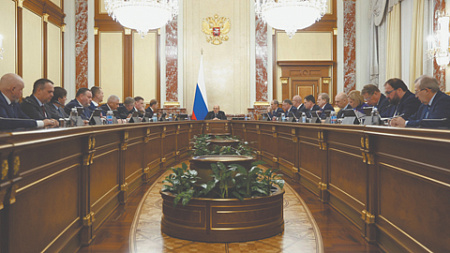
The Russian government will write off RUB 48 bln (USD 610 mln) in debt owed to the federal budget by eight regions, Prime Minister Mikhail Mishustin announced at a government meeting on Thursday. The meeting’s agenda also included discussion of a draft law aimed at supporting the development of artificial intelligence (AI). Government officials claim that more than 70% of Russian companies already use AI, and that virtually all businesses will soon adopt the technology.
The debt write-offs will apply to the Volgograd, Moscow, Nizhny Novgorod, Novgorod, Novosibirsk, Ryazan and Chelyabinsk regions, as well as the Republic of Udmurtia. According to Mishustin, the funds freed up by the debt relief will be used to support the construction of social infrastructure, housing projects and road networks as part of President Vladimir Putin’s initiative to reduce the debt burden on Russia’s regions by cancelling two-thirds of their outstanding budget loans. The government has previously written off similar debts for other regions.
On Thursday, the government submitted to the State Duma a draft law on supporting the development of AI technologies, Deputy Prime Minister Dmitry Grigorenko, who oversaw its preparation, said.
‘The draft law on supporting the development of artificial intelligence effectively becomes the starting point for creating a legal framework governing this technology in Russia. Its main objective is to introduce a basic definition of artificial intelligence into Russian legislation while creating conditions for the priority development of domestic AI technologies. This is directly linked to issues of technological sovereignty and ensuring the secure and stable operation of the country’s key information systems and critical infrastructure,’ Grigorenko said.
Under the current version of the bill, the main regulatory requirements will apply to large foundation models underpinning AI services. At the same time, specialised models and computer vision technologies will fall outside the scope of the legislation. The bill also establishes the right of Russian AI developers to receive state support.
‘A sovereign AI model must be developed entirely in Russia. A national model may incorporate open-source solutions, but its essential characteristics must be determined by a Russian developer. Both types of models must store and process data within the territory of the Russian Federation,’ the government stated. According to officials, sovereign and national AI models will receive priority access to state support. The government will determine the specific support measures. Such models are expected to be deployed primarily at significant critical infrastructure facilities.
However, statements from other government officials suggest that AI technologies are already widely used in Russia. The share of Russian companies using AI already exceeds 70% and will soon reach 100%, Deputy Minister of Finance Ivan Chebeskov said on Thursday. These claims raise the question of whether the government’s proposed AI legislation is arriving too late to regulate a technology that has already become widespread
Talk of sovereign AI in Russia is particularly symbolic against the backdrop of reports that Apple has removed products developed by the Russian technology company VK from the App Store. The strong reaction from Russian officials also suggests that not all policymakers fully appreciate the technological fragmentation of the world into competing spheres of influence.
Alongside the new AI regulations, the government approved additional budget support for Russia’s newly incorporated territories. Nearly RUB 1.3 bln will be allocated to the Donetsk and Luhansk People’s Republics and the Zaporizhzhia and Kherson regions to purchase specialised equipment aimed at improving the reliability of housing and utilities services. The funding will cover dump trucks, excavators, loaders and other specialised machinery needed to modernise heating and water supply networks, ensure uninterrupted operation of public utility infrastructure and prepare the systems for the coming autumn and winter season.
More than RUB 6.3 bln will also be allocated to pension payments for residents of the Donetsk and Luhansk People’s Republics and the Zaporizhzhia and Kherson regions. Mishustin signed the corresponding order, with the funds provided through federal budget grants. The financing will ensure pension payments during the third quarter under regional legislation. Announcing the decision at the June 25 government meeting, Mishustin noted that more than RUB 33 bln had already been allocated for these purposes over the past two years.
Beyond support for the new regions, Mishustin said the government continued to support key sectors of the Russian economy while safeguarding the country’s food sovereignty.
‘To reduce the financial burden on agricultural companies, we will allocate around RUB 60 bln in federal subsidies to lending institutions. These funds will help fulfil obligations under more than 41,000 concessional loans taken out by agricultural producers for farming, food processing, veterinary pharmaceuticals, enzymes, feed and food additives,’ the prime minister said.
The government expects the measures to help maintain the financial stability of agricultural producers while ensuring Russian consumers continue to have access to high-quality domestically produced food.
Support for strategic industries was also discussed on Thursday by a government commission chaired by Deputy Prime Minister Alexander Novak. He instructed the Ministry of Economic Development, together with relevant ministries and agencies, to analyse conditions in the sectors under review and propose additional support measures and policy instruments to facilitate comprehensive and timely decisions tailored to the specific needs of each industry. The sectors under consideration include metallurgy, the timber and coal industries, infrastructure development and residential construction.
ORIGINAL: NG/Government to Back Artificial Intelligence With New Legislation