For modernisation, social stability and national security, Russia requires annual economic growth of 3–3.3%. This, in particular, determines whether the country will be able to minimise widespread ‘near-poverty’ and restore the territories that have been ‘liberated’. However, such growth is unattainable without efforts to change the structure of investment, according to assessments by the Centre for Macroeconomic Analysis and Short-Term Forecasting (CMASF). At the same time, CMASF increasingly links its anti-crisis policy prescriptions to the completion of the special military operation, which it treats as an event on a short-term planning horizon of one to two years.
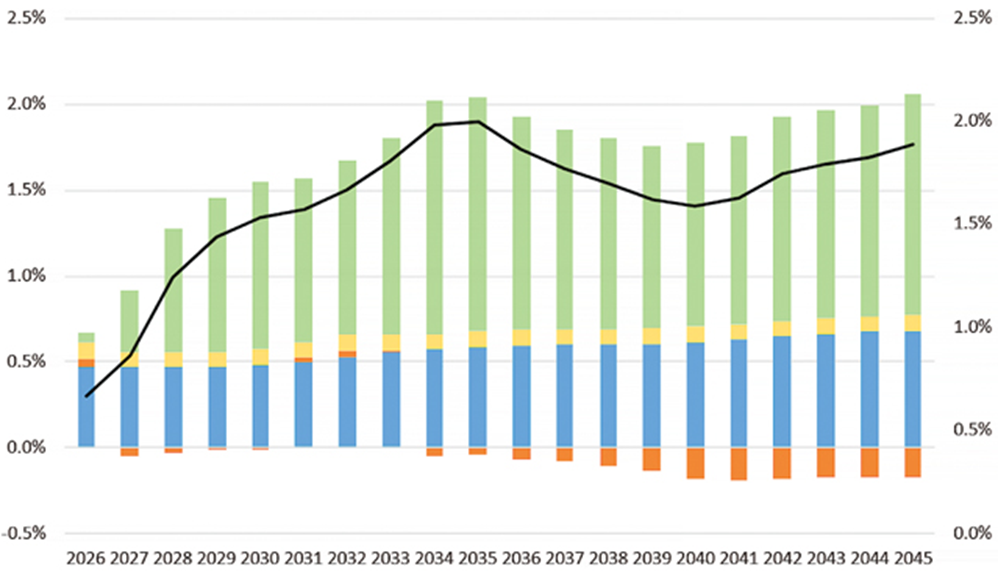
| ▬▬ FC stock |
| ▬▬ Number of employed |
| ▬▬ Human capital |
| ▬▬ TFP |
| ▬▬ GDP growth rate |
Contribution of key factors to Russia’s long-term GDP growth; baseline scenario, growth rates in %. FC – fixed capital; TFP – total factor productivity. Source: CMASF
Russia requires GDP growth of 3–3.3% per year, but within the current structure of the economy it can hardly exceed 2–2.3% per year.
This is stated by the CMASF in a new issue of its analytical ‘series’ titled ‘Thirteen theses (studies) on the economy’. At the end of June, an issue was published dedicated to Russia’s economic growth and ways to stimulate it.
Any discussion of actual and target GDP growth figures may appear, from the outside, to be an abstract exercise.
However, as follows from the new CMASF review, much depends on achieving 3% economic growth. For example, whether the country will be able to eliminate (or minimise) mass ‘near-poverty,’ a situation where people, even if employed, according to surveys, ‘have enough money only for food’ or ‘for food and clothing items,’ but nothing more.
The achievement of target growth rates will also determine prospects for infrastructure construction and modernisation, restoration of liberated territories, financing of scientific and technological development, and more broadly, the maintenance of social stability and reliable national security.
The author of the review, Deputy Director General of CMASF Dmitry Belousov, highlighted the problem of a ‘new stagnation’ in the Russian economy and noted that it has several dimensions in terms of time horizons, and therefore requires different anti-crisis approaches: short-term (one to two years), medium-term (three to seven years), and long-term.
Discussing Russia’s economic trends, CMASF increasingly raises the issue of the completion of the SVO, for which the economy must be prepared. However, the details of what this completion will look like remain outside the scope of analytical consideration; only approximate timelines can be inferred (see Nezavisimaya Gazeta, May 31, 2026).
In the current review, the completion of the SVO and related economic measures are considered by experts from CMASF in the short-term planning horizon.
According to Belousov, as the special military operation approaches completion in the short term, the following is necessary: reduce business taxes (primarily value-added tax) by around 2% of GDP; direct freed-up resources towards production modernisation through investment tax credits and agreements on the protection and promotion of capital investments.
In addition, it is necessary to prevent a large-scale downturn in the defence-industrial complex. In Belousov’s view, this requires advance preparation of the dual-use goods market: orders for civilian drones for state organisations, communications equipment and transport vehicles.
As examples of future applications for drone systems, the economist cited agriculture and several other sectors: ‘It is necessary… to proactively develop private business in the field of agricultural drones and, more broadly, ‘smart agriculture’, unmanned cargo transport, geological exploration, geodesy and remote sensing of the Earth.’
It will also be necessary to issue bonds and other financial instruments aimed at voluntary investment of accumulated resources held by SVO participants.
In this case, CMASF appears to return to its idea from three years ago that one of the outcomes of the SVO could be the formation of a new social group of ‘young wealthy’ individuals from military personnel receiving significant state payments, who would possess investment resources.
However, over time, the emphasis in expert discussions has shifted: there is now growing concern that ‘partial demobilisation’ will be accompanied by a reduction in incentive payments to servicemen, as well as cuts in state defence orders, reduced shift work in industry and falling payments to employees.
In the current CMASF materials there is also an important remark that the source of personnel for the special military operation was previously regions and industries with relatively low wages, and, as Belousov clarified, ‘it is unlikely that such places will be even remotely attractive to returning veterans.’
This contradiction will have to be resolved. One option is to radically simplify the opening and operation of businesses for small technology companies, including those created by special military operation participants.
In addition, Belousov mentioned the need to form ‘technological testing grounds’ in the Arctic, the Far East and the liberated regions, with simplified regulation for testing and practical piloting of new equipment and technologies: drones, control systems with elements of artificial intelligence and small private rockets.
In the medium term, according to CMASF estimates, the problem lies in structural constraints on growth: ‘Due to the structural features of the Russian economy, over the past 10 years the sectoral composition of investment has consistently differed significantly both from the structure of high-productivity jobs and from sectors with high growth potential in the future.’
In the medium term, according to CMASF estimates, the problem lies in structural constraints on growth: ‘Due to the structural features of the Russian economy, over the past 10 years the sectoral composition of investment has consistently differed significantly both from the structure of high-productivity jobs and from sectors with high growth potential in the future.’
At the same time, the bulk of consumer goods industries (food production, leather and leather goods, furniture, beverages, agriculture) and investment goods sectors are characterised by low investment growth and moderate productivity increases. The automotive industry is in the most difficult position, where low investment activity is combined with similarly weak productivity growth, Belousov said.
The key to structural industrial modernisation, according to expert assessments, lies not so much in increasing the volume of fixed capital investment (although this is still important) but in changing its structure, namely the reallocation of investment resources between sectors. This will also require the creation of appropriate financial instruments.
Finally, in the long-term dimension, the issue concerns a ‘shift’ between factors of production: all the resources required to produce goods and services, from raw materials and equipment to labour, technologies affecting productivity and management decisions.
Given increasing demographic constraints (CMASF forecasts that ‘there is a risk that the number of employed will begin to decline’), total factor productivity, in other words, the efficiency of processes and returns on utilised resources, becomes the main condition for economic growth. Economic success is directly linked to technological modernisation.
ORIGINAL: NG/The Economy Is Being Adjusted for the Short-Term Completion of the Special Military Operation