
Innovation among Russia’s small industrial companies is losing momentum, according to the Higher School of Economics (HSE). No more than 2,300 of such companies are currently working in Russia, while innovative products account for just 3% of their total sales. The main barriers to innovation in Russia include shortage of companies’ own funds and high borrowing costs. Economists at the Institute of Economic Forecasting of the Russian Academy of Sciences (IEF RAS) suggest that Russia should expand businesses’ access to concessional financing to speed up the country’s technological development.
By industry, manufacturers of computers, electronic and optical products remain the most innovative businesses in Russia, as noted by the HSE. About a quarter of companies in this sector engage in innovation.
They are followed by manufacturers of medical instruments and equipment, at 21.9%, pharmaceuticals and related materials, at 21.5%, aircraft and spacecraft, at 21.4%, and electrical equipment, at 14.1%.
In 2025, spending on innovation by small industrial companies exceeded RUB 104 bln, making up around 1.5% of the total value of goods shipped and work performed. This share has remained quite flat over the recent years, though it is higher in certain sectors including aircraft and spacecraft manufacturing and pharmaceuticals.
The value of innovative products manufactured by small industrial companies approached RUB 210 bln last year, as reported by the HSE. However, their share of total sales remains at 3.1% and has been pretty much the same in recent years.
Businesses finance innovation mainly from their own resources. Companies’ own funds account for two-thirds of all innovation spending. Loans and other borrowing rank second, at 16.4%. Although government support for small innovative businesses is increasing, it remains limited, with the share of total innovation expenditure reaching 9.5%.
Funding constraints are now limiting companies’ capacity to invest more. More than 72% of businesses surveyed by the HSE described the high cost of innovation as a major or significant obstacle. More than half reported that they lacked sufficient funds of their own.
‘Complicated access to finance is a significant hurdle for the innovative and technological development of small and medium-sized businesses. High lending rates, with the current key rate at 14%, have persisted for the past several years adding to the Russian companies’ restricted ability to raise capital to finance innovation. As a result, innovation is funded primarily from companies’ own resources, which are also shrinking due to the rising cost of raw materials, fuel and electricity,’ says Ivan Yermokhin, a research associate at the Gaidar Institute’s Laboratory for the Analysis of International Best Practices.
Conventional debt instruments are poorly suited to financing innovation even internationally, Yermokhin adds, particularly for small companies and start-ups.
Experts at IEF RAS have come to similar conclusions about the insufficient innovation financing in Russia. They emphasize a general shortage of borrowed funds available to companies for research. In their view, technological sovereignty is impossible without shifting the approach to concessional lending.
The Russian authorities have set a target of raising domestic spending on science to 2% of GDP in the first half of the 2030s and placing the country among the world’s ten leading nations by research and development expenditure. Current domestic spending on research and development (R&D) is estimated at 0.9% of GDP. Many experts consider it insufficient for advanced innovative development and technological sovereignty. Meeting the stated targets will require robust government support for science and innovation, including concessional financing procedures for priority projects.
So far, government funding has remained the largest component of domestic R&D expenditure in Russia, accounting for 65%, while the private sector contributes just about one-third. This differs remarkably from the structure seen in technologically advanced countries.
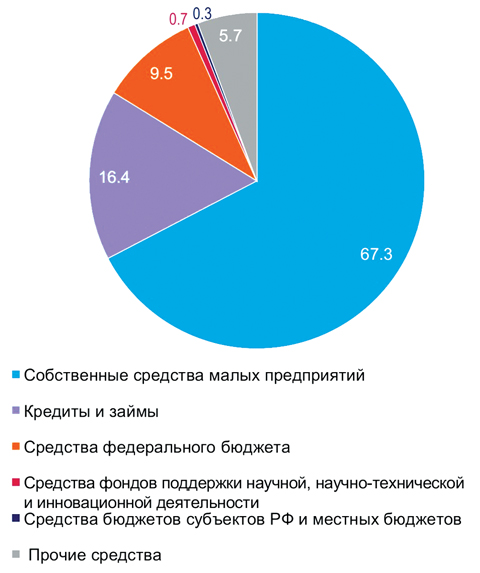
1.Small companies’ own funds
2. Loans and other borrowing
3. Federal budget funds
4. Funds provided by foundations supporting research, scientific and technical, as well as innovation activities
5. Funds from regional and local budgets of the Russian Federation ¢ Other funds
Source: Higher School of Economics
To increase financing for research and development, as well as for the introduction and expansion of high-technology production, researchers propose widening the use of concessional lending in the real economy. This would mean providing loans at rates substantially below market levels through subsidies or concessional funding for banks and development institutions that offer such financing.
The ongoing policy of high interest rates has an adverse impact on companies’ investment activity. IEF RAS surveys show that most companies surveyed regard high rates as a principal constraint on the path to economic growth. Technological inferiority and the absence of breakthroughs in import substitution also persist as a consequence
‘Another group that has experienced a sharp decline in access to financing is small and medium-sized businesses. Surveys show that only about a quarter of small and medium-sized companies are interested in borrowing, with fewer than half of those applied managing to get their loan applications approved. Although business demand for financing remains, primarily for replenishing working capital and refinancing, investment activity is slowing down. Companies are scaling back investment as they fear the high cost of borrowing and macroeconomic uncertainty,’ the researchers believe.
‘This combination of tight monetary policy and the strategic objective of scientific and technological development raises the question of how concessional lending can be expanded without undermining macroeconomic stability, while directing it towards technological modernisation,’ they add.
As a solution, IEF RAS proposes a significant expansion of concessional lending to the economy. According to its calculations, additional RUB 500 bln in concessional loans each year could support priority investment projects without increasing the share of concessional debt in the total loan portfolio above 7%.
‘The additional impetus from concessional lending would be reflected in faster implementation of scientific and technological projects and the creation of additional supply in key sectors. According to our calculations, approximately RUB 4.5 trln in concessional loans beyond existing core programmes could be directed towards financing investment projects in industry and high technology between 2027 and 2035. This is equivalent to 9% of projected budget expenditure on state programmes for the development of science, industry and technology over the same period. In other words, government-backed borrowing could allow the state to boost total resources available for economic transformation without accelerating direct budget allocations,’ IEF RAS proposes.
‘Key factors holding back both innovations in small business and the overall movement towards technological sovereignty trigger a number of issues. Financial hurdles are indeed the primary and most painful bottleneck. Innovative projects are often high-risk and require substantial long-term investment, while their investment phase may last from one to several years. Many small businesses find that they do not have enough of their own funds for innovation, while access to borrowed financing, whether bank lending or concessional government funding, is complicated, partly because the key rate remains high. The current rate of 14% is still burdensome for development. For projects of this kind, it should be within a range of at least 10% to 11%. Thus, companies rely more often on their own resources than on external financing,’ says Vasily Kutyin, analytics director at Ingo Bank.
He considers current market conditions to be detrimental as well. ‘External conditions have a critical influence on innovation activity. Strong competitive pressure reduces project margins, while uncertain market demand, when it’s unclear whether a product is sought-after, makes businesses cautious and leads them to push back any investment,’ he adds. The expert also believes that overcoming these obstacles requires a comprehensive approach which should include improved financial procedures, such as concessional lending and grants, investment in education and infrastructure, as well as a clear government strategy that sets priorities and eliminates inherent risks.