Maintaining tight monetary policy, tax pressure and the fuel crisis have formed a toxic combination that has had the effect of an economic bomb going off. Following its surveys of businesses, the Central Bank recorded the sharpest deterioration in business climate assessments since the start of the special military operation in July. The Central Bank considers these assessments a leading indicator of future changes. Negative sentiment is evident across many key industries. It is too early to say that a recession has become a reality, but calculations by the Centre for Macroeconomic Analysis and Short-Term Forecasting (CMASF) show that the probability of one occurring is high.
The Business Climate Indicator (BCI), calculated by the Central Bank, fell sharply in July to its lowest level since mid-2022, reaching minus 3.6 points
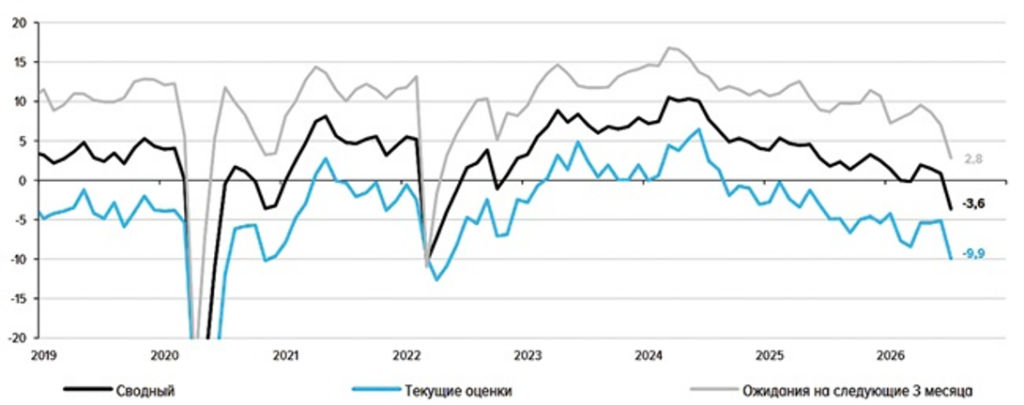
| ▬▬ Overall indicator |
| ▬▬ Current assessments |
| ▬▬ Expectations for the next three months |
Business Climate Indicator based on enterprise surveys: overall indicator and sub-indicators depending on the period assessed by companies; seasonally adjusted data, measured in points. Source: Central Bank.
The Central Bank’s assessments are based on surveys it conducts among non-financial sector companies, with an average of 15,000 participants each month
In these surveys, companies provide qualitative assessments of actual and expected changes in business activity, taking into account trends in production, demand and prices. Responses are divided into positive, where companies report improvements, and negative, where they report deterioration. The difference between the two determines the overall business climate indicator.
A positive overall BCI value means that optimism dominates assessments of current conditions and expectations, and companies view the business environment as favourable. A negative value indicates that negative assessments prevail and that companies consider operating conditions unfavourable.
In July, companies’ assessments did not simply worsen sharply; they moved from positive territory into negative territory. While optimism had prevailed among businesses just a month earlier despite all difficulties, pessimism became dominant in July.
According to the Central Bank, the decline in the BCI in July was driven, first, by a significant deterioration in current conditions reported by companies in mining, transport and storage, and services. Second, expectations worsened in construction, trade, consumer goods manufacturing, and also transport and storage
In manufacturing, the BCI has remained broadly unchanged since the fourth quarter of 2025. In the production of intermediate and investment goods, assessments of current conditions improved in July.
At the same time, despite the extremely difficult fuel situation in the country, references to this factor appeared only once in the Central Bank’s monitoring report
The Central Bank specifically pointed to rising costs, which accelerated in July and reached their highest level since May 2022.
‘Noticeable increases in costs compared with June were observed across all industries. One of the significant factors behind the acceleration in cost growth was the rise in fuel and lubricant prices, including due to temporary fuel shortages in some regions. In addition, businesses cited higher purchase prices and logistics costs among the reasons for rising expenses,’ the Central Bank said.
However, some experts commenting on the Central Bank’s conclusions attributed the sharp deterioration in business sentiment in July primarily to the disruption of the fuel market
The analytical Telegram channel MMI (which previously participated in the Central Bank’s macroeconomic surveys) suggested that the fuel crisis could become a trigger for an economic downturn. According to its estimates, if oil refining does not recover, Russia’s GDP could contract by 1–1.5% by the end of the year.
Describing developments in the economy, the channel’s authors used particularly bleak language, calling the deterioration in business climate assessments the most severe collapse since mobilisation.
The Centre for Macroeconomic Analysis and Short-Term Forecasting, after analysing financial and macroeconomic risks in a new report using June data, also warned of the threat of a recession, meaning an annual decline in GDP.
According to the experts, GDP growth over the rolling year from May 2025 to April 2026 amounted to 0.6%. Accordingly, the decline in GDP observed in January and February 2026 then paused in March and April.
Despite this, CMASF calculations based on various leading indicators show that the Russian economy again risks entering recession. The experts attempted to soften this conclusion by saying that they were referring to a ‘high probability’ rather than a predetermined outcome.
Moreover, according to the CMASF report, if a recession does begin at some point, it will most likely be a prolonged one, lasting more than a year.
One of the reasons behind this forecast is the heavy debt burden on companies, which emerged because of initially incorrect economic expectations. This will require a long and difficult process of debt restructuring and, apparently, the transfer of heavily indebted companies to new owners.
‘This will inevitably prolong the period of subdued economic activity,’ the experts said.
Even in such circumstances, however, CMASF found grounds for a more positive conclusion. In its view, the fact that Russia has managed to avoid a destructive banking crisis and a complete industrial collapse despite an exceptionally long period of high interest rates by international standards demonstrates the ‘exceptionally high resilience and even endurance of the Russian economy.’
ORIGINAL: NG/Russian Economy Risks Getting Stuck in a Prolonged Recession