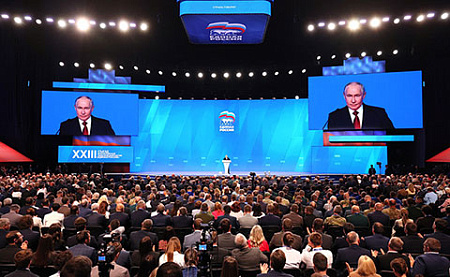
Journalists from the Kremlin press pool drew attention to a campaign poster at the United Russia congress bearing the slogan: ‘Supporting Putin is the basic minimum.’ The same poster also described United Russia as ‘the president’s party.’ It remains unclear whether these slogans will become part of the party’s official campaign for the State Duma elections. However, TASS correspondents reported from the congress that the poster is already being used in the regions.
President Vladimir Putin himself addressed the United Russia congress. It is possible that the slogans were simply intended to frame that appearance appropriately. But it is equally possible that the connection between Putin and the ruling party will be emphasised consistently and explicitly throughout the election campaign. That has not been the case in every State Duma election. Some media outlets have already noted that the last time United Russia campaigned so heavily on its status as ‘the president’s party’ was in 2007. Perhaps the moment has come again.
Thing is, Putin has never actually distanced himself from United Russia. Everyone has long understood that it is the president’s party. But there is a difference between that general understanding and using it as an explicit campaign slogan in an election contested by other political parties, many of which simultaneously criticise United Russia while demonstrating loyalty to the head of state. The Communist Party, for example, regularly argues in public that the president should stop relying on the ‘liberals of the 1990s’ and on United Russia, and instead adopt the Communist Party’s own socio-economic proposals.
Russian political life has evolved in recent years in such a way that parties are, by and large, no longer competing for the support of genuinely distinct electoral constituencies. Ideologically, their platforms and overall rhetoric are remarkably similar. To varying degrees they are populist, occupy broadly the left of the political spectrum, and make extensive use of patriotic themes. Their minimum objective is political survival and preserving the status quo, meaning their representation in the State Duma. Their maximum objective is to win the attention of the president and other key decision-makers. If legislation drafted by a party is approved by the authorities, or if its members are appointed as mayors, governors or ministers, that counts as a major success. Displacing another systemic opposition party is an added bonus.
Making the ‘Putin-United Russia’ connection the centrepiece of election campaigning would effectively freeze this existing political order. The current period is turbulent, with numerous factors capable of unexpectedly influencing public sentiment, whether airports, fuel prices or internet disruptions. For parties integrated into the political system, there is a strong temptation to stretch the rules slightly, step beyond informal, and perhaps formal, understandings, exploit public dissatisfaction and attract genuine voter support. That would be impossible without criticising the authorities, which in turn would mean entering into direct confrontation with the dominant party. Such a scenario might once have been conceivable, but now appears much less likely.
‘If you support Putin, support United Russia’ represents a striking, perhaps even the ultimate, simplification of the election campaign. Other parties are effectively being offered a choice: either play their assigned role without complaint or risk their place within the system. For the president, emphasising such a close association with the party also carries a degree of reputational risk. The party ceases to function as a buffer that could, in the event of a political crisis, be replaced. But the authorities also appear to have made their choice. At present, that choice seems to be preserving the existing balance of forces in the State Duma unchanged. The constitutional majority must remain intact, ensuring a reliable mechanism for approving any legislative initiative and creating whatever new ‘timely’ legal norms may be required. At the same time, the State Duma election becomes yet another referendum on confidence in the authorities, a means of reaffirming their political mandate.
ORIGINAL: NG/Can Anyone Compete with the ‘President’s Party’?