
The Russian economy unexpectedly accelerated in the second quarter. Preliminary estimates from Rosstat show growth of 1.3%, following a 0.2% contraction in the first quarter. The Economy Ministry had previously estimated second-quarter GDP growth at 0.9%. The ministry says the economy is ‘returning to a growth trajectory’. Experts, however, urge caution about the current expansion. The driver of the acceleration is not the actual production of goods but their redistribution, including through consumption of imported goods
The Russian economy grew by 0.6% in the first half of the year, the Economy Ministry said. That is twice its previous estimate. At the beginning of August, the ministry had reported first-half GDP growth of 0.3%.
The ministry headed by Maxim Reshetnikov says second-quarter growth was driven by sustained domestic demand and positive dynamics in several real-sector industries.
‘Consumer activity among citizens continues to grow. Wholesale trade, freight transport, manufacturing, including machinery, pharmaceuticals and food production, also made positive contributions,’ the ministry said.
According to the Economy Minister, the latest data indicate that the weak performance of the first quarter is being overcome and that second-quarter figures confirm the economy’s return to a growth trajectory.
‘The half-year statistics confirmed that the economy is overcoming the dynamics seen at the beginning of the year. The recovery in growth rates, which was already recorded in March, is continuing despite persistent external pressure and restrictions in certain sectors. This is largely the result of systematic efforts by the government and the Central Bank to support structural changes and strengthen the economy’s resilience,’ Reshetnikov said.
Rosstat said GDP growth was driven primarily by increases in retail and wholesale turnover, food-service activity, freight traffic and manufacturing. Passenger traffic fell by 2.3% in the second quarter, while mining, construction and agriculture also contracted. The statistics agency stressed that its preliminary estimate of second-quarter 2026 GDP was calculated using the production method, based on the gross value added of all sectors and institutional sectors at basic prices, plus net taxes on products. The estimate itself is based on operational statistical reporting from large and medium-sized enterprises in the non-financial sector.
The Ministry of Economy had previously put second-quarter GDP growth at 0.9%.
The recovery in Russia’s economic growth was accompanied by stronger business activity across many manufacturing industries, analysts at the Centre for Strategic Research (CSR) say.
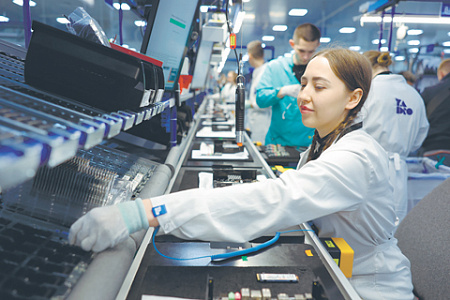
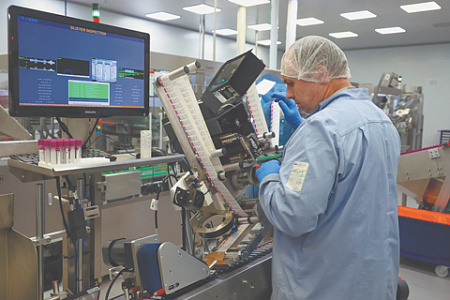
‘In the second quarter of 2026, manufacturing output increased by 2%, including 2.6% in June, with growth recorded in 16 of the 24 manufacturing subsectors,’ said Daniil Nametkin, director of the CSR’s Centre for Investment Analysis and Macroeconomic Research.
Consumer activity remains another stable source of support for the economy.
‘Retail growth accelerated to 7.2% year on year in the second quarter of 2026, from 3.6% in the first quarter, including against a backdrop of steady growth in real disposable incomes, which rose 1.5% in the second quarter,’ Nametkin said.
Government measures to improve business activity, together with the Central Bank’s continued reduction of its key rate, played a significant role in overcoming the downturn at the beginning of the year, he said. Since June 2025, the Central Bank has cut the rate to 14% as of late July 2026
The improvement in the macroeconomic environment is also reflected in investment, Nametkin noted. The pace of decline slowed to 6.6% in the second quarter, from 14.3% in the first quarter of 2026
The Ministry of Economy has highlighted rapid growth in retail trade, which increased by 7.2% year on year in the second quarter, and food services, which grew by 6.2%. Combined turnover in retail trade, paid services to households and food services rose 6% year on year in real terms in June. Consumer activity increased by 4.8% year on year in the first half of 2026 and by 6% in the second quarter, the ministry said
Wholesale trade also accelerated. Growth reached 2.7% year on year in June, compared with 2.1% a month earlier. Over the first half of the year, wholesale turnover increased by 1% year on year, while second-quarter turnover rose 2.4%.
Non-pipeline freight turnover rose 5.1% year on year in June, following 6.1% growth in May. Rail freight turnover increased 4.5% in June, compared with 4.2% in May. Road freight accelerated by 5.7% in June, after growing 1.8% in May. Overall, non-pipeline freight turnover increased 6.8% in the second quarter, compared with a 3.4% decline in the first
Russian Railways had previously reported that freight loading on its network had increased for the fourth consecutive month: by 1.9% in April, 0.5% in May, 1% in June and 0.1% in July. Freight turnover, meanwhile, grew much faster, by 4.1% in April and May, 4.5% in June and 6.5% in July. The company attributed this to longer transport distances as cargo flows continue to be redirected towards longer routes, primarily eastwards
Despite continued growth over the first seven months, total loading on the Russian Railways network amounted to 641.1 mln tonnes, 0.8% less than in the same period last year. Loading of oil and petroleum products, coke, iron ore, ferrous metals, fertilisers, cement and other construction materials, timber, chemicals and industrial raw materials has declined.
The only increases in the first seven months were in coal loading, which reached 193 mln tonnes, grain at 54 mln tonnes, and non-ferrous ore and sulphur raw materials at 10 mln tonnes.
Russia’s military-industrial complex is currently providing a substantial boost to economic growth because of strong demand, Russian officials acknowledge.
‘Right now, it is delivering clear and quite substantial economic growth precisely because there is demand for it, but there could be certain changes in the future,’ Deputy Chairman of Russia’s Security Council Dmitry Medvedev said, stressing that Russia would eventually have to modernise its defence industry. This does not mean stopping any particular areas, he said, but the structure and operating conditions of the sector may change. Both the state and business should prepare for those changes, Medvedev said.
This could include the eventual exhaustion of the military-industrial complex as a driver of economic growth
Experts stress that official GDP growth is being driven by factors that are not directly connected with productive activity. According to Oleg Abelov, head of the analytical department at Rikom-Trust, the main impetus comes from consumer activity fuelled by government spending.
Three main factors are driving GDP acceleration. ‘Retail turnover increased by 7.2% year on year. Food-service turnover rose by 6.2%. Manufacturing and the financial sector also showed positive dynamics. But this growth is structurally distorted because high demand is being supported not by productivity growth but by defence-industry wages, military payments and social transfers,’ Abelov said.
The contradiction between growth in defence-related sectors and negative dynamics in freight transport points to this imbalance, he said. In his view, this is a key indicator of a structural weakness in the economy.
Sanctions pressure on commodity industries also remains. Coal, petroleum products and ferrous metals form the backbone of exports, but their transport volumes have fallen sharply compared with 2021 because of lost traditional markets and logistical restrictions, Abelov said
The second factor is contraction in civilian sectors
‘Construction materials, cement and timber continue to decline. We are seeing stagnation in related industries. And the third issue is infrastructure constraints. Russian Railways is facing insufficient capacity on key routes, preventing freight volumes from increasing even when there is demand,’ the expert said.
Abelov argues that GDP growth is not being driven by the production of new physical goods.
‘The growth in retail trade represents a redistribution of goods, including imports, rather than an increase in their production. Meanwhile, the decline in coal, metals and petroleum-product loading is a direct consequence of the shrinking material base of production, extraction and investment activity. So the economy, as measured by GDP, is growing not because more real goods are being produced, but because of redistribution and consumption. That is the main contradiction. It poses a significant risk to medium-term sustainability,’ he said.
Experts at the Stolypin Institute of Growth Economics say second-quarter GDP growth is hardly a cause for celebration.
‘The economy was essentially pulled up by consumer spending and government procurement. Agriculture and construction contracted. In manufacturing, growth is concentrated mainly in defence-oriented industries. Credit rates remain extremely high, now affected not only by the key rate but also by growing liquidity shortages in the banking system as cash holdings increase. We are still seeing a cooling labour market and a budget deficit that has increased markedly over the first seven months,’ the experts said.
They regard both household and government spending as highly limited resources.
‘Households cannot spend much more. And the government appears to be approaching the limits of its ability to increase the tax burden and finance the deficit through borrowing. The external environment is also unfavourable. High oil prices are still providing some positive effect, but the chances of a significant and, more importantly, sustained decline in prices are very high. Investment data have not yet been released, but investment is clearly continuing to fall. This means that the prospects for growth approaching the target rate, that is, above the global average, are diminishing further,’ the Stolypin Institute said.
It is clear that the economy’s vitality comes from sectors receiving budget funding, while activity slows wherever business owners are expected to invest in the future themselves, adds Oleg Nikolaev, an expert at the Stolypin Institute of Growth Economics.
According to the experts, the only way forward is a radical change in the conditions for investment and doing business inside Russia.
ORIGINAL: NG/GDP Growth Remains Concentrated in Retail Trade and State Defence Procurement