The prevalence of cancer is rising rapidly in Russia, and the increase could accelerate further in the coming years. The Health Ministry attributes the growing number of cancer patients to the ageing population. Annual budget spending on cancer diagnosis and treatment exceeds RUB 390 bln. Over the past year, cancer was diagnosed for the first time in 720,000 Russians, 1.5 times more than 20 years ago. The World Health Organization (WHO) warns that the incidence of cancer worldwide could double.
Rising cancer incidence is a global trend. Doctors attribute the worldwide increase in malignant tumours to an ageing population, obesity and air pollution. By 2050, the number of new cancer cases could double, WHO specialists predict. Experts identify glaring disparities between rich and poor countries in cancer diagnosis and subsequent treatment as the main challenge in the fight against the disease. More tumours are detected in wealthy countries, but many more patients are also treated successfully there than in poorer countries.
One in five people worldwide will develop some form of cancer. Today, cancer causes the deaths of one in nine men and one in 12 women worldwide. But these figures are rising rapidly in almost every country
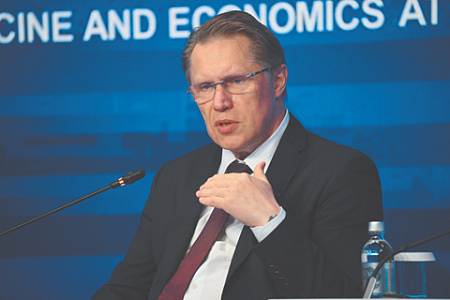
In Russia, according to Rosstat, almost 720,000 people were diagnosed with a malignant tumour for the first time last year. That is 1.5 times more than in 2005. Health Minister Mikhail Murashko said the prevalence of cancer in Russia could increase by another 1.5 times over the next 20–30 years.
The main problem in cancer diagnosis and treatment is insufficient funding in poor countries or countries where local authorities seek to restrict funding for national healthcare. According to the WHO, basic cancer diagnosis and treatment services are covered by universal compulsory health insurance systems and included in the basic package of medical services for all citizens in only 39% of countries worldwide. In just 28% of countries, the basic healthcare package also includes palliative care, including pain management.
The cost of cancer treatment and prevention in Russia is several times lower than in Western countries, according to the Russian Health Ministry.
‘The difference in the cost of diagnosing and treating cancer can reach fivefold or more when treatment is provided at a high-tech level, which in many respects is incomparable with the capabilities even of many European countries,’ Murashko told foreign diplomats. He added that surgery for breast, lung and abdominal cancers is five to seven times cheaper in Russia than in Germany and two to three times cheaper than in South Korea.
According to the Health Ministry, the detection rate for cancer at an early stage is increasing in Russia. Five-year survival among cancer patients has risen by almost 10% in Russia, Murashko said. Funding for cancer treatment increased to RUB 390 bln in 2025, almost 15% more than in previous years.
For comparison, the economic damage caused by the spread of lung cancer in Russia could exceed RUB 2 tn by 2030. These figures come from experts at the Higher School of Economics (HSE), who worked with support from pharmaceutical company Roche. According to HSE researchers, Russia faces a ‘critical need to revise the state strategy for combating the disease’. Spending on cancer care should no longer be treated as an ‘expense item’ but instead as long-term investment in preserving the country’s human capital
According to Murashko, improving access to different forms of treatment, including modern anti-cancer drug therapy, is an important but resource-intensive area
Lung cancer remains the most common form of cancer worldwide, accounting for 12.4% of all new cases, or 2.5 mln cases.
It is followed by female breast cancer, with 2.3 mln cases, (11.6%); colorectal cancer, with 1.9 mln cases (9.6%); prostate cancer, with 1.5 mln cases (7.3%); and stomach cancer, with 970,000 cases (4.9%).
Almost four in 10 cancer cases worldwide are linked to preventable risk factors, primarily infections caused by human papillomavirus, hepatitis B and C viruses, and the bacterium Helicobacter pylori, according to a WHO report. Preventable risk factors also include tobacco and alcohol use, a high body mass index and insufficient physical activity.
WHO experts directly link major differences in cancer detection and patient survival to the Human Development Index (HDI). The United Nations calculates the index by assessing living standards, literacy, education and longevity in different countries. Russia ranks 50th among 159 countries by HDI. Countries are classified according to their HDI into four development groups: very high, comprising 42 countries; high, 43 countries; medium, 42 countries; and low, 42 countries. In different years, Russia has been classified as a country with a high or even very high level of development.
The WHO speaks of ‘enormous inequality’ between populations in different countries in access to cancer diagnosis and treatment. In countries with a very high HDI, breast cancer is diagnosed during a woman’s lifetime in one in 12 women, and only one in 71 women dies from the disease. By contrast, in countries with a low HDI, breast cancer is diagnosed during a woman’s lifetime in only one in 27 women, while one in 48 women dies from it.
Most people will encounter a cancer diagnosis at some point in their lives, either themselves or through a close relative. Beyond the medical consequences, cancer remains one of the most difficult events for families from a financial and social perspective. According to a survey of cancer patients and their relatives, financial difficulties affect at least 45% of respondents, the WHO reports. More than half of cancer patients and their relatives report mental health problems. Almost all people caring for cancer patients experience excessive strain, including because they have to perform unpaid work while their social circles become smaller.
ORIGINAL: NG/Cancer Is Spreading Rapidly Worldwide, Including in Russia