The number of single-person households in Russia is rising rapidly. On the one hand, this reflects a growing share of people who have never married. On the other, it is driven by an increasing number of widowed Russians, according to sociologists at the Institute of Sociology of the Russian Academy of Sciences. Single Russians under the age of 55 generally enjoy relatively high living standards because they have no dependants. After the age of 55, however, the situation changes dramatically: older people living alone become significantly more dependent on financial support from their adult children.
A decline in marriage rates among the working-age population contributes to lower birth rates and, in the longer term, to a higher old-age dependency ratio. It also increases the state’s social obligations to provide assistance and services to people living alone.
The researchers analysed data from Russia’s national censuses covering almost two decades and found that the share of people living alone has continued to increase. The proportion of people over the age of 40 who have never married has risen steadily, particularly among men. In 2002, there were 61 never-married people aged 40–44 per 1,000 population. By 2020, that figure had increased to 92. Among men, the number rose from 70 per 1,000 in 2002 to 104 in 2020.
Modern Russia has also seen an increase in widowhood among people over the age of 70, especially women. In 2002, 658 out of every 1,000 women aged over 70 were widows. By 2020, there were 427 widows per 1,000 women aged 70–74 and more than 620 per 1,000 among women aged 75 and over
Overall, single-person households now account for more than one-third of all households in Russia, according to the study’s authors, Oksana Kuchmayeva, Yekaterina Vasilyeva and Yekaterina Knyazkova. Earlier estimates put the figure at around 40%, or 27.6 mln households (see Nezavisimaya Gazeta, October 30, 2025). Over the past decade, the number of such households has increased 2.4-fold, with the largest share made up of working-age adults (see Nezavisimaya Gazeta, December 10, 2025).
The demographic profile differs sharply by gender. Among men, single-person households are predominantly made up of people under the age of 45. Among women, they are mainly widows aged over 60. More than 72% of men living alone are of working age, while 53% of women living alone are above working age.
‘Among men, the largest category of single-person households consists of those who have never married, accounting for 46.2%, which points to the growing prevalence of the bachelor lifestyle. Divorced men also make up a significant share, at 29.6%,’ the Institute of Sociology said.
Russian women living alone have another distinguishing feature: one in five has never married.
Single men also report higher incomes than single women. Average monthly household income for men living alone exceeds RUB 62,000, compared with RUB 48,700 for women
Average per capita income in one-person households exceeds RUB 40,200 a month. As household size increases, that figure steadily declines, falling to RUB 17,600 per person in households of five or more.
A high proportion of single-person households occupy separate homes. More than 70% of people living alone have their own apartment. By comparison, only around two-thirds of two- and three-person households live in separate accommodation. Among households with four or more members, the figure falls to 55%. ‘This is because fewer people living alone reside in detached houses, at 24.6%, compared with larger households, particularly those with four or more members, where the figure reaches 41.5%,’ the researchers explain.
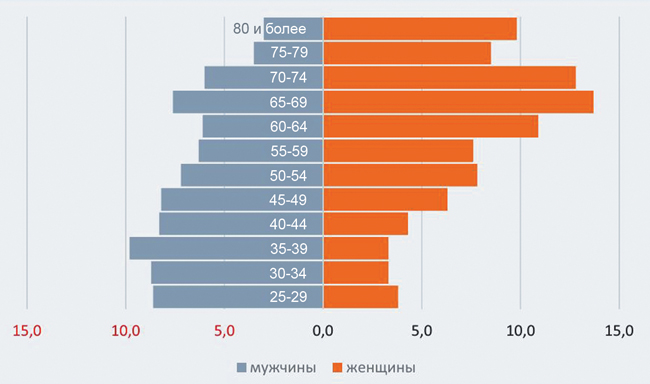
Age and gender pyramid of Russians living alone, 2024
Source: Institute of Sociology, Russian Academy of Sciences
The average living space occupied by a single person in Russia is 50.42 square metres. As a result, people living alone tend to be more satisfied with their housing conditions, with only 12.8% saying they need better accommodation. By comparison, one in three households with four or more members report needing larger housing
People living alone also have higher financial expectations. According to the researchers, their estimate of the minimum monthly income required to ‘make ends meet’ exceeds their average per capita income by around one-quarter. Among members of two- and three-person households, the perceived minimum exceeds actual income by only 11.5%.
The picture changes with age. Older people living alone depend much more heavily on financial support from their children. Overall, 22% of single parents receive monetary assistance from their children. ‘Among single people with adult children, 22.4% have incomes above RUB 60,000 a month, compared with 16.6% among those without children. At the same time, people without children are more heavily concentrated in the lowest income bracket, below RUB 14,000 a month: 5.8%, compared with 3% among those with children,’ the study found.
In other words, while having dependants tends to reduce living standards before the age of 55, after that age having children is associated with higher incomes among people living alone
The researchers conclude that changes in the composition of Russian households will increase the old-age dependency ratio and lead to growing government spending on social support and services for people living alone.
Experts cite several reasons for the rise in the number of people living alone. ‘The first is demographic. The gap in life expectancy between men and women translates into widowhood. According to the 2020 census, there were 627 widows per 1,000 women aged 75 and over, compared with 291 widowers per 1,000 men of the same age,’ said Vadim Kovrigin, Associate Professor at the Plekhanov Russian University of Economics.
Another factor is delayed marriage, which increasingly becomes permanent non-marriage. According to Kovrigin, people are postponing marriage for a variety of reasons, including higher living standards, reluctance to take on family responsibilities and the ‘illusion of choice’ created by dating apps, which makes relationships more likely to end before marriage.
‘Among single men, 46.4% have never married. This is no longer a temporary delay but an established way of life,’ he said.
Given that per capita incomes are higher in one-person households, and that most single Russians live in separate apartments compared with only 55.2% of households with four or more members, ‘living alone’ currently means ‘living more comfortably and more prosperously’. Under such circumstances, appeals to traditional family values are unlikely to outweigh these economic realities
The growing number of people living alone is the result of broader structural trends and reflects a pattern seen around the world for decades, said Igor Golubchenko, Associate Professor at the Presidential Academy.
‘Opportunities for independent living outside the family continue to expand. Material prosperity has increased, communications technologies such as mobile phones and the internet have developed, and transport, both public and private, has improved. Society now offers many more opportunities for a comfortable life as a single person,’ he said.
‘A universal pattern can be observed: where incomes rise, societies become more urbanised and new forms of communication spread, the share of people living alone also increases. Today many people deliberately postpone marriage and parenthood while focusing on careers, education and personal development,’ said Vasily Kutyin, Head of Analytics at Ingo Bank.