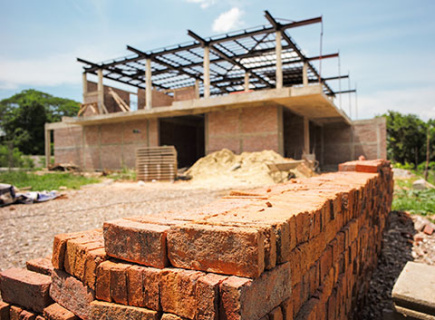
Individual housing construction (IHC) in Russia is experiencing a sharper downturn than the housing sector as a whole. Over the first four months of the year, private home construction fell by more than a third. Experts attribute the slowdown to prohibitively expensive borrowing and tighter regulations affecting small contractors. The IHC segment is proving far more sensitive to borrowing costs and household incomes than other parts of the market. The authorities hope to halt the decline through new support measures.
Government support for the sector remains in place. One example is Rosreestr’s ‘Land for Construction’ project, which aims to bring unused land plots into productive use.
‘Since the project was launched, more than 203,000 plots and territories with a total area of approximately 231,200 hectares have been identified as suitable for residential development,’ Deputy Prime Minister Marat Khusnullin said.
According to him, of the land identified, 12,900 plots covering 63,300 hectares can be used for apartment development, while 190,100 plots covering 167,800 hectares are suitable for individual housing construction.
‘The main task of Rosreestr and the regions within the Land for Construction project is to identify promising sites and accelerate their development. The agency has ambitious targets: by 2030, more than 500,000 hectares of land should be identified for housing construction,’ added Rosreestr head Oleg Skufinsky.
Earlier, the Ministry of Construction announced additional support measures for the IHC sector. Since late April, lending to IHC contractors has been launched using Dom.RF‘s umbrella guarantee mechanism. If a contractor defaults on a loan, the state corporation will compensate half of the amount issued, up to a maximum of RUB 20 mln. The measure is expected to enable an additional 500–700 contractors to work with escrow accounts.
Despite these efforts, however, the volume of newly commissioned private housing continues to decline. As of May 1, 2026, total housing completions in Russia amounted to 29.43 mln square metres, 24% below the level recorded during the same period of 2025. Of this total, 10.57 mln square metres consisted of apartment buildings, up 9.6% year-on-year. Construction of private homes, meanwhile, collapsed by 35% to 18.86 mln square metres, according to the Ministry of Construction. Individual housing still accounted for more than 64% of all housing completions during the first four months of the year, according to Rosstat data.
Russian officials have partly blamed the decline in private housing completions on an unusually cold winter.
‘There is a downturn in individual housing construction. We are analysing the situation in detail. I recently held a meeting with the regions and asked them about the reasons. One explanation was rather unusual: a cold and snowy winter. Many regions report that individual housing construction and completions slowed precisely because of the cold and snowy weather,’ Khusnullin said in May.
Seasonal factors, however, are not considered the primary cause.
‘The key factor is still the high interest rate and the low volume of mortgage lending for individual housing construction. In previous years, mortgage volumes in the sector were much higher. During the cooling-off period for subsidised mortgages, in 2024–2025, lending for individual housing construction fell by 70–80%,’ the deputy prime minister explained.
During the first quarter of 2026, 22,500 new loans were issued in Russia for individual housing construction and completed homes, 2.2 times more than a year earlier, according to Dom.RF. The total value of these loans reached RUB 125 bln. However, only 7,200 loans worth RUB 50.7 bln were issued specifically for the construction of private homes. As a result, mortgages for individual housing construction account for only around 3% of all mortgage issuance. Moreover, Dom.RF reported that almost all such loans were issued under subsidised programmes, representing 98% of total lending.
The IHC segment also has a significantly higher share of overdue loans. According to the Central Bank, as of April 1 the proportion of loans overdue by more than 90 days was five times higher than in the apartment housing segment, at 4.6% compared with 0.9%. The regulator attributes this primarily to frequent contractor failures to fulfil their obligations. Rising arrears are concentrated mainly among loans issued in 2023–2024 under mass subsidised mortgage programmes.
To protect consumers in the IHC market, mandatory escrow accounts were introduced on March 1, 2025, for most state-backed mortgage programmes, the Central Bank notes. From October 1, 2025, the regulator also imposed limits on mortgage lending for private home construction to borrowers with high debt burdens and plans to incorporate the elevated risks of IHC projects without escrow accounts into reserve requirements.
According to the Central Bank, around 6,000 mortgage loans for contractor-built private homes are at risk of unfinished construction due to contractor misconduct and subsequent repayment problems. Many of these loans were issued under subsidised programmes. At the end of the first quarter of 2026, the mortgage portfolio for individual housing construction contained almost 280,000 contracts. Of these, 17,400 were experiencing construction delays, while around 6,000 involved contractor services.
‘These 6,000 loans represent the main risk of construction projects being left unfinished because of unscrupulous contractors, which in turn creates difficulties with loan repayment,’ the regulator said.
In the State Duma, the number of victims of failed IHC projects is estimated at around 20,000 people.
‘At present it is more accurate to speak about the scale of the problem rather than an exact figure. There is still no unified federal register of affected citizens in the individual housing sector, so official statistics remain incomplete. By my estimates, more than 20,000 people may have been affected. However, the true scale will only become clear after systematic work in the regions,’ State Duma Construction and Housing Committee member Alexander Yakubovsky told the media.
The extension of escrow accounts to the individual housing market has made it more difficult for small contractors to obtain project financing. According to Dom.RF, despite a large volume of approved mortgage applications for private home construction, around 30% were ultimately not issued because contractors failed to secure project financing due to the absence of a credit history or sufficient collateral. The organisation noted that fewer than 10 banks currently provide loans for private home construction, including projects using escrow accounts. Dom.RF estimates that project financing currently covers only 1–2% of the IHC market.
Experts and market participants believe the sector is now undergoing a cooling-off period. According to Cian, transactions involving houses have fallen by 33% year-on-year, while demand for land plots has declined by 26%.
‘The drop in private housing completions is the result of falling demand for construction loans. The market contracted primarily because mortgage lending for individual housing construction became dramatically more expensive and less accessible in 2024–2025. During that period, mortgage issuance fell by 70–80%, while market rates exceeded 20–21% by the end of 2025. Following several rounds of Central Bank rate cuts, lending rates for private home construction, whether self-built or contractor-built, declined to around 18–19.5% in May 2026,’ said Dmitry Proskurin, Commercial Director of Metrium.
ORIGINAL: NG/Individual Homebuilding No Longer Affordable for Russians