A second financial system is taking shape in Russia under Central Bank oversight, the crypto sector. The Ministry of Finance, the Central Bank, lawmakers and businesses are setting its rules through a draft law ‘On Digital Currency and Digital Rights’, which has already passed its first reading in the State Duma at speed. The pace of the initial review, combined with ongoing industry debate, suggests the draft law could be substantially revised before its second reading. Even so, the Central Bank has issued a clear warning: regulation will not eliminate the inherent risks of cryptoassets. In other words, citizens should harbour no illusions.
The draft law ‘On Digital Currency and Digital Rights’, passed at first reading by the State Duma on April 21, is largely a framework document.
Prepared by the Finance Ministry in cooperation with the Central Bank, it is intended to bring parts of the crypto economy out of the shadows. The draft law sets out rules for the circulation of digital currencies, or more precisely cryptocurrencies, in Russia. Even its title raises the underlying terminological ambiguity
The document refers to cryptocurrencies, such as bitcoin. This should not be confused with the digital rouble, which is a fundamentally different concept: a third form of money alongside cash, banknotes and coins, and non-cash funds held in bank accounts.
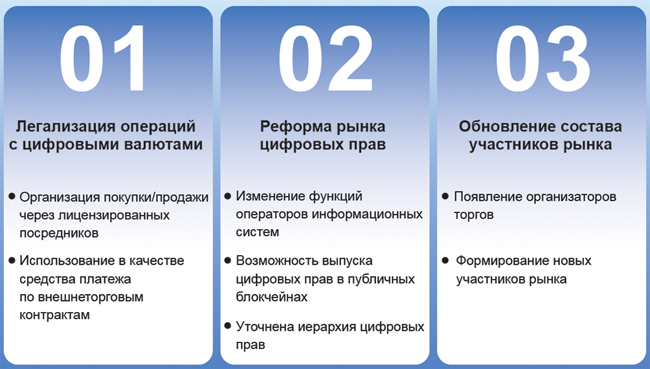
The draft law sets out rules governing access to cryptocurrency transactions for a broad range of investors, including non-qualified investors.
‘Qualified investors will face no limits on investment volumes, while non-qualified investors who pass the required testing will be able to purchase digital currencies within a cap set by the Bank of Russia of no more than RUB 300,000 a year through a single intermediary,’ the Ministry of Finance said.
‘Cryptocurrency transactions will be permitted only through licensed intermediaries. The infrastructure for digital asset circulation will include a range of professional participants, such as exchanges, brokers, asset managers, digital depositories and exchange operators,’ Deputy Finance Minister Ivan Chebeskov said.
In effect, this will pave the way for legal crypto exchanges in Russia.
Vladimir Chistyukhin, First Deputy Chairman of Central Bank, said Russian citizens will be able to use cryptocurrencies in transactions within the country, but not as a means of payment, as only the rouble can serve that function.
‘Cryptocurrencies can be purchased, used in lending transactions or provided under repo arrangements, in other words, they can be used across a wide range of investment activities,’ Chistyukhin said.
He added that clear legal rules would allow businesses to use cryptocurrencies more flexibly in foreign trade settlements, ‘expanding economic cooperation and minimising sanctions risks,’ said Anatoly Aksakov, Head of the State Duma’s Committee on Financial Markets.
‘In foreign trade and broader international economic activity, cryptocurrencies may also be used as a means of settlement,’ Chistyukhin confirmed.
If adopted, the main provisions would come into force on July 1, 2026. For now, however, the draft law continues to raise numerous questions and fuel debate, much of it highly technical and opaque to those outside the industry.
‘Given how easily it passed first reading, I suspect we will barely recognise it by the second,’ said Maria Bolobonova, a member of the State Duma’s Expert Council on Cryptocurrency Regulation, speaking at a specialised conference in Moscow on April 22.
Many specific issues will be left to subordinate legislation, with a raft of by-laws expected to follow once the framework draft law is adopted.
‘The task is extraordinarily complex. We are not just aligning two sectors, the crypto sector and the traditional financial system. In effect, a second financial system is taking shape in parallel under the supervision of the Bank of Russia,’ Bolobonova said. ‘We are not simply integrating digital currency into the financial sector; we are developing an entirely new regulatory framework for this asset.’
Yekaterina Lozgacheva, Director of Financial Market Strategy Department at the Central Bank, addressed the conference the draft law appears ‘fairly balanced’, taking into account both international best practice and Russia’s specific conditions.
At the same time, the authorities are seeking feedback from market participants. Such input will be considered, at least where it does not fundamentally alter the framework set out in the draft law, according to the Central Bank’s report.
As the Ministry of Finance said on its website, ‘regulation will ensure an adequate level of transaction security, protect investors’ rights and bring crypto exchanges into the legal framework’
The Central Bank has since outlined in more detail which risks the legislation is expected to mitigate and which will persist even after it is adopted.
Lozgacheva said operating through regulated intermediaries would eliminate counterparty risks that are currently widespread. This includes ‘numerous cases where individuals, without intending to do so, become involved in illegal activity or end up on blacklists linked to criminal operations’.
At the same time, she warned that regulation should not create the illusion that cryptoassets are inherently safe. ‘Regulation sets the rules of the market, but it does not eliminate the risks inherent in the assets themselves,’ she said.
ORIGINAL: NG/Russians Urged to Steer Clear of Crypto Illusions